So what are some of the variants that Ehrman discussed in his book?
Will attempt to discuss some of them here with the following caveats:
(1) I'm not a textual critic scholar so I can only access their ideas to the extent that a lay person can do so.
(2) I'll be looking at the NIV Bible since that is probably the most commonly used English translation in churches here in the USA.
(3) I'll also be taking a look at the NET Bible which is a resource for the lay reader to have some access to textual critic scholar's notes on translations.
In chapter 5 of his book, Ehrman addressed three variants.
Mark 1:41
Filled with [compassion/anger], Jesus reached out his hand and touched the man. "I am willing," he said. "Be clean!"
Ehrman argued in favor of "anger" as the correct variant because it is more likely that subsequent scribes "softened" the story by swapping in compassion or deleting the word.
The NET text note for this verse also offered reasons why anger might be the original reading but also some ideas on how anger might have gotten swapped in for compassion. They acknowledge deciding between the two is difficult.
Jesus being angry here would probably bother people who have a view of Jesus as being a mild mannered milquetoast kind of nice guy. But those familiar with the Jesus of the Gospels know he can be a tough and challenging Jesus. Thus, in my mind, even if Ehrman is correct, I don't think it changes the picture of Jesus.
Luke 22:43-44
An angel from heaven appeared to him and strengthened him. And being in anguish, he prayed more earnestly, and his sweat was like drops of blood falling to the ground.
Ehrman argues that this passages is an addition to Luke because it isn't found in some of the older manuscripts and in Luke, Jesus is always calm, and this doesn't fit in. In chapter 6, he argued further that it was an addition to bolster the "humanity of Christ" in theological debates.
The NIV includes the verses but in the text note says, "Some early manuscripts do not have verses 43 and 44."
The NET text notes discuss that possibility that there would be theological impulses to add as well as delete these verses. Additionally, it poses the possibility that these verses were literarily inauthentic but historically authentic and even cites one of Ehrman's scholar paper on the issue. They do go further than the NIV by putting these two verses in brackets.
On this variant, scholars are largely in agreement with Ehrman's view. But once again, does removing these verses change what Jesus did on the Cross? Does it change our view of Jesus? I think not.
Hebrews 2:9
But we see Jesus, who was made a little lower than the angels, now crowned with glory and honor because he suffered death, so that [by the grace of God/apart from God] he might taste death for everyone.
Ehrman cited that the "apart from God" phrasing is found only in a couple of late manuscripts but was mentioned in the writings of some early church fathers which suggested an older pedigree.
The NET Bible includes no text notes discussing Ehrman's reading of this variant suggesting Ehrman's view on it might not be one that has gained much traction in the textual scholarly community.
Daniel Williams has an extensive discussion of this variant in his response to Ehrman. Much like Mark 1:41, there are some ideas on how the unusual reading might have arisen by accident.
Whether Ehrman's reading of the variant is correct, I don't know. But even if he is right on this one as well, what does it tell us?
When we say, Jesus died for our sins, what does this really mean to Jesus?
... by the grace of God he might taste death for everyone ...
... apart from God he might taste death for everyone ...
Perhaps the theological subtly escapes me but these two seem compatible with the Christian vision of the significance of Jesus death on the Cross.
Overall, in chapter five, I get the impression that Ehrman thinks the different portraits of Jesus in the various writings of the NT indicated the early believers were confused about who Jesus was.
I'm not sure that really washes. If one wrote a gospel with emphasis on Jesus as a great teacher, another one on the miracle working Jesus, a third booklet on Jesus' debates with the religious leaders of the day and a yet another collecting Jesus' one-on-one conversations, would you conclude that there were FOUR different Jesus?
In terms of the big theological picture of Jesus death on the cross and resurrection from the dead, the NT writings were pretty consistent.
Undoubtedly, variants did creep into manuscripts to "fix" things but text scholars like Ehrman can spot them and "clean" up the text to recover the most likely original reading. Ehrman stresses the number of the variants without equally stressing that most of them have been spotted and the original reading restored.
This does still leave a few handful of variants with some uncertainty which he discusses such as these three. The question then becomes what are the consequences of these options for the original reading.
As I see it, the variants Ehrman described can fall into three categories:
(1) Choosing one variant over another where Ehrman's choice maybe the better one.
Perhaps, Mark 1:41 falls into this category.
(2) Choosing one variant over another where Ehrman might be right or wrong.
Perhaps, Hebrews 2:9 is one of these.
(3) Choosing one variant over another where Ehrman and other scholars agree.
Luke 22:43-44 would be in this category.
Each has different implications for Ehrman's thesis of calling the NT into question. Variants in category #3 don't advance his thesis as these have been factored into the discussion already and are nothing new. Those in #2 may support his thesis but only if his view of the variant is actually correct. Situation #1 is where Ehrman might have traction which has to be evaluated on a case-by-case basis.
Thus far, even if one concedes his position on these three variants, I don't think it really changes anything.
In the next post, let's look at some of the variants he brings into the conversation in chapter 6 of his book.
Showing posts with label ehrman. Show all posts
Showing posts with label ehrman. Show all posts

Theology: The Challenge of Ehrman, part II
One has to give credit to Bart Ehrman for making the topic of New Testament textual criticism into a bestselling book. Of course, I suspect if he didn't have a talk shows garnering thesis (the NT is unreliable), the book probably wouldn't have sold quite so well.
The guild of New Testament textual scholars all acknowledge that Ehrman is a bright star in this field. Ehrman was a student of the late Bruce Metzger who is still regarded as one of the top scholars in the field.
Metzger was more confident in the reliability of the New Testament documents such that he wrote the text book, The Text of the New Testament: Its Transmission, Corruption and Restoration. The first three editions of the book he wrote on his own and he and Ehrman co-wrote the 4th edition.
One of the textual scholars I cite below remarked that the title of the book they co-wrote is: The Text of the New Testament: Its Transmission, Corruption and Restoration. These scholars who work in relative obscurity acknowledge there was textual corruptions of both accidental and intentional variety. The question for the scholars is whether the text could be restored by (1) identifying the corruptions, intentional or accidental, and (2) determining what the original (probably) said.
Thus, Ehrman's premise appears to be (1) the text can't really be restored as there are too many variants or (2) the text can be restored but that resultant text actually tells us nothing about who Jesus really was.
What is Ehrman's view?
Rhetorically, Ehrman made many statements (i.e. there are more variants in the text than there are words in the New Testament) that make him sound like he holds premise #1. However, the very process of textual criticism Ehrman employed means that he probably holds premise #2. If he indeed held premise #1 then the process of textual criticism would be a futile enterprise! In any case, either perspective calls into question the reliability of the NT documents.
As a lay person, as I see it, the number of variants (beyond the small boo-boos that are easily identified and corrected) that Ehrman discussed was actually pretty small. After all, I would figure that Ehrman has put into his book all of the variants he thinks would be detrimental to historic Christianity. In the first 4 chapters he introduced how textual criticism is done for the lay audience. In the next 3 chapters, he presented about 20 variants.
The variants fall roughly into these categories:
1) Choosing one variant over another variant where Ehrman might be right.
In these situations, Ehrman offers an explanation for why he thinks variant A is more likely the original text than variant B. In these cases he might be right as to the authentic variant but does it make as much a difference as he claims? Does it change anything about historic Christianity? In many cases, I think the answer is no. These changes may have been embellishments of what was already believed so there is an already established core belief.
2) Choosing one variant over another variant where Ehrman might be wrong.
In some other cases, his argument for why one variant is better than another is pretty complicated and scholars probably disagree on which is the more authentic variant.
3) Choosing one variant over another variant where Ehrman and others agree.
In still some other cases, the variant he described was clearly a minority variant and almost certainly inauthentic and acknowledged as spurious by most scholars. Ehrman uses this as evidence for his case, but in fairness to the New Testament, these variants would fall into the same category as obvious boo-boos that are easily accounted for.
In the final analysis, the NT document reliability cannot be impeached with a modest number of inconsistencies. To be successful in that charge, one needs to find substantial contradictions.
Does Ehrman's charges rise above modest inconsistencies into substantial contradictions?
That is for the reader to decide.
Unfortunately, Ehrman largely has the floor to himself. Thus, hearing only the prosecution's side of the story, the jury doesn't get to hear the defense.
One piece of the defense would be simply the survival of the Christian faith today holding beliefs that can be traced back 2000 years that is consistent with what the NT documents describe. This testifies to the reality that something pretty unusual happened as a result of the life, teaching, deeds, death and resurrection of Jesus.
At a more technical level, Christian scholars who are also in the Text Criticism scholarly guild have responded via the Web to Ehrman. Here are some I found worth checking out:
P.J. Williams
http://evangelicaltextualcriticism.blogspot.com/2005/12/review-of-bart-ehrman-misquoting-jesus_31.html
Daniel Wallace, short version
http://bible.org/article/review-bart-d-ehrman-imisquoting-jesus-story-behind-who-changed-bible-and-whyi-san-francisco
longer version
http://bible.org/article/gospel-according-bart
Mark D. Roberts
http://www.markdroberts.com/htmfiles/resources/biblequran.htm
Ben Witherington
http://benwitherington.blogspot.com/2006/03/misanalyzing-text-criticism-bart.html
Also, I came across an interesting project called the New English Translation (NET Bible http://net.bible.org/bible.php). Paper based Bibles have practical limitations on the amount of footnotes that could be included. This group of scholars decided to post their translation on the internet and include extensive footnotes often dwelling on the thinking behind how one variant is chosen over another variant. This is probably about the only practical way non-scholars can gain some perspective on the work of textual criticism scholars without actually becoming one.
The bottom line appears to be that the challenge lodged by Ehrman is familiar to the scholars in the field and they think that some of Ehrman's explanations for variants are plausible while others questionable but, in general, Ehrman has overstated the problem.
For Part III, I'll go through some of the variants he discussed in his book.
The guild of New Testament textual scholars all acknowledge that Ehrman is a bright star in this field. Ehrman was a student of the late Bruce Metzger who is still regarded as one of the top scholars in the field.
Metzger was more confident in the reliability of the New Testament documents such that he wrote the text book, The Text of the New Testament: Its Transmission, Corruption and Restoration. The first three editions of the book he wrote on his own and he and Ehrman co-wrote the 4th edition.
One of the textual scholars I cite below remarked that the title of the book they co-wrote is: The Text of the New Testament: Its Transmission, Corruption and Restoration. These scholars who work in relative obscurity acknowledge there was textual corruptions of both accidental and intentional variety. The question for the scholars is whether the text could be restored by (1) identifying the corruptions, intentional or accidental, and (2) determining what the original (probably) said.
Thus, Ehrman's premise appears to be (1) the text can't really be restored as there are too many variants or (2) the text can be restored but that resultant text actually tells us nothing about who Jesus really was.
What is Ehrman's view?
Rhetorically, Ehrman made many statements (i.e. there are more variants in the text than there are words in the New Testament) that make him sound like he holds premise #1. However, the very process of textual criticism Ehrman employed means that he probably holds premise #2. If he indeed held premise #1 then the process of textual criticism would be a futile enterprise! In any case, either perspective calls into question the reliability of the NT documents.
As a lay person, as I see it, the number of variants (beyond the small boo-boos that are easily identified and corrected) that Ehrman discussed was actually pretty small. After all, I would figure that Ehrman has put into his book all of the variants he thinks would be detrimental to historic Christianity. In the first 4 chapters he introduced how textual criticism is done for the lay audience. In the next 3 chapters, he presented about 20 variants.
The variants fall roughly into these categories:
1) Choosing one variant over another variant where Ehrman might be right.
In these situations, Ehrman offers an explanation for why he thinks variant A is more likely the original text than variant B. In these cases he might be right as to the authentic variant but does it make as much a difference as he claims? Does it change anything about historic Christianity? In many cases, I think the answer is no. These changes may have been embellishments of what was already believed so there is an already established core belief.
2) Choosing one variant over another variant where Ehrman might be wrong.
In some other cases, his argument for why one variant is better than another is pretty complicated and scholars probably disagree on which is the more authentic variant.
3) Choosing one variant over another variant where Ehrman and others agree.
In still some other cases, the variant he described was clearly a minority variant and almost certainly inauthentic and acknowledged as spurious by most scholars. Ehrman uses this as evidence for his case, but in fairness to the New Testament, these variants would fall into the same category as obvious boo-boos that are easily accounted for.
In the final analysis, the NT document reliability cannot be impeached with a modest number of inconsistencies. To be successful in that charge, one needs to find substantial contradictions.
Does Ehrman's charges rise above modest inconsistencies into substantial contradictions?
That is for the reader to decide.
Unfortunately, Ehrman largely has the floor to himself. Thus, hearing only the prosecution's side of the story, the jury doesn't get to hear the defense.
One piece of the defense would be simply the survival of the Christian faith today holding beliefs that can be traced back 2000 years that is consistent with what the NT documents describe. This testifies to the reality that something pretty unusual happened as a result of the life, teaching, deeds, death and resurrection of Jesus.
At a more technical level, Christian scholars who are also in the Text Criticism scholarly guild have responded via the Web to Ehrman. Here are some I found worth checking out:
P.J. Williams
http://evangelicaltextualcriticism.blogspot.com/2005/12/review-of-bart-ehrman-misquoting-jesus_31.html
Daniel Wallace, short version
http://bible.org/article/review-bart-d-ehrman-imisquoting-jesus-story-behind-who-changed-bible-and-whyi-san-francisco
longer version
http://bible.org/article/gospel-according-bart
Mark D. Roberts
http://www.markdroberts.com/htmfiles/resources/biblequran.htm
Ben Witherington
http://benwitherington.blogspot.com/2006/03/misanalyzing-text-criticism-bart.html
Also, I came across an interesting project called the New English Translation (NET Bible http://net.bible.org/bible.php). Paper based Bibles have practical limitations on the amount of footnotes that could be included. This group of scholars decided to post their translation on the internet and include extensive footnotes often dwelling on the thinking behind how one variant is chosen over another variant. This is probably about the only practical way non-scholars can gain some perspective on the work of textual criticism scholars without actually becoming one.
The bottom line appears to be that the challenge lodged by Ehrman is familiar to the scholars in the field and they think that some of Ehrman's explanations for variants are plausible while others questionable but, in general, Ehrman has overstated the problem.
For Part III, I'll go through some of the variants he discussed in his book.
Theology: The Challenge of Ehrman, part I
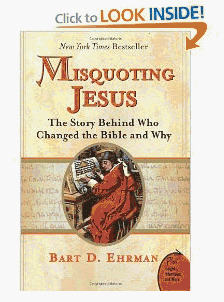
One has to give credit to Ehrman's skill as a writer. In his first 4 chapters, he made the art/science of textual criticism accessible to the lay reader by describing how accidental errors in text copying can occur and also how one might detect intentional changes to the text. In chapters 5-7, he described texts that he thinks were altered deliberately.
His chain of thought appears to be as follows:
(1) There are text variants in the NT manuscripts.
(2) Most people don't know there are variants.
(3) The variants are so numerous as to render the NT as worthless (or nearly so) as a source of knowledge about Jesus.
(4) If the general public knew about the variants, Christianity (as understood by most people) would collapse.
Claim one is beyond dispute. There are many thousands of ancient NT manuscripts (far more copies than any other ancient text) and within them are variants. The vast majority are little boo-boos as described by Ehrman in chapters 1-4 that are easily spotted and accounted for.
Claim two is true as the work of Biblical textual critics reside mostly in scholarly journals and not of interest or easily understood by the lay public. Ehrman has done a remarkable job in explaining the process to a lay audience and citing examples where there is dispute. However, in fairness to Bible translators, they do footnote Bibles to indicate where there is some question about the rendering of the text. The NIV is probably the most popular English Bible translation among US Christians and I checked some of the texts he cited and indeed the footnotes highlight briefly some issues Ehrman raised. Thus, there isn't a "conspiracy" to hide these variants.
Claim three is where sincere people will disagree. Ehrman dedicated his book to his thesis advisor Bruce Metzger who was probably one of the most noted textual critic scholars in the world was also very aware of the variants yet retained his faith while Ehrman did not. In fact, Metzger wrote this academic book to walk highly motivated (I'm not that motivated and I don't read Greek!) readers through the variants. Ben Witherington was also a student of Metzger (though older than Ehrman so their paths didn't cross in graduate school) who writes books for both the academic and lay audience retained his faith in Jesus with the same awareness of textual variants as Ehrman and Metzger. He posted his analysis of Ehrman's book at his blog.
Claim four rests on where one stands on claim three.
I think an important question is what do we expect of the Biblical text we have today?
If we think of the text as written by the finger of God and handed to humanity in one piece then we would be sorely disappointed.
However, God appears to have choose a path that involves human beings (I acknowledge that is a statement of faith). Thus, the texts of the Bible were written by humans under the guidance of God (I acknowledge that is a statement of faith) and then preserved by communities of faith. The preservation was not perfect but with the art/science of textual criticism, most variants (accidental or intentional) can be identified; thus, the Bible remains a reliable witness. Additionally, one has to acknowledge that the very survival of these communities of faith holding certain key beliefs about Jesus testifies to the enduring power of that faith and of the text these communities cling to.
Hope to post more on the challenge of Ehrman because his books are influencing the culture and need responses of both an academic and lay nature.
Subscribe to:
Posts (Atom)