Some musicals become a part of the cultural landscape when we know the songs without having ever seen the movie.
Such a film is Fiddler on the Roof.
Finally saw it a couple weeks back through my Netflix subscription.
Here is a playlist of the well known musical numbers from the film.
Here are a couple of my favorites ...

Devotional Thoughts: For a little while
1 Peter 1:3-9 launches into a uplifting reflection of the end of our stories and how that helps us in the day-to-day.
Praise be to the God and Father of our Lord Jesus Christ! In his great mercy he has given us new birth into a living hope through the resurrection of Jesus Christ from the dead, and into an inheritance that can never perish, spoil or fade—kept in heaven for you, who through faith are shielded by God's power until the coming of the salvation that is ready to be revealed in the last time.

image source: http://www.callbox7.com/a-complete-guide-to-ambulance/
2000 years separate us in the USA from the recipients of this letter from St. Peter. In some ways, we are quite different from those people. I think that the shadow of death hung over them much more than it does today. In a time with no medicine or hospitals, death was probably something the average person saw quite often. A trauma on the city street with no ER to rush them too, an infection with no antibiotics and on goes the list of things that could strike someone down that today we could do something about was a potential death sentence for the hearers of St. Peter's letter.
And so the living hope of Jesus would be very powerful. The idea that something that would not perish, spoil or fade would be immensely re-assuring.
How about us today?
Though we have banished many causes of death with medicine and technology, our essential mortality remains.
And so suffering is still as real today as it was then ... maybe here in the USA we can push it from our minds a little more easily ... but it still lingers and haunts in moments ...
In this you greatly rejoice, though now for a little while you may have had to suffer grief in all kinds of trials.
... and so suffering remains a fact of life ... but rejoicing is possible ... how?
These have come so that your faith—of greater worth than gold, which perishes even though refined by fire—may be proved genuine and may result in praise, glory and honor when Jesus Christ is revealed.
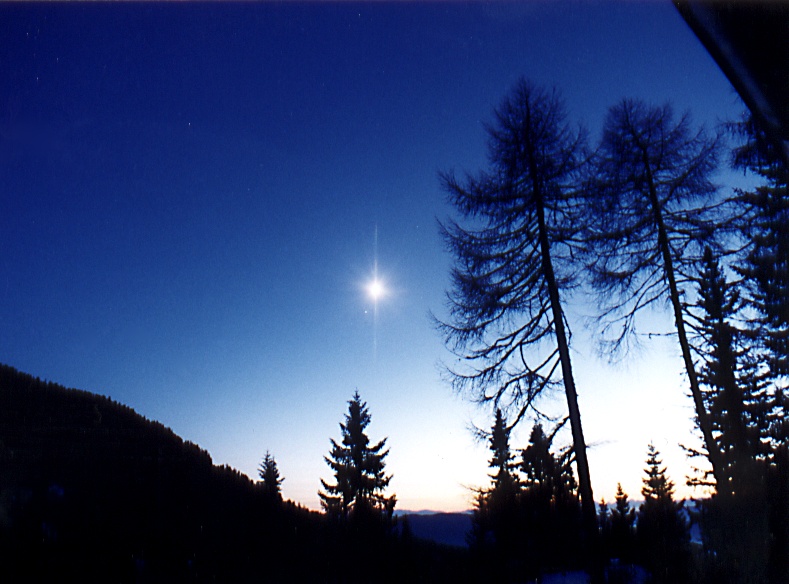
image source: http://www.eso.org/public/outreach/eduoff/vt-2004/Background/Infol2/EIS-D1.html
Pain, suffering, grief, death ... these remain constants in the human story. The slave in ancient Egypt worked to near death, the farmer in the early church seeing a loved one dying for reasons he does not know, John Donne wondering for whom the bells were tolling ...
And so we believe that this can be gone through and redeemed.
Humility, compassion, gratitude, trust ... these can come from suffering. These things, worth more than gold, could be won from the dark nights of despair.
Though you have not seen him, you love him; and even though you do not see him now, you believe in him and are filled with an inexpressible and glorious joy, for you are receiving the goal of your faith, the salvation of your souls.
Lord, through a glass darkly, I see. But I see. And I await the full dawning of the salvation you have begun. Help me to get a taste of the inexpressible and glorious joy. Amen.
Praise be to the God and Father of our Lord Jesus Christ! In his great mercy he has given us new birth into a living hope through the resurrection of Jesus Christ from the dead, and into an inheritance that can never perish, spoil or fade—kept in heaven for you, who through faith are shielded by God's power until the coming of the salvation that is ready to be revealed in the last time.
image source: http://www.callbox7.com/a-complete-guide-to-ambulance/
2000 years separate us in the USA from the recipients of this letter from St. Peter. In some ways, we are quite different from those people. I think that the shadow of death hung over them much more than it does today. In a time with no medicine or hospitals, death was probably something the average person saw quite often. A trauma on the city street with no ER to rush them too, an infection with no antibiotics and on goes the list of things that could strike someone down that today we could do something about was a potential death sentence for the hearers of St. Peter's letter.
And so the living hope of Jesus would be very powerful. The idea that something that would not perish, spoil or fade would be immensely re-assuring.
How about us today?
Though we have banished many causes of death with medicine and technology, our essential mortality remains.
And so suffering is still as real today as it was then ... maybe here in the USA we can push it from our minds a little more easily ... but it still lingers and haunts in moments ...
In this you greatly rejoice, though now for a little while you may have had to suffer grief in all kinds of trials.
... and so suffering remains a fact of life ... but rejoicing is possible ... how?
These have come so that your faith—of greater worth than gold, which perishes even though refined by fire—may be proved genuine and may result in praise, glory and honor when Jesus Christ is revealed.
image source: http://www.eso.org/public/outreach/eduoff/vt-2004/Background/Infol2/EIS-D1.html
Pain, suffering, grief, death ... these remain constants in the human story. The slave in ancient Egypt worked to near death, the farmer in the early church seeing a loved one dying for reasons he does not know, John Donne wondering for whom the bells were tolling ...
And so we believe that this can be gone through and redeemed.
Humility, compassion, gratitude, trust ... these can come from suffering. These things, worth more than gold, could be won from the dark nights of despair.
Though you have not seen him, you love him; and even though you do not see him now, you believe in him and are filled with an inexpressible and glorious joy, for you are receiving the goal of your faith, the salvation of your souls.
Lord, through a glass darkly, I see. But I see. And I await the full dawning of the salvation you have begun. Help me to get a taste of the inexpressible and glorious joy. Amen.
Politics: Ideas on health care in the USA
Wonder if any of the people on the Hill are reading these articles?
The Problem is Cost of Care by Michael Munger who is a professor of economics, and the chair of the political science department, at Duke University.
Excerpt:
The problem is that health care costs have increased at an annual rate double, or more than double, the rate of inflation for the last two decades. Right now, our attempts at reform are doomed by a law of accounting physics: Insurance can’t cost less than the health care it insures. That means that subsidizing insurance likely makes the problem worse.
Cato's What Is the Free-Market Approach to Health Care Reform? is another that goes beyond the usual mantras of "public option" and "mandated insurance."
Excerpt:
We also need to rethink medical licensing laws to encourage greater competition among providers. Nurse practitioners, physician assistants, midwives, and other non-physician practitioners should have far greater ability to treat patients. Doctors and other health professionals should be able to take their licenses from state to state. We should also be encouraging innovations in delivery such as medical clinics in retail outlets.
This sounds a bit like what I heard a couple of decades ago when I was an undergraduate at UCLA. For fun, I took a class in the School of Public Health about Health Care Systems. It was a survey of the different methods health care was delivered in the USA in the 1980s. It touched on how some other countries do it also and discussed some of the problems and challenges ahead.
One of the comments that stuck was when one of the profs remarked, we need more "Doc in the Box!"
The point was that a lot of what doctors deal with are pretty mundane.
So I suppose real reform will need for all interest groups to take a hit:
Patients - bearing a higher percentage of the cost of our own care.
Doctors - allowing non-MDs to carry more of the work load.
Insurance companies - tighter regulations on them regarding denial of coverage on pre-existing conditions.
Trial lawyers - tort reform to help reduce the cost of malpractice insurance and excessive defensive medicine.
Government bureaucrats - might they realize that the solution big government believers want is actually making the problem worse? The government already has a big hand in health insurance through the Medicare program and that program is going broke!
Devotional Thoughts: God's elect, strangers in the world
As far as I can tell, there is no other Bible book that deals with suffering as directly as Job. But I think 1 Peter and 2 Peter do touch on the subject a bit more than many other writings of Scripture. These two books discuss many other topics as well.
So let's take a look ...
Let's get to the introduction.
Peter, an apostle of Jesus Christ,

image source: http://saintpetersbasilica.org/Exterior/StPeterStatue/StPeter-Apos.jpg
I hope someday to visit St. Peter's Basilica in the Vatican.
I would venture to say that Peter was probably the most famous of the 12 disciples as he was the most outspoken of the bunch sometimes to his detriment!
It is generally believed by scholars that the Gospel of Mark was influenced strongly by Peter's preaching. The Book of Acts which chronicles the growth of the early church has much material about Peter (Chapters 1-12). The Book of Acts eventually followed the role of Paul in the advancement of the church (Chapters 13-28).
Some scholars question whether Peter could have written I and II Peter because he was a plain old fisherman from Galilee.
Though Peter would not have had the high level of education of a Jewish rabbi, being a good Jew, he would had a solid knowledge of the Hebrew Scriptures. He would also, of course, have had the benefit of sitting at the feet of Jesus!
It should be noted also that he give up the fisherman's life and would have spent much more time contemplating the teachings he heard from Jesus, re-examining the Hebrew Scriptures in that light, discussing with the other Apostles and the Holy Spirit was promised to the disciples to help them.
We can also speculate on the role Silas may have had in helping him craft this letter.
To God's elect, strangers in the world, scattered throughout Pontus, Galatia, Cappadocia, Asia and Bithynia,

image source: http://www.bible-history.com/maps/asia_minor.html
Today, Turkey is an almost exclusively Muslim country with a small number of Christians. But way back at the beginning of the church, Jesus followers could be found there, a small number also, in what was probably a society dominated by Greek and Roman polytheism.
who have been chosen
according to the foreknowledge of God the Father,
through the sanctifying work of the Spirit,
for obedience to Jesus Christ and sprinkling by his blood:
Grace and peace be yours in abundance.
Isn't this re-assuring?
These believers, whom Peter called strangers in the world, were chosen according to the foreknowledge of God!?
Won't delve into the philosophical implications of that here! 8-)
But it is re-assuring to know that God knew!
There is also the sanctifying work of the Spirit ... we are being made holy and pure.
This work was begun by the sprinkling of the blood of Jesus for the purpose of our being obedient to Jesus.
All three persons of the Trinity are involved in our lives!
And so abundant grace and peace can be available to us.
Thank you Lord that you were not content to see us lost in this world alienated from you and living in turmoil. Instead you sent Jesus. Instead you sent the Spirit. You have called us to something better... to yourself. Thanks be to God! Amen.
So let's take a look ...
Let's get to the introduction.
Peter, an apostle of Jesus Christ,
image source: http://saintpetersbasilica.org/Exterior/StPeterStatue/StPeter-Apos.jpg
I hope someday to visit St. Peter's Basilica in the Vatican.
I would venture to say that Peter was probably the most famous of the 12 disciples as he was the most outspoken of the bunch sometimes to his detriment!
It is generally believed by scholars that the Gospel of Mark was influenced strongly by Peter's preaching. The Book of Acts which chronicles the growth of the early church has much material about Peter (Chapters 1-12). The Book of Acts eventually followed the role of Paul in the advancement of the church (Chapters 13-28).
Some scholars question whether Peter could have written I and II Peter because he was a plain old fisherman from Galilee.
Though Peter would not have had the high level of education of a Jewish rabbi, being a good Jew, he would had a solid knowledge of the Hebrew Scriptures. He would also, of course, have had the benefit of sitting at the feet of Jesus!
It should be noted also that he give up the fisherman's life and would have spent much more time contemplating the teachings he heard from Jesus, re-examining the Hebrew Scriptures in that light, discussing with the other Apostles and the Holy Spirit was promised to the disciples to help them.
We can also speculate on the role Silas may have had in helping him craft this letter.
To God's elect, strangers in the world, scattered throughout Pontus, Galatia, Cappadocia, Asia and Bithynia,
image source: http://www.bible-history.com/maps/asia_minor.html
Today, Turkey is an almost exclusively Muslim country with a small number of Christians. But way back at the beginning of the church, Jesus followers could be found there, a small number also, in what was probably a society dominated by Greek and Roman polytheism.
who have been chosen
according to the foreknowledge of God the Father,
through the sanctifying work of the Spirit,
for obedience to Jesus Christ and sprinkling by his blood:
Grace and peace be yours in abundance.
Isn't this re-assuring?
These believers, whom Peter called strangers in the world, were chosen according to the foreknowledge of God!?
Won't delve into the philosophical implications of that here! 8-)
But it is re-assuring to know that God knew!
There is also the sanctifying work of the Spirit ... we are being made holy and pure.
This work was begun by the sprinkling of the blood of Jesus for the purpose of our being obedient to Jesus.
All three persons of the Trinity are involved in our lives!
And so abundant grace and peace can be available to us.
Thank you Lord that you were not content to see us lost in this world alienated from you and living in turmoil. Instead you sent Jesus. Instead you sent the Spirit. You have called us to something better... to yourself. Thanks be to God! Amen.
Science: Climategate and questions I would want to have answered
Yes, Drudge can add sensationalized headlines to items and highlight odd stories.
But most of the time, he just links to articles that he thinks are interesting.
And so he links to an item that says Al Gore was confused on the emails regarding the "Climategate" scandal.
From that item, there are links to various web pages that highlight why some people are skeptical of man-caused global warming.
The daisy-chain as Dennis Prager points out is as follows:
(1) human activity produces CO2
(2) there are temperature increases
(3) CO2 increases lead to temperature increases
(4) temperature increases will result in calamity.
This is what I would want to know:
Statement #1 is probably true. But in the history of the planet has there been times when CO2 were higher than the are today which would have occurred without human activity?
Is statement #2 actually true? Modern technology gives us good temperature data from many locations. But that is using current technology. How good is the data when you go back into history? How do you figure out the temperature when nobody was sitting around with thermometers to measure it?
Is statement #3 actually true? In science there is causation and correlation. Is CO2 the cause of temperature increases? Or are temperature increases the cause of CO2 increases? Or is there some other factor driving the temperature like solar activity?
Statement #4 would be true if we get many degrees of increase in temperature. In the past, there have been ice ages when temperatures dropped which would be bad too! And in the past, there have been much warmer temperatures. So the question is, how many degrees will the temperatures rise, if indeed they are rising? There is a huge difference between global warming of 1 degree C versus 6 degree C.
I'd also want to know why man-made global warming advocates dismiss skeptics by saying they make money from energy companies (I'm sure some do but probably don't) when it could be said that global warming researchers make money from grants studying global warming?
This last question is rhetorical but the previous ones are real questions I'd have about the science of climate change.
UPDATE: Prager rounds up latest problems with global warming in regards to Himalayan glaciers melting.
Life: Adrenaline junkies with invisible capes and angel wings
Be sure to check out this profile on the ER nurses of Cedars-Sinai Medical Center.
Excerpt:
ER nurses don’t give long-term care. They don’t get to know you, and they don’t even know what happens to you after you leave the ER. They are a platoon of adrenaline junkies with invisible capes and angel wings, there to take care of you at your worst moments. And it never ends. “Patients are like waves of ocean hitting the beach,” Shari says. “New ones just replace the old ones.”
As someone who has been on a gurney at the CSMC ER, I can only say, where do we find such people? Thank God for each one of them!
Non-profit of the month: November 2009 - For the Troops and Reagan Library
Went to the Ronald Reagan Library on Veteran's Day.
While there, there were some folks taking contributions to support For the Troops.
President Obama has asked the military and their families for more sacrifice with his plan to send 30,000 additional soldiers to Afghanistan. He and they need our support in for this difficult, dangerous and important mission.
Of course, many tens of thousands are already there and will have spent Thanksgiving and will spend Christmas away from home. Thus, I felt the desire to support For the Troops.
There are many other like-minded groups and I hope you will consider giving what you can.
I am also supporting the Ronald Reagan Foundation because I cast my first presidential vote for Reagan in 1984 and for many today what he did is ancient history.
2009 marked the 20th Anniversary of the Fall of the Berlin Wall.
None will ever forget that JFK stood there in solidarity with the people of Berlin.
RR stood there in solidarity with the people of Berlin too and saw that the wall was cracking and with his strong leadership in deeds and simple words helped push it down.
Thank you JFK and RR for leadership and THANK YOU to all the US armed forces who have fought for and defended freedom through the decades.
Subscribe to:
Posts (Atom)