There is a lot of talk about the "Emoluments Clause."
Here are a few items you could check out about this matter:
Here is an item from ConstitutionCenter.org giving the history of how the clause has been complied with over the years
WaPo legal opinion/analysis item from Volokh Conspiracy legal affairs blog
WaPo item from their news section giving a rundown of the lawsuit that has been filed
Am not a Constitutional scholar nor do I play one in the movies but my gut reaction is that the lawsuit will probably fail for the reasons mentioned in some of the above articles:
Standing issues - the plaintiff has to be harmed in some way to have standing for a lawsuit.
Non-applicability - routine business activity may not be covered under the clause.
Ultimately, the goal for Trump critics is to use the clause as a way to initiate impeachment and/or force a resignation. However, impeachment is not lightly undertaken. In the history of the US, only two Presidents (Andrew Johnson and Bill Clinton) were impeached by the House and both acquitted in subsequent Senate trial. Richard Nixon would have been impeached and convicted but he resigned.
Down the road, I suppose if it can be showed that foreign governments vastly overpay for the services of the Trump hotels, then the claim could be made that those overpayments constitute attempts to influence. At that point, it would be up to the House to decide if they view those attempts to influence to be so serious as to initiate impeachment proceedings. It would have to be shown that the financial benefits had the effect of causing treasonous activity by the President that is injurious to US national interests or were a form of bribery such that the giver receives benefit from the President.
Showing posts with label POTUS 2016. Show all posts
Showing posts with label POTUS 2016. Show all posts

Politics: Trump Inaugural Address
I heard the speech on radio so I can't comment on the "optics" of the speech.
In no particular order, these were my impressions I scribbled after the speech. I have expanded on the initial thoughts for this blog post.
1. Vintage Trump - for better and for worse. Sounded very much like his campaign sales pitch. Very direct prose with just a few moments of poetry. In the past, we have come to expect "poetry" from Presidents in big moments. Even Bush 43 who was not known as a great orator would rise to the occasion. Trump, in the speech, was very much "the guy at the bar telling it like it is." I understand he has to be true to his own style and that is proper. However, he is now president of the whole country and will need to adjust his speaking style in big moments to include some "poetry." In big moments, POTUS needs to evoke some sense of the historical context of the moment, extend olive branches to the people who didn't vote for you, and assure a watching world. On all three of these fronts, the speech was somewhat weak.
2. Instead, he largely played to his base of support with his populist and nationalist rhetoric. The 54% of the country that did not vote for him (including me) needed something from him and they got very little.
3. On the positive side, his direct prose and keeping it short was a welcome change to 8 years of President Obama speaking on and on and on ....... One should not under-estimate how much this stylistic aspect of the Trump persona contributed to his success. People are tired of politicians doing "politician-speak" and President Obama was one of its most polished practitioners.
4. However, there is plain-speaking and there is bleak-speaking. Yes, America has problems, however, excessively highlighting this was counter-productive. FDR took over during a depression and called forth "only thing we have to fear is fear itself." Instead, we got this from Trump:
But for too many of our citizens, a different reality exists: Mothers and children trapped in poverty in our inner cities; rusted-out factories scattered like tombstones across the landscape of our nation; an education system flush with cash, but which leaves our young and beautiful students deprived of knowledge; and the crime and gangs and drugs that have stolen too many lives and robbed our country of so much unrealized potential. This American carnage stops right here and stops right now.
5. Many Obama critics mocked his "messianic" statements like: "rise of the oceans began to slow and our planet began to heal," and "We are the ones we've been waiting for. We are the change that we seek." Trump's can-do optimism to "make America great again" has been a selling point. However, it runs the risk of Obama "messianic" over-promising over-stating what can actually be done. Nonetheless, it lays down a marker for accountability. How voters answer for themselves the question, "Do I think America is great again?" will affect their vote accordingly in the mid-terms in 2018 and in the Presidential race of 2020.
6. "America First" language. On one hand, there is a historical meaning of the phrase that calls back a pacifist and isolationist foreign policy mindset of the era after World War I and before World War II. That was my first reaction to hearing it. The notion of American total withdrawal from world affairs would be problematic. However, upon looking at the speech more closely, I don't think that is what Trump is thinking of when he uses the phrase. He used the phrase and then launched into a passage on economics:
We will bring back our jobs. We will bring back our borders. We will bring back our wealth. And we will bring back our dreams. We will build new roads, and highways, and bridges, and airports, and tunnels, and railways all across our wonderful nation. We will get our people off of welfare and back to work -- rebuilding our country with American hands and American labor. We will follow two simple rules: Buy American and hire American.
Of course, raising trade barriers and engaging in trade wars would be counter-productive foreign and economic policy. Whether that is what will happen remains to be seen. After this part, he gave a short statement of principles of his foreign policy:
We will seek friendship and goodwill with the nations of the world -- but we do so with the understanding that it is the right of all nations to put their own interests first. We do not seek to impose our way of life on anyone, but rather to let it shine as an example for everyone to follow. We will reinforce old alliances and form new ones -- and unite the civilized world against radical Islamic terrorism, which we will eradicate completely from the face of the Earth.
Thus, it would appear his "America First" meaning is not the historical pacifist and isolationist foreign policy of post-World War I. However, to what extent the Trump administration plans to pull back from world affairs is unclear.
7. The one section that rose to the occasion was his closing and was the heart of his campaign:
The time for empty talk is over. Now arrives the hour of action. Do not let anyone tell you it cannot be done. No challenge can match the heart and fight and spirit of America. We will not fail. Our country will thrive and prosper again. We stand at the birth of a new millennium, ready to unlock the mysteries of space, to free the Earth from the miseries of disease, and to harness the energies, industries and technologies of tomorrow. A new national pride will stir our souls, lift our sights, and heal our divisions. It is time to remember that old wisdom our soldiers will never forget: that whether we are black or brown or white, we all bleed the same red blood of patriots, we all enjoy the same glorious freedoms, and we all salute the same great American Flag. And whether a child is born in the urban sprawl of Detroit or the windswept plains of Nebraska, they look up at the same night sky, they fill their heart with the same dreams, and they are infused with the breath of life by the same almighty Creator. So to all Americans, in every city near and far, small and large, from mountain to mountain, and from ocean to ocean, hear these words: You will never be ignored again. Your voice, your hopes, and your dreams will define our American destiny. And your courage and goodness and love will forever guide us along the way. Together, We will make America strong again. We will make wealthy again. We will make America proud again. We will make America safe again. And yes, together, we will make America great again. Thank you. God bless you. And God bless America.
This passage standing alone by itself is inspirational and aspirational. However, it was all the other "stuff" around Trump during the wild and woolly campaign that has spurred visceral opposition to his candidacy and now his presidency. As is often the case, the strength of a leader that draws supporters is often the trait that repels others into opposition.
In no particular order, these were my impressions I scribbled after the speech. I have expanded on the initial thoughts for this blog post.
1. Vintage Trump - for better and for worse. Sounded very much like his campaign sales pitch. Very direct prose with just a few moments of poetry. In the past, we have come to expect "poetry" from Presidents in big moments. Even Bush 43 who was not known as a great orator would rise to the occasion. Trump, in the speech, was very much "the guy at the bar telling it like it is." I understand he has to be true to his own style and that is proper. However, he is now president of the whole country and will need to adjust his speaking style in big moments to include some "poetry." In big moments, POTUS needs to evoke some sense of the historical context of the moment, extend olive branches to the people who didn't vote for you, and assure a watching world. On all three of these fronts, the speech was somewhat weak.
2. Instead, he largely played to his base of support with his populist and nationalist rhetoric. The 54% of the country that did not vote for him (including me) needed something from him and they got very little.
3. On the positive side, his direct prose and keeping it short was a welcome change to 8 years of President Obama speaking on and on and on ....... One should not under-estimate how much this stylistic aspect of the Trump persona contributed to his success. People are tired of politicians doing "politician-speak" and President Obama was one of its most polished practitioners.
4. However, there is plain-speaking and there is bleak-speaking. Yes, America has problems, however, excessively highlighting this was counter-productive. FDR took over during a depression and called forth "only thing we have to fear is fear itself." Instead, we got this from Trump:
But for too many of our citizens, a different reality exists: Mothers and children trapped in poverty in our inner cities; rusted-out factories scattered like tombstones across the landscape of our nation; an education system flush with cash, but which leaves our young and beautiful students deprived of knowledge; and the crime and gangs and drugs that have stolen too many lives and robbed our country of so much unrealized potential. This American carnage stops right here and stops right now.
5. Many Obama critics mocked his "messianic" statements like: "rise of the oceans began to slow and our planet began to heal," and "We are the ones we've been waiting for. We are the change that we seek." Trump's can-do optimism to "make America great again" has been a selling point. However, it runs the risk of Obama "messianic" over-promising over-stating what can actually be done. Nonetheless, it lays down a marker for accountability. How voters answer for themselves the question, "Do I think America is great again?" will affect their vote accordingly in the mid-terms in 2018 and in the Presidential race of 2020.
6. "America First" language. On one hand, there is a historical meaning of the phrase that calls back a pacifist and isolationist foreign policy mindset of the era after World War I and before World War II. That was my first reaction to hearing it. The notion of American total withdrawal from world affairs would be problematic. However, upon looking at the speech more closely, I don't think that is what Trump is thinking of when he uses the phrase. He used the phrase and then launched into a passage on economics:
We will bring back our jobs. We will bring back our borders. We will bring back our wealth. And we will bring back our dreams. We will build new roads, and highways, and bridges, and airports, and tunnels, and railways all across our wonderful nation. We will get our people off of welfare and back to work -- rebuilding our country with American hands and American labor. We will follow two simple rules: Buy American and hire American.
Of course, raising trade barriers and engaging in trade wars would be counter-productive foreign and economic policy. Whether that is what will happen remains to be seen. After this part, he gave a short statement of principles of his foreign policy:
We will seek friendship and goodwill with the nations of the world -- but we do so with the understanding that it is the right of all nations to put their own interests first. We do not seek to impose our way of life on anyone, but rather to let it shine as an example for everyone to follow. We will reinforce old alliances and form new ones -- and unite the civilized world against radical Islamic terrorism, which we will eradicate completely from the face of the Earth.
Thus, it would appear his "America First" meaning is not the historical pacifist and isolationist foreign policy of post-World War I. However, to what extent the Trump administration plans to pull back from world affairs is unclear.
7. The one section that rose to the occasion was his closing and was the heart of his campaign:
The time for empty talk is over. Now arrives the hour of action. Do not let anyone tell you it cannot be done. No challenge can match the heart and fight and spirit of America. We will not fail. Our country will thrive and prosper again. We stand at the birth of a new millennium, ready to unlock the mysteries of space, to free the Earth from the miseries of disease, and to harness the energies, industries and technologies of tomorrow. A new national pride will stir our souls, lift our sights, and heal our divisions. It is time to remember that old wisdom our soldiers will never forget: that whether we are black or brown or white, we all bleed the same red blood of patriots, we all enjoy the same glorious freedoms, and we all salute the same great American Flag. And whether a child is born in the urban sprawl of Detroit or the windswept plains of Nebraska, they look up at the same night sky, they fill their heart with the same dreams, and they are infused with the breath of life by the same almighty Creator. So to all Americans, in every city near and far, small and large, from mountain to mountain, and from ocean to ocean, hear these words: You will never be ignored again. Your voice, your hopes, and your dreams will define our American destiny. And your courage and goodness and love will forever guide us along the way. Together, We will make America strong again. We will make wealthy again. We will make America proud again. We will make America safe again. And yes, together, we will make America great again. Thank you. God bless you. And God bless America.
This passage standing alone by itself is inspirational and aspirational. However, it was all the other "stuff" around Trump during the wild and woolly campaign that has spurred visceral opposition to his candidacy and now his presidency. As is often the case, the strength of a leader that draws supporters is often the trait that repels others into opposition.
Politics: Trying to Understand Trump
I've been trying to get my head around the Trump phenomena and I found listening to these two podcasts to be helpful.
Robert Costa (currently a reporter at the Washington Post) was one of the first reporters to start covering Trump and recognized he was a serious candidate during a little covered Trump visit to Iowa very early in the campaign process in 2013. In this interview, Costa shared many anecdotes that illustrates the traits of Trump that voters were drawn to. Costa has a plaque at his office that says, "Assume Nothing" that allowed him to observe and report on Trump without dismissing him like many other typical political reporters.
After seeing this episode, I looked for more episodes in the "Uncommon Knowledge" series and found this item about J.D. Vance and his memoir, "Hillbilly Elegy." Vance grew up in the "rustbelt" where some of the "rural white working class" live and that Trump often talked about and championed. I had heard Vance in a shorter interview on NPR in 2016 and he commented he understood Trump's appeal to "his people" but he himself was not a Trump supporter.
Robert Costa (currently a reporter at the Washington Post) was one of the first reporters to start covering Trump and recognized he was a serious candidate during a little covered Trump visit to Iowa very early in the campaign process in 2013. In this interview, Costa shared many anecdotes that illustrates the traits of Trump that voters were drawn to. Costa has a plaque at his office that says, "Assume Nothing" that allowed him to observe and report on Trump without dismissing him like many other typical political reporters.
After seeing this episode, I looked for more episodes in the "Uncommon Knowledge" series and found this item about J.D. Vance and his memoir, "Hillbilly Elegy." Vance grew up in the "rustbelt" where some of the "rural white working class" live and that Trump often talked about and championed. I had heard Vance in a shorter interview on NPR in 2016 and he commented he understood Trump's appeal to "his people" but he himself was not a Trump supporter.
Politics: By the numbers Presidential popular votes
The electoral college is the official Constitutional body that votes for the President of the United States.
The national popular vote tallies gives us a window into how divided the nation was around the time of the election. Suffice to say, in most elections, the national popular vote reveals division among the voters.
For what it is worth, by the numbers, the percent of voters who did NOT vote for the elected President since 1980.
49% voted for candidates other than Reagan in 1980
41% voted for candidates other than Reagan in 1984
47% voted for candidates other than Bush in 1988
57% voted for candidates other than Clinton in 1992
51% voted for candidates other than Clinton in 1996
52% voted for candidates other than Bush in 2000
49% voted for candidates other than Bush in 2004
47% voted for candidates other than Obama in 2008
49% voted for candidates other than Obama in 2012
54% voted for candidates other than Trump in 2016
The national popular vote tallies gives us a window into how divided the nation was around the time of the election. Suffice to say, in most elections, the national popular vote reveals division among the voters.
For what it is worth, by the numbers, the percent of voters who did NOT vote for the elected President since 1980.
49% voted for candidates other than Reagan in 1980
41% voted for candidates other than Reagan in 1984
47% voted for candidates other than Bush in 1988
57% voted for candidates other than Clinton in 1992
51% voted for candidates other than Clinton in 1996
52% voted for candidates other than Bush in 2000
49% voted for candidates other than Bush in 2004
47% voted for candidates other than Obama in 2008
49% voted for candidates other than Obama in 2012
54% voted for candidates other than Trump in 2016
Electoral College
Pretty much every four years essays are written for and against the electoral college. Go ahead and google and you'll get plenty of articles. This year (2016) and in 2000 when the electoral college result differed from the popular vote, the conversation is even more intense.
Whether the electoral college is "fair" or not depends on whether one accepts the premise of the system that the founders established.
My understanding is that the founders tried to balance population based representation and state based representation in our system of governance. Hence, the House is population based and the Senate is state based. Then the question became how to determine the Presidency? They opted to construct an electoral college that reflected both population and state based aspects by linking the number of electors to the number of House and Senate members per state. The net effect of this imperfect compromise is that the electoral college mostly mirrors the population but diminishes the impact of larger states and magnifies the impact of smaller states. Taking 2012 election data: California cast ~ 13 million votes while Wyoming cast ~ 250,000. Thus, from a population perspective California weighs 52 times more than Wyoming. But in the electoral college California gets 55 while Wyoming gets 3; thus, California's weight is 18 times larger. One can argue whether this is "fair" but that is the system we have and it was intended that way by the founders when, at that time, Virginia was the big state all the other states were worried would have too much influence. Additionally, should the electoral college fail to provide a winner, the Constitution calls for the decision to be made in the House which is the population based body yet the House members vote as states. Using the House to elect the president has very rarely happened (1800 and 1824) but the design again reflects an attempt to balance state and population based representation.
The Constitution did not set up a pure direct democracy for the national government but rather a representative democracy: as determined by population in the House, as determined by states in the Senate, as determined by a mixture of both in the electoral college mechanism for the Presidency.
Whether the electoral college is "fair" or not depends on whether one accepts the premise of the system that the founders established.
My understanding is that the founders tried to balance population based representation and state based representation in our system of governance. Hence, the House is population based and the Senate is state based. Then the question became how to determine the Presidency? They opted to construct an electoral college that reflected both population and state based aspects by linking the number of electors to the number of House and Senate members per state. The net effect of this imperfect compromise is that the electoral college mostly mirrors the population but diminishes the impact of larger states and magnifies the impact of smaller states. Taking 2012 election data: California cast ~ 13 million votes while Wyoming cast ~ 250,000. Thus, from a population perspective California weighs 52 times more than Wyoming. But in the electoral college California gets 55 while Wyoming gets 3; thus, California's weight is 18 times larger. One can argue whether this is "fair" but that is the system we have and it was intended that way by the founders when, at that time, Virginia was the big state all the other states were worried would have too much influence. Additionally, should the electoral college fail to provide a winner, the Constitution calls for the decision to be made in the House which is the population based body yet the House members vote as states. Using the House to elect the president has very rarely happened (1800 and 1824) but the design again reflects an attempt to balance state and population based representation.
The Constitution did not set up a pure direct democracy for the national government but rather a representative democracy: as determined by population in the House, as determined by states in the Senate, as determined by a mixture of both in the electoral college mechanism for the Presidency.
Mixed feelings post-election
Am still processing the elections and am slowly trying to put my finger on where I am at. In the past, in some cases I voted for a candidate that would go on to be elected (1984, 1988, 2000, 2004) and so there was satisfaction in the result. In others, I voted for a candidate who lost and so there was disappointment (1992, 1996, 2008, 2012) but satisfaction that the political process was working.
This year was unique in that I knew I would feel no satisfaction in either candidate's victory and I am concerned our political system is failing. Clinton supporters would have felt elation at the first woman president. Trump supporters would feel the voice of the forgotten working class was heard. Reluctant Clinton supporters who were #NeverTrump would feel relief that Trump lost. Reluctant Trump supporters who were #NeverClinton would feel relief that Clinton lost.
But #NeverTrump #NeverClinton voters would feel disappointment no matter who would win.
I believe that George Will is also #NeverTrump #NeverClinton. He put it this way in his column this morning:
At dawn Tuesday in West Quoddy Head, Maine, the easternmost point of the United States, it was certain that by midnight in Cape Wrangell, Alaska, the westernmost fringe, there would be a loser who deserved to lose and a winner who did not deserve to win. [......] The simultaneous sickness of both parties surely reveals a crisis of the U.S. regime. The GOP was easily captured, and then quickly normalized, by history’s most unpleasant and unprepared candidate, whose campaign was a Niagara of mendacities. And the world’s oldest party contrived to nominate someone who lost to him. To an electorate clamoring for disruptive change, Democrats offered a candidate as familiar as faded wallpaper. The party produced no plausible alternative to her joyless, stained embodiment of arrogant entitlement. And she promised to intensify the progressive mentality. [......] The moving finger writes, and having writ moves on, perhaps soon to inscribe this: In 2016, Republicans won a ruinous triumph that convinced them that they can forever prosper by capturing an ever-larger portion of an ever-smaller portion of the electorate. This kamikaze arithmetic of white nationalism should prompt the president-elect to test his followers’ devotion to him by asking their permission to see the national tapestry as it is and should be.
This year was unique in that I knew I would feel no satisfaction in either candidate's victory and I am concerned our political system is failing. Clinton supporters would have felt elation at the first woman president. Trump supporters would feel the voice of the forgotten working class was heard. Reluctant Clinton supporters who were #NeverTrump would feel relief that Trump lost. Reluctant Trump supporters who were #NeverClinton would feel relief that Clinton lost.
But #NeverTrump #NeverClinton voters would feel disappointment no matter who would win.
I believe that George Will is also #NeverTrump #NeverClinton. He put it this way in his column this morning:
At dawn Tuesday in West Quoddy Head, Maine, the easternmost point of the United States, it was certain that by midnight in Cape Wrangell, Alaska, the westernmost fringe, there would be a loser who deserved to lose and a winner who did not deserve to win. [......] The simultaneous sickness of both parties surely reveals a crisis of the U.S. regime. The GOP was easily captured, and then quickly normalized, by history’s most unpleasant and unprepared candidate, whose campaign was a Niagara of mendacities. And the world’s oldest party contrived to nominate someone who lost to him. To an electorate clamoring for disruptive change, Democrats offered a candidate as familiar as faded wallpaper. The party produced no plausible alternative to her joyless, stained embodiment of arrogant entitlement. And she promised to intensify the progressive mentality. [......] The moving finger writes, and having writ moves on, perhaps soon to inscribe this: In 2016, Republicans won a ruinous triumph that convinced them that they can forever prosper by capturing an ever-larger portion of an ever-smaller portion of the electorate. This kamikaze arithmetic of white nationalism should prompt the president-elect to test his followers’ devotion to him by asking their permission to see the national tapestry as it is and should be.
Political earthquake
Did not see that coming.
As a #NeverTrump #NeverClinton voter, when I left the ballot box Tuesday morning, I knew the next President of the United States would not be someone I voted for.
Nate Silver at 538 did hedge a bit on the morning of election day with his analysis piece. Excerpt:
First, Clinton’s overall lead over Trump — while her gains over the past day or two have helped — is still within the range where a fairly ordinary polling error could eliminate it.
Second, the number of undecided and third-party voters is much higher than in recent elections, which contributes to uncertainty.
Third, Clinton’s coalition — which relies increasingly on college-educated whites and Hispanics — is somewhat inefficiently configured for the Electoral College, because these voters are less likely to live in swing states. If the popular vote turns out to be a few percentage points closer than polls project it, Clinton will be an Electoral College underdog.
As the night wore on, it became apparent that it was a "perfect storm" that Nate Silver described.
First, Clinton underperformed in the Obama coalition demographics.
Second, Trump's "silent voters" turned out in much larger numbers.
Third, the electoral college map yielded what is looking to be a very close popular vote total in favor of Clinton but a small but solid electoral college win for Trump.
No matter who would win last night, the nation is divided. If Clinton had won, there would still be about half the voters who did not vote for her. Trump has won and there are half the voters who did not vote for him.
No matter who would have won last night that individual will have the challenge of finding it in themselves to have the big heartedness to reach out to those who opposed their candidacy, the open mindedness to bring into the executive branch appointees who can work with people, and the humility to seek the welfare of the whole nation and not just personal ambition.
As a #NeverTrump #NeverClinton voter, when I left the ballot box Tuesday morning, I knew the next President of the United States would not be someone I voted for.
Nate Silver at 538 did hedge a bit on the morning of election day with his analysis piece. Excerpt:
First, Clinton’s overall lead over Trump — while her gains over the past day or two have helped — is still within the range where a fairly ordinary polling error could eliminate it.
Second, the number of undecided and third-party voters is much higher than in recent elections, which contributes to uncertainty.
Third, Clinton’s coalition — which relies increasingly on college-educated whites and Hispanics — is somewhat inefficiently configured for the Electoral College, because these voters are less likely to live in swing states. If the popular vote turns out to be a few percentage points closer than polls project it, Clinton will be an Electoral College underdog.
As the night wore on, it became apparent that it was a "perfect storm" that Nate Silver described.
First, Clinton underperformed in the Obama coalition demographics.
Second, Trump's "silent voters" turned out in much larger numbers.
Third, the electoral college map yielded what is looking to be a very close popular vote total in favor of Clinton but a small but solid electoral college win for Trump.
No matter who would win last night, the nation is divided. If Clinton had won, there would still be about half the voters who did not vote for her. Trump has won and there are half the voters who did not vote for him.
No matter who would have won last night that individual will have the challenge of finding it in themselves to have the big heartedness to reach out to those who opposed their candidacy, the open mindedness to bring into the executive branch appointees who can work with people, and the humility to seek the welfare of the whole nation and not just personal ambition.
November 2016 Election Forecast
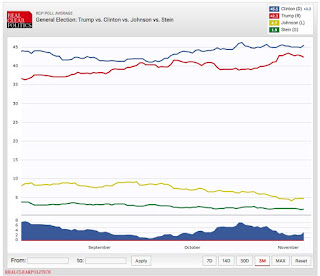
Why should all the pundits have a corner on the market on forecasts? This pajama wearing blogger can forecast too! Below are two graphs from Real Clear Politics.
Graph 1 is the 3 month data on Clinton Trump in a "two-way" race.

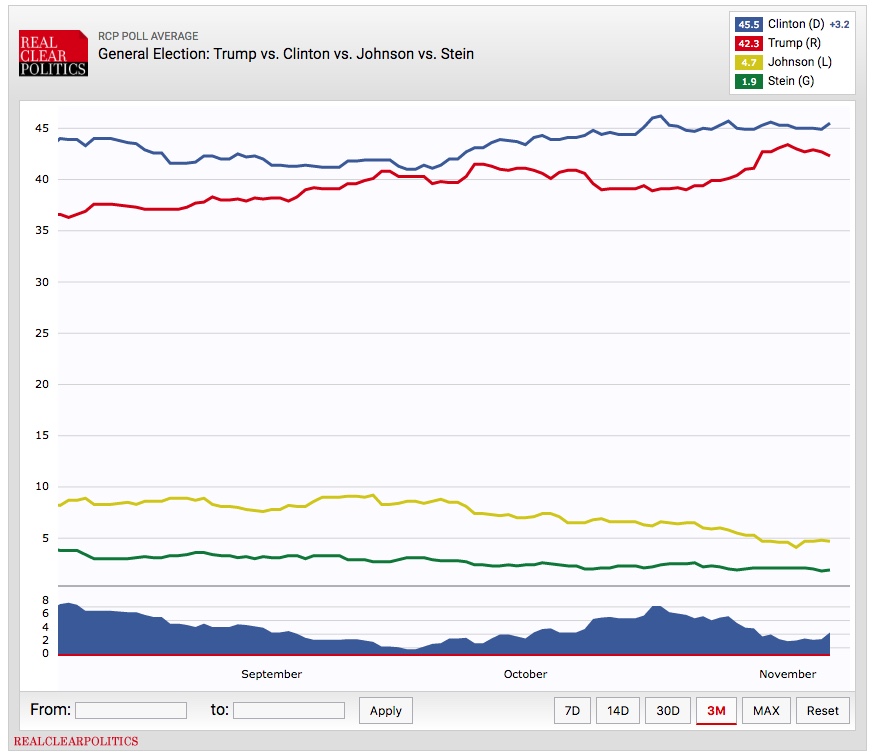
Graph 2 is the 3 month graph of the "four-way" race.

Map 2 is the my adjustments to the RCP map.

Graph 1 is the 3 month data on Clinton Trump in a "two-way" race.

Graph 2 is the 3 month graph of the "four-way" race.
There are two striking features from graph 1.
1. Clinton's numbers bounce between 45% and 49%. {hitting the mark with 47.6%}
2. Trump's number bounce between 40% and 45%. {stunning at 47.4%}
This would suggest Clinton has the advantage as the high end of Trump's numbers are at the low end of Clinton's numbers - the two lines never crossed. This scenario could happen resulting in a very long night. UPDATE: Nate Silver of 538 explains the probabilities due to the uncertainties in polling and the action of undecided voters. But nonetheless, the most likely outcome is that Clinton will edge out Trump by 2 to 3%.
There are two striking features from graph 2 regarding the two minor party candidates.
1. Johnson's numbers maxed out around 9% and have declined to 4% as election day approaches.
2. Stein's numbers peaked near 4% but is now closer to 2% as election day approaches.
This suggests that when Clinton had the larger lead, more voters entertained the idea of a minor party candidate. But as the race has tightened, probably about half of those voters have moved back to one or the other main party candidates or will cast no vote on POTUS.
Thus, what happens on November 8?
Green party candidate Nader got almost 3% in 2000 in what was known to be a close race. This indicates that Green voters are fiercely loyal. Thus, I suspect, the Stein supporters will stick with her and be joined by Sander supporters who refuse to support Clinton. My prediction Stein gets 1.7% of the vote.
As for the Johnson/Weld ticket, I think they continue to lose support. Their repeated "foot in mouth" episodes have alarmed the loosely adherent supporters. How does 3.6% sound? Because there are some states that are very strongly Clinton or Trump, the Libertarians may get some protest voters. However, the dream of a historic non-major party performance is gone with the overall tighter race between Clinton and Trump. Of course, it will still be historic for the Libertarian party in specific.
Thus, final figures:
48.6% Clinton {currently 47.6% likely to increase some due to California}
45.9% Trump {currently 47.4%}
3.6% Johnson {3.2%}
1.7% Stein {1.0%}
0.2% Others {0.5%}
But of course, it is the electoral college that actually determines the presidency.
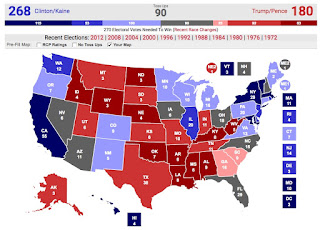
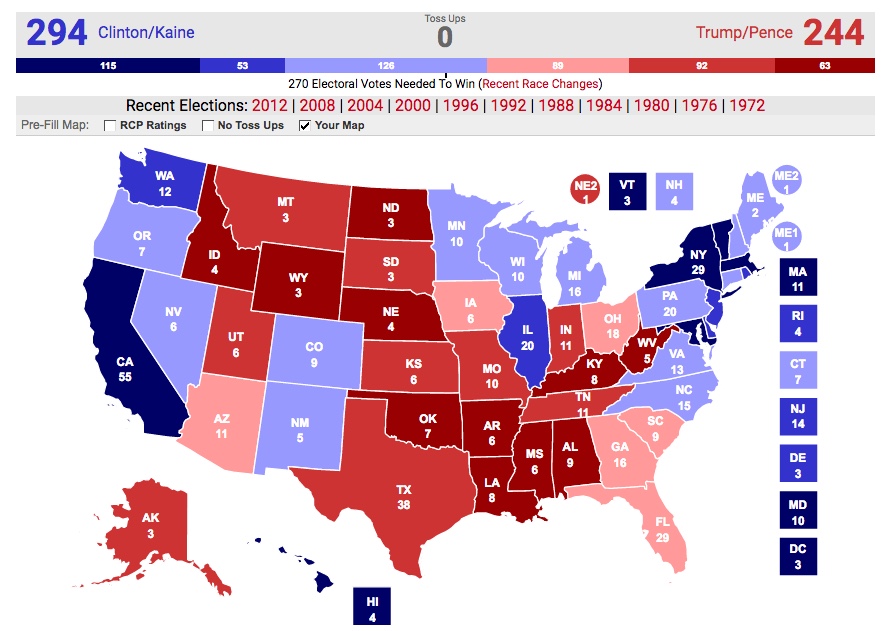
Map 1 is the Real Clear Politics map with the "toss-up" states in gray.

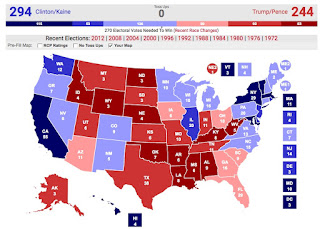
Map 2 is the my adjustments to the RCP map.

Some of the "toss-up" in map 1 are probably not that close. Colorado, Maine, New Mexico I think are in the Democratic column as is Pennsylvania, Virginia and Michigan. Philadelphia is so strongly Democrat that Republicans can't get enough supporters in the rest of the state to off-set that advantage {Clinton support was too little too late and called to Trump breaking the "blue wall"}. Same in Detroit thus keeping Michigan safe for Clinton {Trump up 10K votes but still counting as of Thursday}. And the suburbs of northern Virginia just outside of DC is probably too strongly for Clinton for Trump to compensate with showings in the rest of the state {Clinton support came in and edged Trump}. Though Georgia is probably trending away from the GOP, don't see Trump losing that state.
As you can see in map 2, Trump would have to win all the gray locations to get to 270.
Thus, the balance hangs with these 8 elections:
Poll closing time (EST)
7:30
North Carolina {this race was close but eventually called for Trump later in the evening}
Ohio {this race was not close and that was a sign there was something happening}
8:00
Florida {this race was close but eventually called for Trump later in the evening}
Maine CD2 {I don't know when it was called for Trump}
New Hampshire {ultimately on Wednesday or Thursday called for Clinton but it didn't matter}
9:00
Arizona {ultimately on Wednesday or Thursday called for Trump but he had exceed 270 already}
10:00
Iowa {this race was close initially but eventually called for Trump later in the evening}
Nevada {this race was close but eventually called for Clinton later in the evening}
Probably sometime around 11pm, North Carolina, New Hampshire or Nevada will be called for Clinton thus ending the night of drama. {The drama started with Minnesota and Wisconsin were too close to call a clear sign something was happening in the "blue wall." Eventually, Clinton edged Trump out in Minnesota but the shocker was Wisconsin going Trump}.
Final map:
Will Clinton have any "coat-tails" to bring the Senate into Democratic hands?

It is going to be close, RCP has 8 races as toss-ups. I think the Democrats take Nevada, Wisconsin, and Pennsylvania. While the GOP take Indiana, North Carolina and Florida. The cliff-hangers will be Missouri and New Hampshire. I am calling it 50-50 split with NH going GOP and Missouri Democrat. With the VP Kaine, the Senate will organize with the Democrats in control.
Crazy and unlikely but possible electoral college scenarios
Using the RCP electoral college map.
Here is today's "no toss-up" map showing a very narrow Clinton victory.

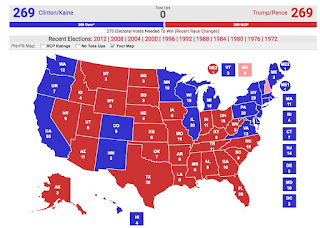


Here is today's "no toss-up" map showing a very narrow Clinton victory.

Change New Hampshire and you get the 269 tied scenario! That means the election goes to the House of Representatives with two candidates qualified for the House of Representatives to choose from.

What happens if McMullin pulls off the upset in Utah and Nevada and Virginia flip? You get no one with 270 and three candidates qualified for the House of Representatives to choose from.

538 has a similar map to the RCP "no toss-up" map with the exception that 538 has Nevada in the Clinton column.
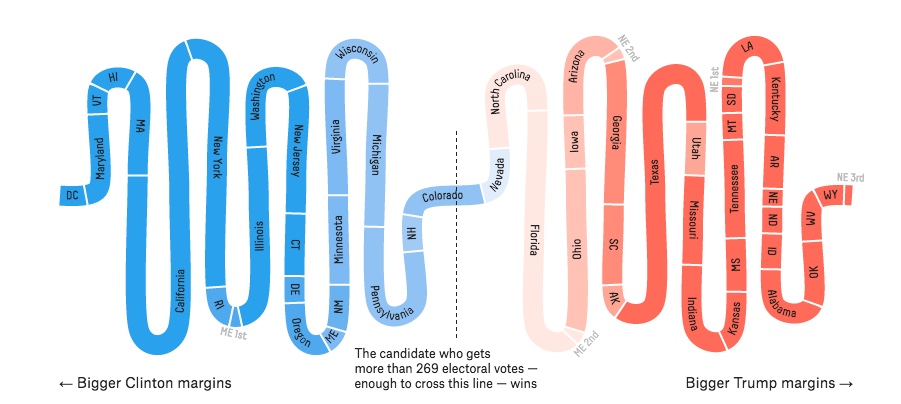
As of October 31 - RCP Electoral Map

The screen grab is from Monday morning. As you can see, the Clinton campaign is on the cusp of 270. Trump would need to run the table of toss-up states to win the election. However, the poll numbers behind the map haven't factored in the latest twist in the news. We have no way of knowing if there is yet another twist left in this crazy campaign.
In the abstract, this election was going to be difficult for the in-power party because running for the "third" term is always an uphill fight. The last time someone running for a "third" term was McCain and he lost in 2008 though a big factor was the economic crisis at the time. Gore was running for a "third" term and lost narrowly in 2000. The last successful election to a "third" term was 1988 when Bush defeated Dukakis.
Clinton as a candidate has disadvantages: she has none of the charm of Bill Clinton and all the baggage of the Clinton brand name. She is an older candidate (fairly or unfairly) like McCain. She has the political stiffness of Gore. These are three huge negatives. On the positive, she positioned herself as the heir to Obama (Sanders positioned himself as Obama didn't go far enough) which solidifies her position among the party faithful. The other positive (fairly or not), she has played the first woman president card. Thus, she was positioned for a close election against a generic Republican candidate with a 50-50 chance of winning.
However, Trump was a "black swan" event in the GOP pushing Clinton to a 75-25 favorite.
The remaining wild-cards:
How many "shy Trump" voters are out there?
If he is under-polling by ~ 1%, it won't matter
But if it is ~ 2%, it could be a longer night with Clinton probably still winning but closer than people anticipate.
If it is > 2%, Trump might draw the "inside straight" in the electoral college and win.
Any last minute twists in the news for either Clinton or Trump in the next week and a half?
There is less sensitivity to last minute news as more and more people vote early by mail and other mechanisms but still the bulk of the votes are cast on November 8 so some last minute shocking news could still shake the undecided or loosely committed voters.
UPDATE: Here is the latest from the team over at 538.
What a choice .......
It is a real mess we are in.
On one hand, we have 35-40% of the public supporting Trump. Some of these voters are doing so because they want to give Washington DC the "middle finger."
I wonder what percentage of the Trump support is from the "lesser of two evils" voters versus the I want "to flip the bird" to DC voters?
On the other side, we have 40-45% of the public supporting Clinton. I don't know what percentage are doing so because they see Clinton as the "lesser of two evils" choice and how many have the fawning "Saint Hillary" mind-set.
I can understand the "lesser of two evils" voter. I don't like it but I understand it.
I can't understand the "Saint Hillary" voter. If a Republican candidate had the same baggage as Clinton, the Democrats would be screaming at the top of their lungs complaining about that baggage. The "Saint Hillary" voter is in denial about how much baggage the Clinton brand carries with it.
So what is a voter to do?
Johnson-Weld is a possible protest vote. They have good track records as governors but when the spotlight has been on Johnson, he shown himself not ready for prime time.
The Stein-Baraka ticket is the Green Party choice and they remain a boutique-niche party.
McMullin-Finn are running as independents and are having ballot-access problems.
So what is a former GOP now independent voter to do?
On one hand, we have 35-40% of the public supporting Trump. Some of these voters are doing so because they want to give Washington DC the "middle finger."
To his supporters, a vote for Trump is a way to flip the middle finger to the system, the media, the elite, the liberals, the know-it-alls and the people who pretend they're better than "us." (excerpt from Mel Robbins at CNN.com)Of course, that may feel good but do we really want that to be the basis for selecting POTUS?
I wonder what percentage of the Trump support is from the "lesser of two evils" voters versus the I want "to flip the bird" to DC voters?
On the other side, we have 40-45% of the public supporting Clinton. I don't know what percentage are doing so because they see Clinton as the "lesser of two evils" choice and how many have the fawning "Saint Hillary" mind-set.
I can understand the "lesser of two evils" voter. I don't like it but I understand it.
I can't understand the "Saint Hillary" voter. If a Republican candidate had the same baggage as Clinton, the Democrats would be screaming at the top of their lungs complaining about that baggage. The "Saint Hillary" voter is in denial about how much baggage the Clinton brand carries with it.
I can understand the anger at DC sentiment but the I want to give DC the "middle finger" voter is in denial about the consequences of voting for someone so unstable.
So what is a voter to do?
Johnson-Weld is a possible protest vote. They have good track records as governors but when the spotlight has been on Johnson, he shown himself not ready for prime time.
The Stein-Baraka ticket is the Green Party choice and they remain a boutique-niche party.
McMullin-Finn are running as independents and are having ballot-access problems.
So what is a former GOP now independent voter to do?
Kaine-Pence 2016 Pence-Kaine

What is a #nevertrump #neverhillary voter to do? The respective VP are both "no drama" and some say even "boring" but they have worked with people as governors to generally good reviews. Prefer that to the traveling road show of Clinton or Trump!
Don't know if California allows write-ins but it is a temptation. May also consider Johnson-Weld, two former governors running on the Libertarian ticket. What else can a dis-enchanted voter do?
The write-in option would be a somewhat "wasted" protest vote as it may or may not count (see items below). Voting Libertarian will "count" but unless they garner much more votes their impact on the two major parties will remain on the margins but perhaps that is worth something.
If you are curious, here are a few articles about write-in candidates. Suffice to say, it will either not be counted or lumped together with generic "other."
From https://ballotpedia.org/Ballot_access_for_presidential_candidates:
An individual can run as a write-in candidate. In 34 states, a write-in candidate must file some paperwork in advance of the election. In nine states, write-in voting for presidential candidates is not permitted. The remaining states do not require write-in candidates to file paperwork in advance of the election
From http://www.bloomberg.com/news/articles/2004-11-01/the-ins-and-outs-of-write-ins:
In most states, registered write-in candidates like Nader and Allen at least get the joy of seeing their piddling results the next day. But in Oregon, the computerized tabulation system won't calculate any specific write-in results unless it appears the contender has enough support to win. And five states -- Hawaii, Nevada, South Dakota, Oklahoma, and South Carolina -- don't allow any Presidential write-ins, and never have. Louisiana, the sixth no-write-in state, got rid of them in 1975 after it adopted a system in which anyone could get on the regular ballot, regardless of party affiliation. [.....] Unregistered write-ins have to be thrown out manually. "My friends used to write me in for county attorney, and I used to think it was funny," says Kanefield, letting his chuckle stop short. "[That was] until I got into the election administration. It takes time to process those." The person who has to sort your vote for Boston Red Sox center fielder Johnny Damon from the pile will undoubtedly find it less amusing than you do.
From http://wtop.com/elections/2016/05/write-in-votes-rarely-count-for-presidential-candidates/:
In Maryland and Virginia, write-in votes for candidates who did not file their candidacies with the state get piled into a generic “other” or “write-in” category. “Even though those votes should be counted for, sometimes elections boards think it is too much trouble and you’ll have a vote here and a vote there and they’ll lump them together as ‘other,'” said Johns Hopkins University professor Ben Ginsberg. “(Your vote) will count in the sense that somewhere in that computer, the vote will be registered,” Ginsberg added, noting that the vote will not be counted for a specific candidate.
No Party Preference Voter

In California, one can update your registration information online.
A handful of days ago, I went in and re-registered as a "No Party Preference." Part of my #NeverTrump sentiment.
Of course, I'm also #NeverHillary so I don't know what I am going to do on the POTUS vote in November. I could skip that item. I am also looking at the Johnson-Weld ticket.
#Never Trump - end of the line .......
There was an attempt to allow GOP delegates to vote unbound to their state results; however, the #NeverTrump side lost those votes by a wide margin. It appears the last actions could take place at the convention with gestures of dissent.
As a #NeverTrump voter, am looking at a protest vote with the Libertarian Johnson-Weld ticket...
Here Gov. Johnson makes his pitch to the #NeverTrump voters ....
And here Johnson makes his pitch to #FeelTheBern voters ....
As a #NeverTrump voter, am looking at a protest vote with the Libertarian Johnson-Weld ticket...
Here Gov. Johnson makes his pitch to the #NeverTrump voters ....
And here Johnson makes his pitch to #FeelTheBern voters ....
Bret Stephens of Wall Street Journal and his concerns about Trump
Stephens was interviewed by Hugh Hewitt recently and offered his thoughts.
Excerpt:
Stephens: I will never vote for Donald Trump. I have a very, very hard time voting for Mrs. Clinton. I have been, I have been writing about Hillary Clinton, I just actually looked this up, since 1998 when she was busy standing by when Suha Arafat was launching anti-Semitic tirades against Israel and the Jews. And Hillary Clinton’s record in office is dreadful. Her ideas are dreadful. They will make us less safe. So, but there is no way I’m going to vote for a guy who is just totally uninformed, un-presidential as Donald Trump is.
[........]
Who knows better than you what it means to have a commander-in-chief who lived his entire life, who lived throughout the entire Cold War, and doesn’t know what the nuclear triad is? It’s absolutely astonishing. And so it’s terrific to have Joe Dunford and you know, perhaps John Bolton and other people in positions of trust. But you have to have a president who bothered over the last 70 years to gain a cursory understanding of how the world works. And on so many issues, Hugh, on so many issues, I know not all of the issue, but on so many issues, this guy is just the antithesis of what I’d want a Republican president to be on foreign policy.
[.......]
The United States survives so long as at least one of its major parties is politically and intellectually healthy. I don’t think the Republican Party, or I should say the Republican Party as the vehicle for modern American conservative ideas, survives with Donald Trump.
As a practical matter, in California, I don't have to worry that my vote will make any difference. Clinton is going to get all of California's electoral votes no matter what people like me (who don't want to vote for Clinton or Trump) do. My decision is whether to skip the POTUS part of the ballot or to cast a "protest" vote for a minor party candidate.
George Will not only won't vote for Trump, he has changed his voter registration in Maryland from Republican to unaffiliated.
I will wait for the GOP convention in Cleveland. There is a slim chance probably 1 in a 1000 that they will dump Trump and pick someone else. If they indeed nominate Trump, I'll file to change my voter registration from Republican to "decline to state" which is the term used in California forms.
From 1981 to 1993 I was registered in California as a "decline to state."
From 1993 to 1996, I was an unaffiliated Maryland voter.
From 1996 to 1997, I was a Republican registered voter in Maryland. I cast a protest vote for Steve Forbes that year.
From 1997 to today, I have been a registered Republican in California.
In Presidential primaries since, I have voted:
2000 - McCain
2004 - Bush
2008 - Romney
2012 - Romney
2016 - Kasich
Excerpt:
Stephens: I will never vote for Donald Trump. I have a very, very hard time voting for Mrs. Clinton. I have been, I have been writing about Hillary Clinton, I just actually looked this up, since 1998 when she was busy standing by when Suha Arafat was launching anti-Semitic tirades against Israel and the Jews. And Hillary Clinton’s record in office is dreadful. Her ideas are dreadful. They will make us less safe. So, but there is no way I’m going to vote for a guy who is just totally uninformed, un-presidential as Donald Trump is.
[........]
Who knows better than you what it means to have a commander-in-chief who lived his entire life, who lived throughout the entire Cold War, and doesn’t know what the nuclear triad is? It’s absolutely astonishing. And so it’s terrific to have Joe Dunford and you know, perhaps John Bolton and other people in positions of trust. But you have to have a president who bothered over the last 70 years to gain a cursory understanding of how the world works. And on so many issues, Hugh, on so many issues, I know not all of the issue, but on so many issues, this guy is just the antithesis of what I’d want a Republican president to be on foreign policy.
[.......]
The United States survives so long as at least one of its major parties is politically and intellectually healthy. I don’t think the Republican Party, or I should say the Republican Party as the vehicle for modern American conservative ideas, survives with Donald Trump.
As a practical matter, in California, I don't have to worry that my vote will make any difference. Clinton is going to get all of California's electoral votes no matter what people like me (who don't want to vote for Clinton or Trump) do. My decision is whether to skip the POTUS part of the ballot or to cast a "protest" vote for a minor party candidate.
George Will not only won't vote for Trump, he has changed his voter registration in Maryland from Republican to unaffiliated.
I will wait for the GOP convention in Cleveland. There is a slim chance probably 1 in a 1000 that they will dump Trump and pick someone else. If they indeed nominate Trump, I'll file to change my voter registration from Republican to "decline to state" which is the term used in California forms.
From 1981 to 1993 I was registered in California as a "decline to state."
From 1993 to 1996, I was an unaffiliated Maryland voter.
From 1996 to 1997, I was a Republican registered voter in Maryland. I cast a protest vote for Steve Forbes that year.
From 1997 to today, I have been a registered Republican in California.
In Presidential primaries since, I have voted:
2000 - McCain
2004 - Bush
2008 - Romney
2012 - Romney
2016 - Kasich
How am I going to (not?) vote? #NeverTrump

And I thought this year California would finally have a say in the outcome. Ugh.
#NeverTrump - Gerson's view
Count me in the #NeverTrump camp.
Gerson in this piece thinks there are three broad category of Republican voters: those who support Trump energetically, those who support Trump reluctantly and may actually hope he loses so this sorry chapter of the GOP is quickly put into the dustbin of history, and those who oppose Trump.
Excerpts:
This is the main reason that some of us cannot simply lump it and reluctantly lend our support to Trump. The Republican Party is not engaged in a policy argument; it is debating the purpose of politics. For some Trump opponents, the justice of a political system is determined by its treatment of the vulnerable and weak. In the Catholic tradition, this is called "solidarity." Whatever you call it, this commitment is inconsistent with a type of politics that beats up on the vulnerable and weak -- say, undocumented workers, or Muslims -- for political gain. Those who accuse Trump opponents of elitism are engaged in a particularly mendacious slur. Trump is attempting to place nativism at the center of American politics. [......] Some are trying their best to act as though all this were normal. But we are seeing, in the words of G.K. Chesterton, "lunacy dancing in high places." None of this requires a vote for Hillary Clinton. But it forbids a vote for Donald Trump.
Gerson in this piece thinks there are three broad category of Republican voters: those who support Trump energetically, those who support Trump reluctantly and may actually hope he loses so this sorry chapter of the GOP is quickly put into the dustbin of history, and those who oppose Trump.
Excerpts:
This is the main reason that some of us cannot simply lump it and reluctantly lend our support to Trump. The Republican Party is not engaged in a policy argument; it is debating the purpose of politics. For some Trump opponents, the justice of a political system is determined by its treatment of the vulnerable and weak. In the Catholic tradition, this is called "solidarity." Whatever you call it, this commitment is inconsistent with a type of politics that beats up on the vulnerable and weak -- say, undocumented workers, or Muslims -- for political gain. Those who accuse Trump opponents of elitism are engaged in a particularly mendacious slur. Trump is attempting to place nativism at the center of American politics. [......] Some are trying their best to act as though all this were normal. But we are seeing, in the words of G.K. Chesterton, "lunacy dancing in high places." None of this requires a vote for Hillary Clinton. But it forbids a vote for Donald Trump.
GOP Post-mortem - Prager's view and Levinson's view #NeverTrump
I didn't think Trump would win. I figured at some point he would self-destruct. But it seemed with each "out there" comment, he gained more popularity. Meanwhile, his opponents got picked off one-by-one and were voted off the nomination island Survivor style.
Prayer offered these thoughts as to what happened.
Excerpt:
There are many reasons Donald Trump is the presumptive Republican presidential nominee. The four most often cited reasons are the frustrations of white working-class Americans, a widespread revulsion against political correctness, disenchantment with the Republican “establishment,” and the unprecedented and unrivaled amount of time the media afforded Trump. They are all valid. But the biggest reason is this: The majority of Republicans are not conservative. [.........] Only America was founded on the idea of small government. But the Left is based on big government. America was founded on the principle that human rights come from the Creator. For the Left, rights come from the state. America was founded on the belief that in order to maintain a small government, a God-fearing people is necessary. The Left opposes God-based religions, particularly Judeo-Christian religions. Secularism is at the core of Leftism every bit as much as egalitarianism is. It took generations, but the Left has succeeded in substituting its values for America’s. [....] Those who do are called “conservatives” because they wish to conserve the unique American idea. But conservatives now constitute not only a minority of Americans, but a minority of Republicans. That is the primary reason Donald Trump -- a nationalist but not a conservative -- is the presumptive Republican nominee.
Am part of the #NeverTrump voter group and have nowhere to go so maybe not voting on the President or doing a protest vote. We shall see.
Here is some more post-mortem from Levinson.
Excerpt:
Some people involved in what came to be called the #NeverTrump movement lamented that their efforts to bloody the front-runner wouldn’t have been necessary if any of the other candidates had been willing to attack him themselves. Many laid the blame on Ted Cruz, calling him an unacceptable alternative to Trump. Cruz’s camp blamed John Kasich, saying the race would have unfolded differently if he’d dropped out and let Cruz go head to head with Trump. Others blamed the strategy of anti-Trump groups, saying it’s no help telling voters who to be against if you can’t tell them who they should be for. Several said the Republican National Committee should have stepped in and effectively excommunicated Trump from the party. And still others wondered whether Trump had ever been stoppable in the first place. [...........] The most consistent knock on the anti-Trump outside groups is that their efforts did not start early enough. [.....] The non-Trump contenders were all damaged by spending onslaughts, even as their chief antagonist largely proved impervious to outside spending on negative ads. Attacks from the super PAC backing Rubio damaged Chris Christie’s chances in New Hampshire. Spending by Right to Rise, the Super PAC backing Jeb Bush, kept Rubio’s poll numbers low leading up to the Iowa caucuses. But Right to Rise was a cautionary tale of the limited impact of paid attacks this cycle — the group spent over $100 million to help Bush, who dropped out after the South Carolina primary, having never placed higher than fourth place. And the attacks that truly damaged Rubio’s campaign were not backed by Right to Rise’s millions, but rather leveled at him in person: Christie’s attack on him as a robot at the New Hampshire debate, and Trump’s unflattering “Little Marco” moniker. [.......] Anti-Trump Republicans argued from the beginning that even if Trump was leading the polls, the fact that he was below 50 percent meant there were always more people against him than for him. But when the race began there were 16 people splitting that anti-Trump vote.
Prayer offered these thoughts as to what happened.
Excerpt:
There are many reasons Donald Trump is the presumptive Republican presidential nominee. The four most often cited reasons are the frustrations of white working-class Americans, a widespread revulsion against political correctness, disenchantment with the Republican “establishment,” and the unprecedented and unrivaled amount of time the media afforded Trump. They are all valid. But the biggest reason is this: The majority of Republicans are not conservative. [.........] Only America was founded on the idea of small government. But the Left is based on big government. America was founded on the principle that human rights come from the Creator. For the Left, rights come from the state. America was founded on the belief that in order to maintain a small government, a God-fearing people is necessary. The Left opposes God-based religions, particularly Judeo-Christian religions. Secularism is at the core of Leftism every bit as much as egalitarianism is. It took generations, but the Left has succeeded in substituting its values for America’s. [....] Those who do are called “conservatives” because they wish to conserve the unique American idea. But conservatives now constitute not only a minority of Americans, but a minority of Republicans. That is the primary reason Donald Trump -- a nationalist but not a conservative -- is the presumptive Republican nominee.
Am part of the #NeverTrump voter group and have nowhere to go so maybe not voting on the President or doing a protest vote. We shall see.
Here is some more post-mortem from Levinson.
Excerpt:
Some people involved in what came to be called the #NeverTrump movement lamented that their efforts to bloody the front-runner wouldn’t have been necessary if any of the other candidates had been willing to attack him themselves. Many laid the blame on Ted Cruz, calling him an unacceptable alternative to Trump. Cruz’s camp blamed John Kasich, saying the race would have unfolded differently if he’d dropped out and let Cruz go head to head with Trump. Others blamed the strategy of anti-Trump groups, saying it’s no help telling voters who to be against if you can’t tell them who they should be for. Several said the Republican National Committee should have stepped in and effectively excommunicated Trump from the party. And still others wondered whether Trump had ever been stoppable in the first place. [...........] The most consistent knock on the anti-Trump outside groups is that their efforts did not start early enough. [.....] The non-Trump contenders were all damaged by spending onslaughts, even as their chief antagonist largely proved impervious to outside spending on negative ads. Attacks from the super PAC backing Rubio damaged Chris Christie’s chances in New Hampshire. Spending by Right to Rise, the Super PAC backing Jeb Bush, kept Rubio’s poll numbers low leading up to the Iowa caucuses. But Right to Rise was a cautionary tale of the limited impact of paid attacks this cycle — the group spent over $100 million to help Bush, who dropped out after the South Carolina primary, having never placed higher than fourth place. And the attacks that truly damaged Rubio’s campaign were not backed by Right to Rise’s millions, but rather leveled at him in person: Christie’s attack on him as a robot at the New Hampshire debate, and Trump’s unflattering “Little Marco” moniker. [.......] Anti-Trump Republicans argued from the beginning that even if Trump was leading the polls, the fact that he was below 50 percent meant there were always more people against him than for him. But when the race began there were 16 people splitting that anti-Trump vote.
Washington Post Podcast - "Presidential" with Lillian Cunningham
The above video is a modern rendition of the William Henry Harrison (elected 1840) campaign song "Tippecanoe and Tyler Too" by the group They Might Be Giants. I heard the song while listening to the WaPo's Presidential podcast series hosted by Lillian Cunningham.
In the episode, the focus was on his life prior to the presidency since his time in office was a mere 32 days! We also hear that the explanation for this death being due to his long inaugural address causing him to catch pneumonia is probably incorrect. Further research into the circumstances surrounding his death suggest that it is more likely he caught an illness from contaminated water in the White House. Combine that ailment with the harmful medical treatments of that time of poor medical understanding of disease hastened his death.
Am still catching up with all the podcasts that have already been released. Am enjoying them very much. Each episode profiles one president at a time though references are made to other presidents. The podcasts are anywhere from 25 to 50 minutes so they are not meant to be exhaustive explorations. However, major highlights of their term in office are discussed. But, additionally, and most interestingly, with a blend of irreverence and historical scholarship, their respective leadership styles and personalities are explored. Follow on Twitter and Instagram at @presidential_wp and the weekly podcasts drop each Sunday.
If you are interested in the lyrics of the song "Tippecanoe and Tyler Too" in the above audio clip:
Oh who has heard the great commotion, motion motion
All the country through?
It is the ball a-rolling on
For Tippecanoe and Tyler too
And with him we'll beat Little Van, Van
Van is a used up man
And with him we'll beat Little Van
Sure, let 'em talk about hard cider (cider cider)
And log cabins too
't'will only help to speed the ball
For Tippecanoe and Tyler too
And with him we'll beat Little Van, Van
Van is a used up man
And with him we'll beat Little Van
Like the rush of mighty waters (waters waters)
Onward it will go
And of course we'll bring you through
For Tippecanoe and Tyler too
And with him we'll beat Little Van, Van
Van is a used up man
And with him we'll beat Little Van
Disclaimer - 2016 Presidential Nomination
If you have mouse clicked to this blog to look in on politics, you could probably guess I'm supportive of the Republican viewpoint but in the #NeverTrump #NeverTrump category. Nonetheless, I do try to write as objectively as I can. And so, thinking about the practice of objectivity, I should disclosed that I'm a classic "small donor" to several campaigns.
I have donated to the following:
Ben Carson - I appreciated his calm manner of presentation even if I did not think he would win. We need more calm voices in the political process so I was disappointed when he endorsed Donald Trump.
Marco Rubio - I thought he exhibits the solidly center-right policy views I think is prudent for the USA. He is one of the more articulate spokesman for the party. His biography is also fantastic.
John Kasich - My preference in presidential candidates are governors as they have served in executive branch roles. Bush had the disadvantage of being the 3rd Bush to run. Christie was too combative for my taste although clearly the GOP electorate is in a combative mood. Kasich has a solid history of effective service in various levels of government.
Ted Cruz - Cruz is solid center-right in his policy views that are generally in the mainstream of the conservative political side of the aisle. His experience is a bit on the thin side but at this point, he is the most viable alternative for the #NotTrump #NeverTrump voter. I suppose you might say I'm a "realist" at this point.
Below is a TED talk by Arthur Brooks that captures a lot of the sentiments I have about politics.
I have donated to the following:
Ben Carson - I appreciated his calm manner of presentation even if I did not think he would win. We need more calm voices in the political process so I was disappointed when he endorsed Donald Trump.
Marco Rubio - I thought he exhibits the solidly center-right policy views I think is prudent for the USA. He is one of the more articulate spokesman for the party. His biography is also fantastic.
John Kasich - My preference in presidential candidates are governors as they have served in executive branch roles. Bush had the disadvantage of being the 3rd Bush to run. Christie was too combative for my taste although clearly the GOP electorate is in a combative mood. Kasich has a solid history of effective service in various levels of government.
Ted Cruz - Cruz is solid center-right in his policy views that are generally in the mainstream of the conservative political side of the aisle. His experience is a bit on the thin side but at this point, he is the most viable alternative for the #NotTrump #NeverTrump voter. I suppose you might say I'm a "realist" at this point.
Below is a TED talk by Arthur Brooks that captures a lot of the sentiments I have about politics.
Subscribe to:
Posts (Atom)