Showing posts with label faith. Show all posts

Read through the Bible in one-year, reflections part VII

In a typical read through the Bible plan, I know I struggle with the big chunk of material in Exodus, Leviticus, and Numbers that are filled with various minute details of the tabernacle, the garments, the sacrifices, and the numerous codes of conduct. 

#1
I think one perspective to keep in mind as we wade through these sections is the holiness of God. God is perfectly holy, and we are not. The laws are there to hold up a mirror to us to show us we are not holy. We not only fail to keep the letter of the law we fail to even uphold a fraction of the spirit of the law. These laws are in regard to our relationship to God. These laws are in regard to our relationship to each other. And we fall short on both fronts.

#2
Mixed in with all these laws that are a megaphone announcing the holiness of God are the provisions for us to be made right before God. We can’t be made right using our own methods, we need to follow the way set forth by God. Thus, the over-arching theme is God is holy, we are not, God has made a way to be restored, and we need to trust and obey God’s way of restoration. 

#3 
As such, we need to be careful as New Testament Christians how we talk about the Old Covenant. We should not talk down upon the Old Covenant. The stories of God's people who lived and walked in the Old Covenant like Abraham, Isaac, Jacob, and others are illustrative of the human condition. They stumbled around a lot (we do to) and it was God's mercy and grace that picks them (and us) up!

So yes, the Old Covenant was well ... a certain way at a particular time. And, yes, the New Covenant is well … new! But the message is still the same: God is holy, we are not, God has made a way to be restored, and we need to trust and obey God’s way of restoration. In the New Covenant, the way is through trust and obedience to our Lord and King Jesus! The grace of God is the same, yesterday, today, and forever. Abraham needed grace. We need grace.

Jesus’ critique of the religious leaders of the time was that they missed the point of the Old Covenant. These religious leaders thought they kept the letter of the Law and that their birthright as the children of Abraham was enough. Regarding the letter of the Law, they under-estimated just how holy God actually is and thought more highly of their own holiness than actually warranted. As such, they also missed the spirit of the law:  God is holy, we are not, God has made a way to be restored, and we need to trust and obey God’s way of restoration. 

Anyway, these handholds have been a helpful 30,000 feet perspective for me. 

Keep reading!

Soli Deo Gloria!

Read through the Bible in one-year, reflections part V

As we proceed through the Old Testament in the reading plan, all of Genesis and the first half of Exodus are narrative. These are the stories of great pathos and the stuff of movies! When we hit Exodus 20 and the giving of the 10 Commandments, much of the remainder is what is known broadly as “the Law.” 

 #1 We need to start by defining our terms when we think about “the Law.” This concept is used to describe several different things, so we need to understand its different meanings. The various definitions are: 1) it is the 613 commandments as tallied by Jewish scholars; 2) it is the five books from Genesis to Deuteronomy; 3) it is the theology of the Old Testament; and 4) it can also refer to how the Jewish religious leaders at the time of Jesus and the early church interpreted and sometimes mis-interpreted the Law as mentioned in the first sense previously. When we are reading through Exodus and eventually Leviticus and so forth, we are largely thinking of meaning 1 and 3. 

#2 What are the Laws in the 613-commandment sense? They fall into three broad categories: moral law, civil law, and ritual law. For current day Jewish people, the ritual laws that pertain to Temple sacrifice are moot since as there is no longer a Temple and the civil laws don’t apply since whatever country a Jewish person lives in has its civil laws. The Jewish people who are very committed still observe some of the ritual laws. And, of course, the moral law still applies. Likewise, as Christians, the moral law is authoritative since they are largely restated in some form or another in the New Testament while the civil law and ritual law don’t apply. 

#3 What is the purpose of the Law? There are a number of them: 1) they make clear the the holiness of God; 2) they describe the provision of God for restoration and forgiveness when we inevitably fail to live up to the standards set by God; and 3) they point toward Jesus. 

Keep reading! 

Soli Deo Gloria!

Read through the Bible in one-year, reflections part IV

In a “read through the Bible in a year plan,” for the New Testament, we will likely be reading in the Gospels. 

#1 Each Gospel is about Jesus. Note how each Gospel starts by turning the spotlight onto Jesus in its own distinctive way. Matthew 1:1, “An account of the genealogy of Jesus the Messiah, the son of David, the son of Abraham.” Mark 1:1, “The beginning of the good news of Jesus Christ, the Son of God.” Luke 1:1-3 “Since many have undertaken to set down an orderly account of the events that have been fulfilled among us, just as they were handed on to us by those who from the beginning were eyewitnesses and servants of the word, I too decided, after investigating everything carefully from the very first, to write an orderly account for you, most excellent Theophilus, so that you may know the truth concerning the things about which you have been instructed.” John 1:1-5, “In the beginning was the Word, and the Word was with God, and the Word was God. He was in the beginning with God. All things came into being through him, and without him not one thing came into being. What has come into being in him was life, and the life was the light of all people. The light shines in the darkness, and the darkness did not overcome it.” 

So right off the bat, when reading in the Gospel, a good question to ask is who is Jesus in the portion I just read? 

#2 There are Four Gospels. Many analogies have been made for the idea of Four Gospels but one Jesus: one musical score but different instruments playing, or one piece of music but four stereo speakers. There will be something we read in one Gospel, and it will move us in a particular way. We may run into that same teaching in another Gospel, and it will impact us in a different way as it is told in a slightly different way. Over repeated readings of the Gospels, we will be drawn to it in different ways. Using an art analogy, repeated viewing of a masterpiece will reveal new beauty each time. Using a music analogy, repeated listening of a masterpiece will reveal new beauty each time. 

#3 In Matthew, the kingdom of heaven (kingdom of God in other gospels) is a big feature of Matthew. On one hand, the kingdom of God is at hand but also, Jesus teaches the disciples to pray, “thy kingdom come.” From this, we get the idea of the kingdom is “already and not yet.” The kingdom teachings are particularly given in the five extended teaching sections of Jesus:

  1. The Sermon on the Mount as the constitution of the kingdom of God (Mt. 5-7) 
  2. The kingdom personnel on mission (Mt. 10) 
  3. The parables describing the kingdom (Mt. 13) 
  4. The relationships in the kingdom (Mt. 18) 
  5. The near future (probably fulfilled in AD 70) and final future of the kingdom (Mt. 24-25) 

Keep reading! 

Soli Deo Gloria!

Homelessness and Hunger in Los Angeles

The Los Angeles Times recently ran a series of editorials on the issue of homelessness in Los Angeles.

Excerpts:
Homelessness burst its traditional borders several years ago, spreading first to gloomy underpasses and dim side streets, and then to public parks and library reading rooms and subway platforms. No matter where you live in L.A. County, from Long Beach to Beverly Hills to Lancaster, you cannot credibly claim today to be unaware of the squalid tent cities, the sprawling encampments, or the despair and misery on display there.
[.....]
Today, we are paying the price: The economically homeless are now estimated to make up more than half of L.A.’s unhoused — and it is their rising numbers that are fueling the unprecedented growth in that population. More than half of the people surveyed by the Los Angeles Homeless Services Authority last year said they were homeless because of an eviction, foreclosure, unemployment or “financial reasons.”
[.....]
Until the mayor and the members of the City Council treat the building of these 10,000 units of housing with the kind of extraordinary urgency this crisis requires — the kind that the federal and state governments bestowed upon, for example, the rebuilding of the broken Santa Monica Freeway after the Northridge earthquake — they simply will not be built. And they must be built. Supportive housing in particular — which offers not just a place to live but also access to job counseling and mental health and substance abuse treatment, among other things — is the best long-term solution for the chronically homeless, whose cases are the most difficult to solve. A substantial number of these housing units must be located in every single council district. They cannot just be concentrated in poor areas or in neighborhoods with less political clout. Already, a new report shows that even more housing will be needed than was estimated at the time HHH was passed.
[.....]
The largest psychiatric institutions in the United States are the Los Angeles County jails, the Cook County Jail in Chicago and Rikers Island in New York. L.A. County incarcerates thousands of mentally ill people. The Sheriff’s Department reports that more than 70% of inmates who enter jail report a serious illness, either mental or physical. The county is moving forward with a $2-billion-plus plan to replace the aging Men’s Central Jail with a new facility specifically geared toward mental health treatment — but still a jail. We’re back where we started, but this time even more literally than before: Mentally ill people are prisoners. It’s not that jailers want the new business. It’s a population, L.A. County Sheriff Jim McDonnell recently told ABC7, “that I would argue should not be treated in a jail facility.”
[.....]
Across the city, drivers exiting freeways routinely encounter homeless people on the off-ramps shuffling from window to window requesting money. Libraries, train stations and public parks have become refuges for homeless people. In many residential neighborhoods and commercial districts, encampments have become a seemingly immutable fact of life. As homelessness spreads across Los Angeles County — the official tally shows a 46% increase from 2013 to 2017 — it is drawing two conflicting responses, at times from the same people. There’s sympathy and a desire to help, but there’s also a sense of being invaded and perhaps even endangered — in terms of both physical safety and public health
[.....]
Yet such a czar would only be as powerful as the mayor who appointed him or her. And in L.A., the mayor lacks legal authority to override City Council members, who can and do frequently say “no” to proposed housing and mental health facilities in their districts. And neither the mayor nor the czar would have control over the county, which supplies the services, or the region’s other 87 cities. Czar-like powers would be possible only if council members were to relinquish some land-use and budget authority through something like an emergency declaration. And remember, they never did that. They gathered together and said they were going to do it, and much of the world’s media mistook that cleverly phrased promise to do it as actually doing it. You’ll find news stories saying they did it. But they did not.

As an individual, there is little one can do against such massive needs. But we can be faithful to what we can do. Like most Angelinos, I voted for Measure H and HHH. I also donate to Union Rescue Mission and Salvation Army and Venice Family Clinic, three organizations that have been providing help for many years.

I'm a research scientist not a social worker. I'd have no idea how to help the people in these situations. Each person and family has a story and hats off to people who have the heart, knowledge, and skills to help them. And so I support the three organizations mentioned above. I'd encourage you to find a group or two to support. And maybe all of us together helping in some small way can begin to help turn the tide of this crisis.

The role of preaching the Bible in the life of the church

Over the years I've attended and visited a variety of churches. And, not surprisingly, there is quite a variety of ways preaching is embedded in the Sunday gathering.

How much time devoted to the sermon?

At one end of the scale, I've seen 10 minute sermons where there might be one or two key points of reflection. On the other, I have heard 45 minute deep dives into a topic or passage with three or four key points and explanations and defenses of each point. And of course, have heard pastors speak for anywhere and everywhere between 10 to 45 minutes.

How does one decide how much emphasis (in terms of tangible percentage of minutes) to place of the ministry of the word in communal Sunday gatherings?

What about the content of the sermon?

Some teaching pastors preach through the Gospel of John (or some other book in the Bible) and they do so for however many weeks or months are needed to cover the text they are teaching from.

There are pastors who teach through a series of sermons lasting anywhere from 4 to 12 weeks. In the case of a shorter book of the Bible, they can preach the entire book. For instance, Paul's letter to the Philippians is just four chapters. A sermon series can touch upon every verse in every chapter of that book. But in the situation where the book is much longer, they may hit highlights of that book. If you were planning to preach the Book of Acts, which parts of the 28 chapters would you preach on if you do not plan to preach through every chapter?

In some churches, the pastor will teach topically. I'm sure we have all had the experience of seeing the church bulletin that contains a three or four point outline and under each point is two or three verses pertaining to the point thus yielding a topical sermon. I think Rick Warren is a well known example of this kind of preaching.

There are some churches, usually of the more liturgical variety, a lectionary guides the preaching schedule. For instance, the Revised Common Lectionary has a cycle of readings set over a three-year period. Supporters of this approach say that this allows the community to be exposed to a wider swath of God's wisdom found in the Bible because that is the intent of the lectionary. If the pastor can pick and choose the passages for preaching, they might gravitate toward favorite passages or favorite portions of the Bible and miss out on gems in lesser known or less popular parts of the Bible.

In the few times I've visited a Catholic mass, the readings in the service follow the lectionary but the sermon always seems to be drawn upon the Gospel reading. I suppose this could be due to the fact that the sermon leads into the administration of the Lord's supper, the culmination of the mass.

Lastly, I have encountered some churches where the pastor prays for a message for the upcoming Sunday. Thus, the message could be a text exposition or it could be a topic explanation or some combination of the two. And week-to-week, the text or topic will be different and unrelated.

The merit of the "pray for a message" approach is that when Paul and the other apostles wrote their epistles they were addressing a "problem" in the churches they were ministering to. They responded to the Spirit's inspiration to write to them something that will help them re-orient themselves to God's ways in light of their need or problem.

On the other hand, I have noticed the "preach to the need" approach can become "limiting" because of the experiences and personality of the preacher. A carpenter will always see nails to be hammered. A firefighter will see fires to be put out. A surgeon will see somebody to open up and operate upon. And so whatever background a pastor has, he/she might wind up preaching toward their "strengths" to the neglect of other matters?

Anyway, all of this to wonder aloud, if you are a preaching pastor and you happen on this blog post, how do you approach your preaching? What do you think are the strengths and weaknesses of the approach you take?

May God bless the feet and words of those who proclaim Good News to the flock entrusted into your care and feeding!

Larry Shapiro and John Lennox in conversation "Is there truth beyond science?"


A lively, honest, and friendly conversation between a classical Christian (Lennox) and an atheist (Shapiro) held at the University of Wisconsin.

People engaged in our current political discourse could learn a lot from these two gentleman and scholars about how to talk about things where there is disagreement.

In our 21st century world, there are people who don't think there is even such a thing as truth. On this point, they both agree that there is such a thing.

On the question of whether truth can be found outside of science, I think they would both agree on that point as well. They both point out that science as a method is very good for understanding the natural world. However, our lives have aspects that are more than just the natural world - morality, purpose, meaning, etc.

Where they do part company is whether or not God is in the equation of our grasping of truth. Shapiro does not think there is enough (or perhaps even any) evidence for the existence of God. In an interesting segment, he asks how would one distinguish "god" from a powerful alien from another planet or a "flying spaghetti monster."

Lennox's response was that the claims of Christianity exist within a long historical narrative framework that can be assessed by human reason.

The podcast is about 90 minutes and a worthwhile listen if you are interested in such things.

P.S. If you find these types of conversations interesting, be sure to check out Bishop Robert Barron (Catholic Christian) and Professor William Lane Craig (Protestant Christian) discuss faith, science, and society. In this discussion there was much more agreement between the two speakers (compared to Lennox and Shapiro) but the same friendly honest approach. There was a short segment on the differences between Protestant and Catholics but both emphasized that the common ground is so large. One could also see some differences in emphasis and style but the centrality of Christ was the guiding light in their presentations.

Update: found the video for embedding (1/25/2018)

Episode 7: The Bowels Awaken (albeit rather slowly)

Day 8 - Tuesday September 13

The overnight MD for 8-West is usually just one person for the unit but since the team showed up it must have been the transition to the morning shift that happens around 5AM.

The MD in charge asked a few questions and the order was given: nasal gastric tube insertion. In a matter of minutes, the tube was placed and in a matter of minutes hundreds of milliliters of fluid was collected in the vacuum trap. This would be the eighth time I've had this medical device utilized for my medical care - the second time during this hospitalization.

Eight days earlier .....

Day 1 - Tuesday September 6

On this day, I was scheduled for Laparoscopic Lysis of Abdominal Adhesions (video) (text explanation) at 1pm.

Briefly, I had surgery for small bowel obstruction in 2004. As a result, I was at risk for recurrent small bowel obstruction (SBO) due to adhesions from scar tissue formation resulting from the surgery. Most adhesions don't cause problems but some do and in my case, recurrent SBO episodes took place in 2005, 2009 (spring), 2009 (fall), 2014, and 2016 (spring) all resolved by non-surgical management using the nasal gastric tube and supportive IV.

After the episode in 2014, the surgeon in charge of my care said the number of recurrences is getting to be unusual high and elective surgical intervention might eventually need to be considered. After the episode in 2016, the surgeon in charge of my care (different MD), made a more insistent recommendation that elective surgical intervention should be very seriously considered. As a result of that recommendation, I was scheduled for elective surgery on this fine fall southern California day.

I checked into the procedure treatment unit (PTU). I changed into the surgical gown - a neat little thing that can be hooked up into a warm air blower! The nurse placed the IV catheter into my left hand. A member of the surgical team gave me a quick rundown of what to expect. For this type of surgery two hours would be typical if nothing unusual is found inside. The plan was to use four laparoscopic sites. However, if things got complicated, they would resort to a laparotomy. Blood transfusion is not anticipated but my blood type was determined should it be necessary.

I was informed that the surgery in the surgical suite I was scheduled for was running overtime and that there is a 45 minute sterilization procedure for the room before it would be ready for my surgery. I would know the surgery would be soon when the anesthesiologist checked in with me.

At 2pm, the anesthesiologist came by and explained what will happen. He and one of the medical students on the team walked with me as the medical bed threaded its way to the surgical suite. He asked about my research work and I asked him about his. Once in the surgical suite, I was transferred onto to the surgical stage. The anesthesiologist hooked me up to an IV and he explained he was beginning the process of putting me under. I was beginning to fade out. He placed an oxygen mask over me. I think the last thing I said was, "God bless you all." He said, "God bless you too."

I woke up in the post-anesthesia care unit (PACU). I was told by the surgeon that my case turned out to be more complicated that expected. Instead of just a few adhesions localized to one area there were dense matted adhesions in two areas. However, the team decided a laparotomy was not needed though it took nearly four hours to release all the adhesions.

With the anesthesia worked out of my system, I was moved into the transitional recovery unit (TRU). The regular surgical unit patient rooms on the eighth floor were full so I would be cared for in the TRU that is meant for recovery of out-patient procedures during the day. However, in a pinch they can be converted to regular recovery if somewhat cramped space for in-patients.

Day 2 - Wednesday September 7

A little after midnight, I hit the call button and reported feeling nausea. I was given some anti-nausea medication. I think it was around 2:30AM when I hit the call button again as the feeling came back and was much stronger. This time the overnight MD came in and explained nasal gastric tube insertion was necessary since I was suffering from post-operative ileus as my bowels were asleep as they don't like to be handled and four hours of handling had just taken place.

Day 3 - Thursday September 8

By nightfall, room 8331 opened up in 8-West. The IV fluids kept me hydrated. The NG tube suction kept the nausea and abdominal pains at bay.

Day 4 - Friday September 9

In the afternoon, the amount of fluid collected by the NG tube decreased enough that they removed the NG tube.

Day 5 - Saturday September 10

I began on some liquid diet with the plan of a discharge on Sunday. I felt the liquid food was still feeling a bit "heavy" but it wasn't too bad.

Day 6 - Sunday September 11

I was advanced to some solid food but it was was still feeling a bit "heavy" and it felt worse that on Saturday. The MD examined by abdomen and canceled the discharge order. One thing MDs try to avoid is sending people home only to have them come back into the ER with post-surgery complications. They thought that the post-operative ileus might still be hanging on.

Day 7 - Monday September 12

I went back to the liquid diet. It was still feeling a bit "heavy" and it was beginning to feel painful in my belly. I was given toradol since opioid (morphine and morphine-derivative) meds often slow down the digestive tract.

Day 8 - Tuesday September 13

Sometime after midnight, I can't remember when, I felt very bloated. There was so much air trapped in my belly that I belched repeatedly and it seemed to go on forever but it was probably just a couple of hours. Eventually, I hit the call button to report my situation to the nursing staff. They suggested that I get up and walk and see if it would clear up. I was able to walk around for a handful of minutes but I was starting to feel very weak and unstable and the nurse could see that I was at risk of falling so she brought me back to the room and had me sit in the chair. It seemed like a long time but was probably less than an hour when things started to go seriously sideways.

The nausea was welling up fiercely but vomit attempts come up dry after multiple attempts. The abdominal pain was off the charts; easily a 9 or 10 on the 0-10 pain scale the staff asks their patients to report their pain experience. I found sitting in the chair was getting very uncomfortable so I lowered by myself to the floor and put my face in the bucket in the hope vomiting would bring relief. But relief did not come.

I realized this was not going well and I hit the call button but was too weak to explain the reason for my call. The nurse came in and it was clear I was in distress and she was soon joined by several others. They tag teamed carried me off the floor and put me into bed and after a few questions and my weak attempts to describe what I was going through, the nursing staff paged the medical staff.

UPDATE: Was revisiting this post 1 year later and thought I'd add a few thoughts about morphine type pain medications. Clearly, there are occasions where receiving morphine and morphine-derivatives is entirely appropriate medically. For my SBO condition, I have generally declined the morphine because they can "slow down" the intestinal tract. You may have seen TV ads for the condition called OIC, opioid induced constipation. For people who have chronic pain and take opiod type medications, they often have constipation. Thus, in most of my hospital stays, I opted out of the morphine but did take it on a few occasions. So indeed, there were occasions when the pain was just too much and I would get the shot and the pain would dial down and one even feels a little euphoria as a result. However, at least for me, I would feel a miserable "brain haze" and overall "icky feeling" as it wore off. 

The overnight MD for 8-West is usually just one person for the unit but since the team showed up it must have been the transition to the morning shift that happens around 5AM.

The MD in charge asked a few questions and the order was given: nasal gastric tube insertion. In a matter of minutes, the tube was placed and in a matter of minutes hundreds of milliliters of fluid was collected in the vacuum trap. This would be the eighth time I've had this medical device utilized for my medical care - the second time during this hospitalization.

The NG tube drew out liters of fluid through the day.

I found solace recalling the familiar Psalm written by David.

Psalm 23

The Lord is my shepherd, I shall not want
He makes me lie down in green pastures
He leads me beside quiet waters
He restores my soul
He guides me in the paths of righteousness For His name’s sake.
Even though I walk through the valley of the shadow of death
I fear no evil, for You are with me
Your rod and Your staff, they comfort me.
You prepare a table before me in the presence of my enemies
You have anointed my head with oil
My cup overflows
Surely goodness and lovingkindness will follow me all the days of my life
And I will dwell in the house of the Lord forever

Day 9 - Wednesday September 14

Somewhere around mid-morning, I was wheeled down to the x-ray unit where contrast was delivered through the NG tube. The plan was to take a series of x-rays to monitor the flow of the contrast through my GI tract to see what was going on inside. Suffice to say I threw up some of the contrast but enough was inside me for the study to go forward. I can't recall how long I was down at the x-ray facility and at what intervals the x-rays were taken. Eventually, I was wheeled back up to 8-West where the portable x-ray unit would take additional pictures at designated intervals. By 3pm the nausea and pain from the fluid build up was too great and the NG tube suction was restarted. Additional x-rays were shot in the afternoon and early evening.

UPDATE: Revisiting this blog post almost a year later, I should note in regards to morphine (see notes on day 10), I did take some on this occasion in the late afternoon. Though the pain wasn't as intense as it was on day 8, it had just been so many hours of discomfort that I took the shot. Would also like to discuss, anti-nausea medication. The feeling of nausea is miserable. We know that feeling from sea-sickness (for those who have that problem - I do!) - that "I need to throw up and need to throw up now feeling." Of course, a lot of times, we don't actually throw up and it just feels icky. Anyway, I find nausea medicine takes the sensation back a couple of steps. It still doesn't feel great but it takes the edge off of it. And like the morphine, I did find myself getting a little foggy in the head as a result of taking it. So I did opt out of the nausea medicine when the nausea wasn't too bad. But I definitely did take that medication more frequently than the morphine.

Day 10 - Thursday September 15

The team ordered a CT scan with IV contrast for the morning. By the afternoon, the team told me that the contrast study from the previous day and from today showed that some of the contrast dye did make it into my colon but some was still trapped in the small bowels and that there were indications of looped bowels suggesting obstruction. It was likely I had some combination of small bowel obstruction and post-operative ileus. Whether one proceeded the other was not clear but the treatment for both was the same: NG tube and watch and wait. Surgical intervention would only be called upon if strangulation occurred.

Day 11 - Friday September 16

Up to this point, I had been given various saline solutions with dextrose to keep me hydrated and supplied with energy. However, this is not a complete nutritional profile. Since it was clear I would not be leaving anytime soon, provision needed to be made for me to receive total parenteral nutrition (TPN). Since this material cannot be delivered by the standard peripheral IV, a peripherally inserted central catheter (PICC) line needed to be installed.The specially trained technician swabbed my arm with disinfectant, laid out the sterile materials, visualized the vein in my arm with the ultrasound and threaded the catheter into the vein and eventually ending in my heart. Total time from beginning to end: 20 minutes. During this hospital stay, one song I learned in high school came to my mind during the many moments of discouragement. It is a simple song but it redirected my eyes toward God and sustained me.

Matthew 11 (Wes Terasaki)

Come unto me, all who are weak 
Weary and heavy laden 
Gentle am I, humble in heart 
And you shall find rest for your soul.

All things are given unto those who believe 
Princes and lowly ones His blessings receive 
And just when I think that means everyone but me 
Jesus comes beckoning to me 

Enter the holy gates just as you are 
No need for a happy face, just come with your heart 
And Jesus will bring us a joyful melody 
If only His calling we heed 

We are His little ones, children of God 
Children and fellow heirs of His kingdome come 
And we share the greatest love the world has ever seen 
Here in the Lord's family 

Day 12 - Saturday September 17

The TPN bag was hung this evening. One bag had amino acids for my protein needs along with vitamins and minerals and a much higher percentage dextrose (sugar for calories) compared to the regular saline/dextrose IV bags. The other bag contained lipids and phospholipids.

UPDATE: Revisiting this blog post 1 year after this experience, I thought I'd mention a bit about the nutritional situation. The doctors went to TPN because they knew I would not be eating food anytime soon. The saline mix plus sugar IV that I had been receiving maintained my electrolyte balance which is absolutely essential as NG tube suction involves the loss of electrolytes that if not replenished would have potentially fatal consequences. At a nutritional level, by this point, the sugar in an IV is not enough nutrition. At this stage nearly 2 weeks into my hospitalization, my body had run down whatever stored sources of sugar I had, burning fat reserves to provide enough calories to keep various bodily functions going, and beginning to break down muscle to keep my supply of protein up for other higher priority functions. More nutrition was needed.

Day 13 - Sunday September 18

Rinse and repeat: the PICC line continued to give me TPN over a 24 hour period and the lipid bag was infused over 12 hours. NG tube output was measured during each shift and comparable replacement fluid was infused during that shift.

Day 14 - Monday September 19

Rinse and repeat: the PICC line gave me TPN over a 24 hour period and the lipid bag was infused over 12 hours. NG tube output was measured during each shift and comparable replacement fluid was infused during that shift.

Previously, the daily meds were: famotidine, lovenox, and atorvastatin. One new thing added was Reglan, three times a day via IV.

Today, I was issued "patio privileges" which meant I could tell the nurse that I was going to take a walk away from the 8th floor and could even go outside to the patios of the hospital. Since I was still dependent on the NG tube suction, the recommendation be away for a maximum of 30 minutes. I didn't have the energy to take advantage of it on this day but would in all the subsequent days.

Day 15 - Tuesday September 20

Rinse and repeat.

Day 16 - Wednesday September 21


The day started and seemed headed toward rinse and repeat. However, today, the team decided to test if I can go without the NG tube suction. The NG tube stayed in but I was unhooked from the suction starting in the late morning. If I felt nausea or pain, I was to report it to the nurses and they would examine me and reconnect me to the suction if needed. Interestingly and positively, no nausea or pain arrived after many hours "off leash!"

Day 17 - Thursday September 22

By the afternoon, I had been off suction for over 24 hours so the team decided it was time to remove the NG tube!

Day 18 - Friday September 23

Liquid diet was started. Since my bowels had been asleep nearly 3 weeks, I was told take a sip every 10 minutes and don't push it. Just go slow.

Day 19 - Saturday September 24

More liquid diet. Take a bit every 10 minutes or so and don't push it. Just go slow.

Day 20 - Sunday September 25

Pureed food. Take a bit every 10 minutes or so and don't push it. Just go slow.

Day 21 - Monday September 26

Limited solid food. Take a bit every 10 minutes or so and don't push it. Just go slow.

The nutritionist came to check in on me in the morning. She anticipated I might be discharged on Tuesday. When I get home I was told to take it very slow. Wait a couple of weeks before adding raw fruits and vegetables.

The order was given to taper off the TPN. Because of the high dextrose content, they don't want to just stop the flow. The flow rate was cut in half for a couple of hours and then cut in half again for a couple of hours and then stopped all together.

By the afternoon, the PICC line was removed.

Day 22 - Tuesday September 27

Limited solid food. Take a bit every 10 minutes or so and don't push it. Just go slow.

By 1pm I was officially discharged!

Another song that gave me comfort and strength during my three-week stay was this old classic hymn.

Great is thy Faithfulness (Thomas Chisholm)

Great is thy faithfulness, O God my Father
there is no shadow of turning with thee
thou changest not, thy compassions, they fail not
as thou hast been thou forever will be. 

Great is thy faithfulness! Great is thy faithfulness! 
Morning by morning new mercies I see
all I have needed thy hand hath provided
great is thy faithfulness, Lord, unto me!

Much appreciation goes to the staff of 8West, Team "L," the surgical group, and all the professionals at Ronald Reagan UCLA Medical Center for their efforts in my care. I am grateful we can find such people to do this kind of work - they are amazing.

Also, much thanks go to family and friends who visited and supported through prayer me and my wife through this health episode.

And most of all, God has shown me so much love and grace through Mrs. Rambler who was my heartbeat and rock to lean upon during this extended stay in the hospital.

Previous SBO hospitalizations:
2005
2016

Disclaimer: The material above is a description of my health experience. Though I have attempted to be accurate I am not a medical professional. If you are in need of actual medical advice, please contact your physician.

Recurrent Small Bowel Obstruction and 24 Inches of Plastic Tubing

image source: http://www.oxfordmedicaleducation.com/clinical-skills/procedures/nasogastric-ng-tube/ 

24 inches of plastic tubing. Doesn't seem like much but it is one of the major pieces of technology in the non-surgical management of small bowel obstruction. The ER nurse knew my medical history so she knew I knew what was about to happen thus her explanation was relatively brief. In 2004, twelve years earlier, the descriptions and assurances were quite extensive as it was the first time I underwent the procedure. But on this afternoon, it was all done in short order. She coated the tubing with anesthetic gel and skillfully placed the nasal gastric tube.

24 hours earlier ........

April 22 Friday

I was at work having a mostly normal day. But inside, in my small intestines, things were not normal. Around 5PM, I began to experience abdominal pain. It was a familiar sensation. Over the years, sometimes the pain would go away after a few hours as the obstruction would resolve on its own in short order. On some occasions, the pain would remain at a low level for more than a few hours and then go away. On some occasions, the pain would escalate and the decision would be made to head to the emergency room. By midnight, the pain was present for seven hours and was increasing. We made the decision to head to the Ronald Reagan University Medical Center. 

April 23 Saturday

Emergency department (ED) waiting rooms are somber places. The patient waiting is in some kind of distress. The family member or friend bringing them in is concerned. 

The first point of contact with the ED is the triage nurse who asks some questions, gets medical history and takes vital signs. Some cases get moved right into the emergency room itself. Others are sent to the waiting area. Small bowel obstruction (SBO) in the early stages don't get moved to the front of the line so my wife and I waited quietly with about a dozen other people.

After an hour or so, I was called in. There are examination rooms with various equipment and there are designated areas in the hallway with a number on the wall where gurneys are parked. As would be typical for a big city ED there were many patients parked in the hallway and I was parked. 

ED's are like Las Vegas casinos in a couple of ways: there is a pretty constant beehive of activity and you have no sense of the passage of time unless you have a watch or someone to tell you what time it is. When you are in pain time seems to pass very slowly. I was eventually examined by a doctor. I can't remember how long it was I was parked in the hallway. But during the passing time, I could see and hear the stories of other patients and what pain has brought them to the ED. Some are in good humor despite the suffering and others wail in pain. I tip my hat to the medical professionals who live and work in this world!

I have been told UCLA tries very hard to encourage good doctor-patient communication experiences. The doctor came he asked me to describe (without any interruption) what I was experiencing. He then did a physical exam. He said given my medical history and current physical state, an SBO was quite likely and a CT scan was ordered. Pain (morphine) and anti-nausea medication was administered and I began the process of drinking the liquid contrast for the CT scan. 

Time passed and my drinking of the contrast liquid was slow. First, it tastes terrible and second, with a SBO (i.e. backed up plumbing in your gut), adding more fluid is very uncomfortable. The pain and nausea came back fiercely and I was given another dose of both meds. I eventually gulped down enough of the contrast liquid. However, the call to go to the CT didn't come. We asked about it and the nurse found out that one of the CT units had broken down so the backlog was causing the delay. 

Eventually, I was rolled to the CT suite and a set of images were taken with the contrast liquid. Then another set was taken using IV contrast that gives an indication of blood flow to the area being imaged. I was rolled back to my spot in the hallway.

The MDs (two this time) came back and said, yup, the CT showed a SBO so we are going to admit you into the hospital but the problem right now is that the hospital is completely full. However, a bed should open up in a few hours. 

At some point, I was moved into an examination room where the nasal gastric tube was installed and hooked up to the house vacuum system. By mid-afternoon, I was moved into Eighth Floor East Wing. The ED portion of the story was a least 14 hours.

The NG tube was gurgling and the IV was keeping my electrolytes in balance and giving me sugar for energy and I slept in short bits through the night.

April 24 Sunday


Psalm 27:1 The Lord is my light and my salvation - whom shall I fear? The Lord is the stronghold of my life - of whom shall I be afraid?

I was in 8-East so the window faced the morning dawn which roused me from my fitful slumber. I reached for the phone and snapped the picture you see above. 

The surgical team made their visit and said it was pretty much wait and see.

SBO is a fairly common reason people are hospitalized. If a patient comes into the ED and determined to have SBO and they have NEVER had abdominal surgery, the recommendation is surgery. Tumors of the small intestine can cause SBO and they would not be detected by imaging. However, if a patient has SBO and they have had prior surgery, non-surgical management is recommended since the case may resolve on its own. In the case of recurrent SBO due to prior surgery, the reality is that even the best of surgical techniques can leave scar tissue adhesions on the intestines which raises the risk of SBO. In my case, the surgery was in 2004 and this was my fifth recurrent SBO. 

Non-surgical management is not without risk. The main concerns are complications of the SBO. Strangulation of the bowel (blood flow being cut off) will lead to death of intestinal tissue and requires immediate surgical intervention. The other concern is perforation of the bowel that also demands immediate surgical intervention. Either can be fatal if surgical intervention is delayed. Thus, monitoring of the patient by direct observation, blood work up, and vital signs help the doctors know if things are going in a bad direction. 

But if the patient appears stable, it is watch and wait and hope the SBO resolves on its own. One clue is the how much material is being collected via the NG tube. When the SBO resolves, fluid once again begins moving forward in the intestinal tract and less material is extracted by the NG tube suction.

April 25 Monday 


Psalm 142:5 I cry to you, Lord; I say, “You are my refuge, my portion in the land of the living.”

With an NG tube placed and being in hospital (even if without an NG tube) is not conducive to high quality sleep and there is diminished quantity of sleep. Besides reduced sleep, physical weakness due to one's condition, and the uncertainty takes its toll on even the most positive of personalities. For me, I took to reading the Psalms on the Bible on my iPhone. I jotted down some phrases on the iPhone notepad that resonated with me. I've put some of them underneath the photos I took.

Check out this wonderful video of a conversation between U2 front man Bono and Bible scholar Eugene Peterson about the Psalms.


In the afternoon, the surgical team dropped by to check in on me. Based on the NG tube output and the x-ray they took in the morning, they decided to turn off the NG tube suction and installed a bag to collect fluid by gravity. The plan was to check back the next morning to see how much fluid would be collected.

April 26 Tuesday


Psalm 18:2 The Lord is my rock, my fortress and my deliverer; my God is my rock, in whom I take refuge, my shield and the horn of my salvation, my stronghold.

The surgical team came in and took a look at the NG tube collection bag and noted the volume and color. The volume was modest and the color consistent with gastric fluid. They decided it was time to take the NG tube out! The next test would be to have some liquid diet food for lunch and monitor my reactions.

Although I was already walking around (if at all possible patients are encouraged to get out of bed) the previous days, it is a bit easier with no NG tube. I did many laps around 8-East and ventured out to other parts of the 8th floor. I noticed the art work and below are pictures of some of my favorites.


Just love the humor of a picture of people looking at a picture!


Modern art can be hit or miss. At least this was kind of pretty and interesting!


Of course, you got to get an obligatory picture of a work by a famous artist like Worhol!

Hospitals and healing go together. In addition to the medical procedures and drugs, the other part of the equation is helping the patient's emotional state. I suppose that is part of the art collection to make the place seem more alive than just sterile walls. As I took my walks around the corridors, I came across many other patients doing the same thing. Some had an IV pole like myself. Others had many other things attached to them. But we all tried to give a smile to each other as we walked the hallways. I'm told also that there are more and larger windows in newer hospital design to bring more light in and allow the patients to see the outside world. In the rooms are couches and recliner chairs so that visitors can if they wish stay the night.

Visiting a patient in the hospital is not an easy thing to do for most people. It is a reminder of our mortality which is something most of us struggle with. Also, unless you have a special gift, knowing what to say or not to say is an issue. As someone laying in the hospital bed, I can only say that company is welcome. However, conversation readiness is highly variable from a patient perspective. Sometimes I felt filled with words that longed for someone to hear. But at other times, the medications or the lack of sleep or the aches and pains, the words were few and conversation was an energy drain and the silent company was needed and welcome. Thus, take your cues from the patient you are visiting.


Psalm 63:6 On my bed I remember you; I think of you through the watches of the night.

April 27 Wednesday


Psalm 19:1 The heavens declare the glory of God; the skies proclaim the work of his hands.

Good morning! Lunch and dinner (liquid meals) were tolerated from the day before. This morning was pureed food. By late morning, the word was given ... they were cutting me loose! The paperwork worked its way through the system and finally by early afternoon, my last tie to medical procedures was cut with the removal of the IV needle in my left forearm. Below is the IV pole on which hung the bags that fed me a saline solution with dextrose sugar and potassium for five days. The rectangular shaped boxes are the IV pumps. In my case, only one of them was active. I suppose some other patients might have multiple bags of things to be infused as there were three IV pumps on this pole.


There is no place like home!


Thanks to the doctors and nurses and staff of RRUMC. Thanks to friends and family who visited. And a huge thank you to Mrs. Rambler for love and support through this episode of "in sickness and in health" of our married life.

Previous SBO hospitalizations:

Disclaimer: The material above is a description of my health experience. Though I have attempted to be accurate I am not a medical professional. If you are in need of actual medical advice, please contact your physician.


Philemon - a small story of the big difference Jesus makes in life

What do Christians believe?

How do we see and describe how God is at work in the lives of human beings?

At one level, we can go to the theologically rich descriptions that can be found in St. Paul's writings in Romans and Galatians and other places. And there is definitely a place for that.

However, sometimes, it is just as powerful and perhaps even more so when we look at the "small" stories that reveal the big impact of what God means to people's lives.

In the New Testament, I think of the one chapter book of Philemon. It is the story of three men: Paul, Onesimus, and Philemon. These three me all want to follow Jesus. In 25 verses, we read their story in all its humanity and their wrestling with what it truly means to follow the Christ!

In the video below, noted Bible scholar NT Wright offers some of his reflections of the grandeur of what God was doing in Christ in the lives of these three believers. Their example of Jesus' reconciling work 21 centuries ago is just as relevant today.

The Horns of Psalm 75

I write periodically over at Center for Chinese Church Studies. Here is a short item I posted over there recently about Psalm 75 and "horns."

Excerpt:
v. 10 All the horns of the wicked I will cut off,
but the horns of the righteous shall be lifted up.

The Psalm is clearly about the reality that God is the Judge and that is explicitly stated in v. 7 but what are the horns all about? This is a case where we need a reference work to give us a window into the Ancient Near East usage of metaphors. I turned to Bible Background Commentary – Old Testament and on p. 541 it said, “See the comment on ‘horn’ in the sidebar on common metaphors in Psalms.” Thus, I turned to that item on p. 514 where there was a paragraph on how horns were used in the iconography of the Ancient Near East. For instance, deities were often portrayed as having horns emanating from their crowns. Thus, the bottom line is that horns are used as a symbol for power.

Easter Sunday

Luke 24:1-12
But on the first day of the week, at early dawn, they came to the tomb, taking the spices that they had prepared. They found the stone rolled away from the tomb, but when they went in, they did not find the body. While they were perplexed about this, suddenly two men in dazzling clothes stood beside them. The women were terrified and bowed their faces to the ground, but the men said to them, "Why do you look for the living among the dead? He is not here, but has risen. Remember how he told you, while he was still in Galilee, that the Son of Man must be handed over to sinners, and be crucified, and on the third day rise again." Then they remembered his words, and returning from the tomb, they told all this to the eleven and to all the rest. Now it was Mary Magdalene, Joanna, Mary the mother of James, and the other women with them who told this to the apostles. But these words seemed to them an idle tale, and they did not believe them. But Peter got up and ran to the tomb; stooping and looking in, he saw the linen cloths by themselves; then he went home, amazed at what had happened.


He is risen!


He is risen indeed!

Holy Week Reflections - Holy Saturday and Liminal Space

Psalm 31:1-4
In you, O LORD, I seek refuge; do not let me ever be put to shame; in your righteousness deliver me. Incline your ear to me; rescue me speedily. Be a rock of refuge for me, a strong fortress to save me. You are indeed my rock and my fortress; for your name's sake lead me and guide me, take me out of the net that is hidden for me, for you are my refuge.


In the churches I have been a part of, the emphasis has been on Good Friday and Easter Sunday. A few churches I've been a part of have included Maundy Thursday services.

But what about Holy Saturday, what shall we make of that practice?

Maybe we in less liturgical churches could gain something from our more liturgical fellow Jesus followers?

At this point, would like to toss out another SAT word - liminal. Excerpt from the URL:
What happens if you lose what appears to be your “everything” and you do not know what to do next? If you feel that you are anxiously floating in the in between perhaps you are in The Liminal Space. [.......]"It is when you have left the tried and true, but have not yet been able to replace it with anything else. It is when you are between your old comfort zone and any possible new answer. If you are not trained in how to hold anxiety, how to live with ambiguity, how to entrust and wait, you will run ... anything to flee this terrible cloud of unknowing." 
- Richard Rohr
After Jesus died on the Cross, the followers of Jesus were in that Liminal Space. Their "everything" was gone and even if they remembered those words about resurrection they didn't know if it would happen. And so they waited ...
Peter replaying in his mind his three denials.
John watching Jesus die and receiving instructions from him to care for mother Mary wondering what was next for the whole group.
Thomas questioning himself about what he had said.
Simon of Cyrene wondering how he found himself helping carry Jesus' cross - did he know who Jesus was? Was he already a follower?
The feelings of guilt and shame the 12 felt having fled Jesus at his arrest.
Joseph of Arimathea and Nicodemus perhaps in muted conversation about the shocking events.
And let's not forget the women who were there and what they were thinking and feeling.

All of these people were in liminal space, "anxiously floating in the in between." And as good Jewish people, they may have turned to the Psalms for comfort, for a way to put into words their feelings, for some way to shake replying in their minds the grisly events that had unfolded, for turning their souls toward God. Specifically, they would turn to Psalms of Lament.

How about us?

Though we know the story (Resurrection) after the story (Cross), we in a sense live in Holy Saturday not just today but every day. We know the story (the Incarnation Jesus and the Outpouring of the Spirit) but we await the story (Jesus return). We live in the already-but-not-yet.

And so, we too turn to the Psalms of Lament like Psalm 31:1-4 on Holy Saturday and on many other days .....
In you, O LORD, I seek refuge; do not let me ever be put to shame; in your righteousness deliver me. Incline your ear to me; rescue me speedily. Be a rock of refuge for me, a strong fortress to save me. You are indeed my rock and my fortress; for your name's sake lead me and guide me, take me out of the net that is hidden for me, for you are my refuge.

Holy Week - Good Friday

Good Friday as remembered in John 19:16-30

Then he handed him over to them to be crucified. So they took Jesus; and carrying the cross by himself, he went out to what is called The Place of the Skull, which in Hebrew is called Golgotha. There they crucified him, and with him two others, one on either side, with Jesus between them. Pilate also had an inscription written and put on the cross. It read, "Jesus of Nazareth, the King of the Jews." Many of the Jews read this inscription, because the place where Jesus was crucified was near the city; and it was written in Hebrew, in Latin, and in Greek. Then the chief priests of the Jews said to Pilate, "Do not write, 'The King of the Jews,' but, 'This man said, I am King of the Jews.'" Pilate answered, "What I have written I have written." When the soldiers had crucified Jesus, they took his clothes and divided them into four parts, one for each soldier. They also took his tunic; now the tunic was seamless, woven in one piece from the top. So they said to one another, "Let us not tear it, but cast lots for it to see who will get it." This was to fulfill what the scripture says, "They divided my clothes among themselves, and for my clothing they cast lots." And that is what the soldiers did. Meanwhile, standing near the cross of Jesus were his mother, and his mother's sister, Mary the wife of Clopas, and Mary Magdalene. When Jesus saw his mother and the disciple whom he loved standing beside her, he said to his mother, "Woman, here is your son." Then he said to the disciple, "Here is your mother." And from that hour the disciple took her into his own home. After this, when Jesus knew that all was now finished, he said (in order to fulfill the scripture), "I am thirsty." A jar full of sour wine was standing there. So they put a sponge full of the wine on a branch of hyssop and held it to his mouth. When Jesus had received the wine, he said, "It is finished." Then he bowed his head and gave up his spirit.

Good Friday as remembered in the hymn "And can it be that I should gain" by Charles Wesley

And can it be that I should gain
An int'rest in the Savior's blood?
Died He for me, who caused His pain?
For me, who Him to death pursued?
Amazing love! how can it be
That Thou, my God, should die for me?

Refrain:
Amazing love! how can it be
That Thou, my God, should die for me!

'Tis mystery all! Th'Immortal dies!
Who can explore His strange design?
In vain the firstborn seraph tries
To sound the depths of love divine!
'Tis mercy all! let earth adore,
Let angel minds inquire no more. [Refrain]

He left His Father's throne above,
So free, so infinite His grace;
Emptied Himself of all but love,
And bled for Adam's helpless race;
'Tis mercy all, immense and free;
For, O my God, it found out me. [Refrain]

Long my imprisoned spirit lay
Fast bound in sin and nature's night;
Thine eye diffused a quick'ning ray,
I woke, the dungeon flamed with light;
My chains fell off, my heart was free;
I rose, went forth and followed Thee. [Refrain]

No condemnation now I dread;
Jesus, and all in Him is mine!
Alive in Him, my living Head,
And clothed in righteousness divine,
Bold I approach th'eternal throne,
And claim the crown, through Christ my own. [Refrain]

Good Friday remembered in a painting by El Greco "Jesus Carrying the Cross"

Image source: https://en.wikipedia.org/wiki/Good_Friday


We remember.

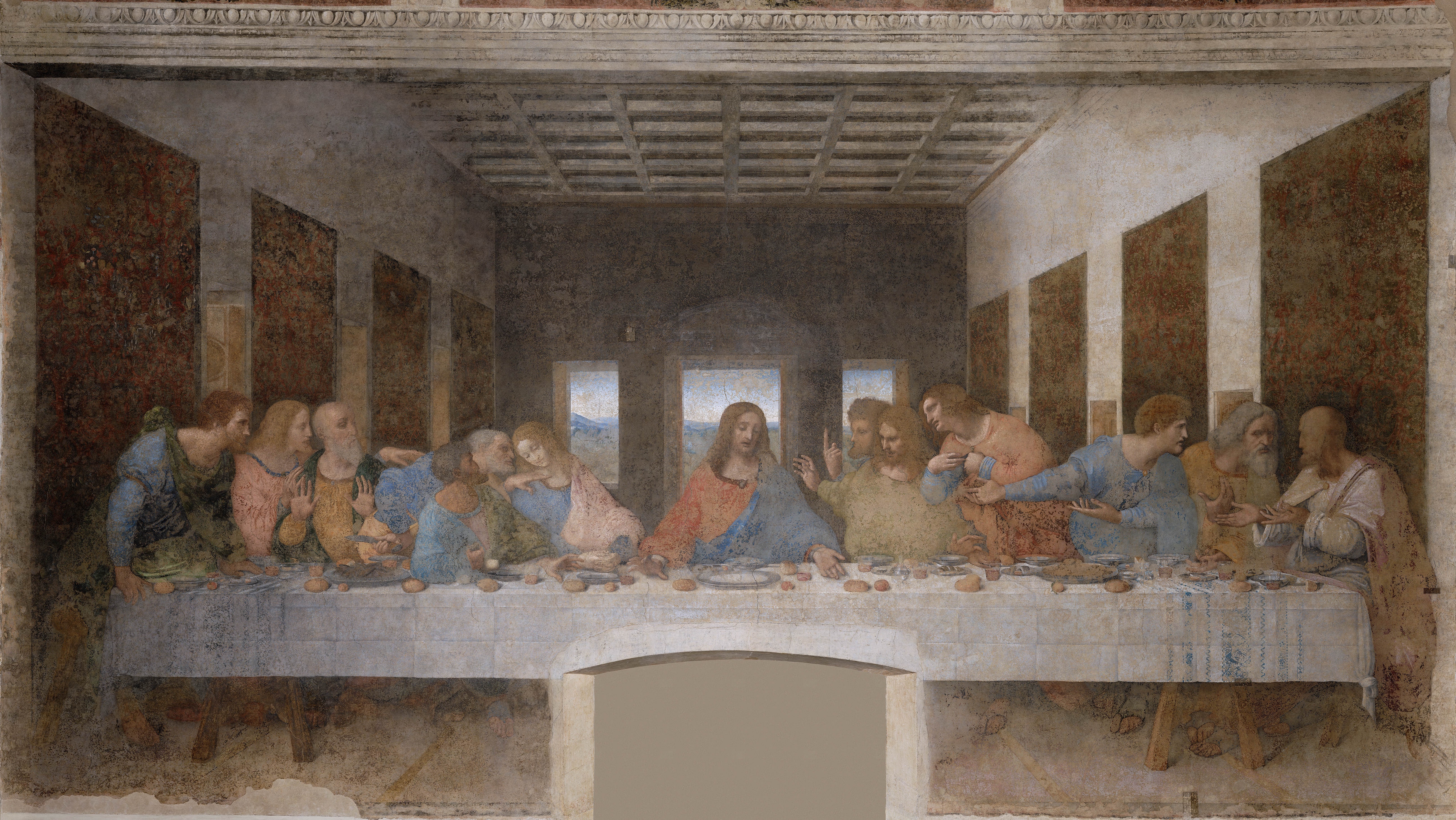
Holy Week - the Lord's Supper


image source: https://en.wikipedia.org/wiki/The_Last_Supper_(Leonardo_da_Vinci)

1 Corinthians 11:23-26
For I received from the Lord what I also handed on to you, that the Lord Jesus on the night when he was betrayed took a loaf of bread, and when he had given thanks, he broke it and said, "This is my body that is for you. Do this in remembrance of me." In the same way he took the cup also, after supper, saying, "This cup is the new covenant in my blood. Do this, as often as you drink it, in remembrance of me." For as often as you eat this bread and drink the cup, you proclaim the Lord's death until he comes.

Each church practices their Lord's Supper remembrance a little differently. Some use regular bread while others use unleavened bread. Some use grape juice while others use wine. Some churches conduct it weekly and others monthly. The Lord's Supper can also be called Communion and others call it the Eucharist. In some churches, only the pastor or priest can handle and serve the elements while in others it is passed from participant to participant.

Regardless of all the variations on how the ritual is performed, the core of its meaning is remembering what our Lord Jesus has done for us.

Think about how many facets of the Christian story is embodied in this practice?

We see the humanity of Jesus. He dwelt among us. He ate food. For the disciples and various followers who knew Jesus, he was as real as real can be. They heard the sound of his voice, they could see his facial expressions, they could feel his hands when he touched them to bless them or heal them. They could taste the water that he had turned into wine, they could enjoy the five loaves and two fish he multiplied. The aroma of the ointment used to anoint his feet would float through the room. He was as real as real can be.

And he died.

That is ultimate expression of the human condition. He was as real as real can be.

For as often as you eat this bread and drink the cup, you proclaim the Lord's death until he comes...

Let's lean into this. In this statement is bundled a whole lot. A whole slew of "theological" SAT words can be used to unpack this simple phrase:
Christology - the humanity of Jesus in the incarnation, the divinity of Jesus in his title as Lord
soteriology - salvation is the mission of Jesus of which death, resurrection, and return is included
ecclesiology - the story of the church that is to remember Jesus and to proclaim Jesus to the world
eschatology - future things as Jesus is coming back

All of this meaning built around the simple act of taking some bread and some wine. Getting down into the very basics, we eat food and drink fluids to survive. But the Lord Supper points to life abundant and not mere survival. And so Jesus has invested into this simple ceremony a way for us to remember the reality that eternal living - a relationship with God - is possible because of the free, complete, and costly work of Jesus.

We remember.

Holy Week Reflections - Suffering and Vindication


image source: https://en.wikipedia.org/wiki/Isaiah

Isaiah 50:4-9a,
The Lord GOD has given me the tongue of a teacher, that I may know how to sustain the weary with a word. Morning by morning he wakens - wakens my ear to listen as those who are taught. The Lord GOD has opened my ear, and I was not rebellious, I did not turn backward. I gave my back to those who struck me, and my cheeks to those who pulled out the beard; I did not hide my face from insult and spitting. The Lord GOD helps me; therefore I have not been disgraced; therefore I have set my face like flint, and I know that I shall not be put to shame; he who vindicates me is near. Who will contend with me? Let us stand up together. Who are my adversaries? Let them confront me. It is the Lord GOD who helps me; who will declare me guilty?

Over the years, have not read too much of the OT prophets. One of the things I have found challenging at times is knowing when is God speaking and when is the prophet speaking? In this passage, since God is referred to in the third person, I figure Isaiah is speaking.

Isaiah declares that he has tried his very best to do what God wants. We know from Isaiah 6 that he knows he is a flawed man but he one who has experienced God's forgiveness. He enters God service and suffers for his obedience. But through it, he remains confident in God for his vindication.

I was recently reading Job and I found his situation to be similar. He was recognized as a righteous man by God in Job 1. Yet he suffered. And his friends in the various speeches in Job think he has secretly sinned leading to his suffering. Job's story is a window into the struggles of a faithful man trying to make sense of his situation. He puts into words what many have felt and do feel looking at the world where injustice appears to have the upper hand. Yet, amidst all this, Job is still wrestling with God. He won't stop talking to him and about him. He is honestly pouring out his heart in sorrow, anger, and confusion. Underlying it all, he was seeking vindication that comes from God.

In Holy Week, Jesus was headed toward the culmination of his vocation. He is a righteous man who has suffered. One can imagine the circumstances of his birth resulted in behind the back whispering. Perhaps, some of the commentary was not so behind the back! In his ministry of teaching and healing, he runs into opposition. Some even say his good deeds are done with the power of Satan! Things come to the collision course in Jerusalem. He is betrayed by one of the disciples. His closest followers abandon him at his arrest. He is headed toward the cross.

Jesus all his life opened his ear to the Father and was not rebellious but fully obedient and dependent on the Father. He was insulted and struck down by those who call for his crucifixion and those who conduct the crucifixion. In the eyes of the world he was disgraced and put to shame with a death on a cross, the punishment for criminals. But on Easter Sunday, he was VINDICATED by RESURRECTION and the Father has exalted him!

As one who is trying to live for God, I'm wrestling each day to put off my old self and put on the new self. I cannot claim the fidelity to God like Isaiah and Job. But I can receive the work of Christ on my behalf. I can yield to the work of the Spirit to empower and guide my life. In addition to my internal struggles, there is the external world with its difficulties and its opposition that I live in. Christ's Easter Sunday and vindication has happened. It is applied to us and to me by grace through faith. Our life experience is still on this side of our ultimate vindication. But that vindication is sure and it impacts life now and it was made possible by the free, complete, and costly work of Jesus that we remember this Holy Week.

May we have the same kind of trust and confidence as Isaiah to be able to say:
The Lord GOD has given me the tongue of a teacher, that I may know how to sustain the weary with a word. Morning by morning he wakens - wakens my ear to listen as those who are taught. The Lord GOD has opened my ear, and I was not rebellious, I did not turn backward. I gave my back to those who struck me, and my cheeks to those who pulled out the beard; I did not hide my face from insult and spitting. The Lord GOD helps me; therefore I have not been disgraced; therefore I have set my face like flint, and I know that I shall not be put to shame; he who vindicates me is near. Who will contend with me? Let us stand up together. Who are my adversaries? Let them confront me. It is the Lord GOD who helps me; who will declare me guilty?


Temple Destruction in AD 70 In Context

As someone sitting in the 21st Century, reading that Jesus forecasted (in ~ AD 33) the destruction of the Temple (see Olivet Discourse Matthew 24, Mark 13, Luke 21) probably doesn't conjure up the full impact of the event that took place in AD 70.

The picture in my head would be of a temple for any number of Asian Eastern Religions found in Chinatowns in any large city in the USA. These buildings can be quite well built but they probably don't match up to the size and grandeur of the Temple of Jerusalem. Additionally, for the Jews of the ancient world, beyond the sheer size and grandeur of the Temple of Jerusalem, it was a singular structure, truly at the center of their religious beliefs and practices and identity as a people.

Of course, if one extends the search for religious structures worldwide, one can find some pretty spectacular structures. A Google search for Buddhist temples yields this tourism web page that has wonderful photos of what they consider the 10 most spectacular Buddhist temples. While at it, the same tourism web page has fantastic photos of the 10 most notable Hindu temples.  An architect offers his opinion of the 10 cathedrals you should see before you die and here is a list of 10 mosques.

However, relative to the Temple of Jerusalem which was the HEART of the people of Israel's faith, these don't compare. They may compare in terms of beauty and the grand scale of a structure but in terms of significance to an entire group of people there would be no comparison.

What did the Temple look like?

Since it was destroyed, one can only attempt to recreate it based on Biblical and historical documents that described it. And a model was built that resides at the Israel Museum. See photo below from Wikipedia.

Jerusalem Modell BW 3

Does all this context help us understand how traumatic Jesus' prediction of the Temple destruction would be to those who heard it?

However, it was more than just the destruction of a building. The events surrounding it also meant the ending of the Jewish nation of that time and was accompanied by deaths that may have exceed one million.

The Long Life of the Genesis Patriarchs?


Image from p. 12 of the 1995 edition of Spirit Filled Life Bible for Students.

Ever wonder about those people in Genesis who lived a long time?

Certainly, those who take the Scriptures seriously have to grapple with how we should view these texts.

One option would be to suppose that there was something different about the environment of those times or something different about the humans of those times or some combination of both that fostered the longer life spans. From this perspective, the great age of these individuals are taken at face value.

However, could one offer an explanation that takes the integrity of Scripture seriously and yet acknowledges that people rarely live beyond 100 years of age and certainly not many centuries beyond 100 years as the Patriarchs seem to?

One of the principles of Bible interpretation is to recognize the GENRE of the particular text being examined. Thus, is it possible that these long-life recitations fall into a genre that is non-literal?

Was chatting with a friend who is very interested in the Old Testament suggested that this might be the case. Apparently, in the ancient Middle East, other cultures of the time also had documents that claimed people who lived a very long time. For instance, the Babylonian kings. 

Of course, we can only speculate as to what is going on. Scholars suggest that these exaggerated life spans was a way to (1) highlight the greatness of those people, (2) account for the fact the historical memory of ancient events encompassed more years than they could accurately account for, and (3) the inflated numbers were keyed to numerology of the culture.

Thus, could the Genesis genealogies with extended life spans be of that same genre?

A case could be made that there is a "mythic" quality to the accounts of Adam until Abraham. One definition of myth is a fanciful untrue story. However, as a literary style, a myth is a non-literal explanation of reality. And indeed, that is one of the purposes of those early chapters of Genesis. They are attempts to describe how things came to be with particular emphasis on the relationship of God and humanity, God and the creation, and humanity and the creation.

As for numerology in these texts, the one that jumps out right away is that there are 10 generations from Adam to Noah and 10 generations from Noah to Abraham. Because of this, some interpreters have suggested that from Abraham onward, the writing is more historical in the sense we understand literal history and the material prior to Abraham is more mythic in the genre sense of non-literal history.

The challenge of the numerology explanation is the ages specified for the various people in these genealogies. However, the lack of clarity on what the "key" is doesn't change the impact of these texts to describe the reality of the human condition.


Aging Parents - Random things from this season of life, part I

A handful of years ago, I entered the phase of life of helping out in looking after aging parents.  At this moment in 2024, my dad passed on...