Showing posts with label science. Show all posts

Covid19 fatalities and median age of nations

Heard on a podcast that some hypothesize that many of the poorer countries have weathered Covid19 without too much trouble (unlike USA and Europe) because they have younger populations and thus they have relatively mild cases from the infection. Thought I'd take a quick look at the "Our World In Data" web page to see if that seems plausible. Am using the data listed as 2022-02-06 and from nations with at least 1 million people. 

The bar graph divides the nations into those with median population age < 30 (n=83) and > 30 (n=73) and takes the average per capita fatalities. Difference was p < .0001. 

As you can see, the average of per capita Covid19 deaths in nations with median age of population > 30 are higher compared to those nations with median age < 30.

The scatter graph is a simple linear regression and the R^2=0.3404 with a p < .0001 and this level of R^2 would be considered "moderate" strength by some statisticians.

Correlation of median age of nation (x-axis) with Covid19 per capita deaths (y-axis) shows an upward trend line indicated a positive correlation.

Of course correlation is not causation but we know from CDC data that majority of the fatalities in the USA have been in the older population as seen in the table.


COVID19 - a quick look at the numbers as of April 27, 2020

It is day 40 in California as the lockdown was declared on March 19.

Where are we now?

Here is a screen capture of the death per 1 million over at Real Clear Politics.

The first screen grab is a partial list of nations. Italy was hit hard very early and then Spain followed. Since Belgium is a rather small country it hasn't made the news, but relative to population, it has been hit very hard. The USA number though terrible indicate it could have been much worse. There undoubtedly will be many studies as to why some countries got struck so severely while others fared better. From media reports, the sense is that Italy was the "perfect storm" of the high density of the cities in northern Italy, the age of the population, and the slow initial response. Whether this set of circumstances will account for some of the other hard hit countries remains to be seen.


Meanwhile, in the USA, the states in the northeast had death rates comparable to Italy/Spain/Belgium with New York exceeding the worst of Europe. There will be many studies and second guessing as to what resulted in the calamitous march of COVID19 in the northeast USA in particular New York and New York City. Most pundits have cited the high density of New York City and the large numbers of international passenger travel.


The fatality rate of COVID19 remains a moving target. The number often cited for flu is 0.1% of people who get the flu die from the flu. Thus, in the USA, a nation of about 330 million, if 30 million catch the flu during a typical season, 30,000 may die of it. If you look at the CDC estimates, from 2010-2017, the range was 12,000 to 51,000. Flu viruses are constantly mutating and some years it is more dangerous than others. Additionally, in some years the mixture of strains put into the flu vaccine design is more effective and sometimes less so.

But what is the fatality rate for COVID19?

We don't know.

According to John Hopkins COVID19 dashboard as of April 27, there were 3 million cases worldwide with about 211 thousand deaths. That is a 7% fatality rate. However, it is generally acknowledged that testing is not robust enough at this time to really get a fix on the fatality rate. What happens is that the tests are generally given to people who have some symptoms or are at risk (medical personnel). Thus, the figure is very likely to be overstated.

Also, likely to lower the fatality rate is the hypothesis that a certain percentage (currently unknown) of the population got COVID19 but they either had no symptoms or the symptoms were mild such that they never got tested. This could explain how the disease spread so rapidly as people unwittingly passed it onto others.

As a government official setting public health policy, the fatality rate estimate - really a guess back in March - drove the decision making. If you need to decide for Los Angeles County, a region with 10 million people, what do you do?

If you think 10% of the population is going to catch COVID19; then, 1 million people could get sick. If you think the fatality rate is 1% (10x worse than the flu), then 10,000 people will die. If you are working with numbers in this range, you are going to lock everything down and hope for the best.

But if your public health team thinks that only 4% will get COVID19 as this very small study shows (1). Thus, 400,000 gets COVID19. And what if the fatality rate in your projection is only 0.2%, worse than the flu but not astronomical? This scenario yields 800 dead. If you think these are the "facts" on the ground back in March, you probably don't go for a total lock down (2)?

As of this writing, the LA County reports 942 deaths attributed to COVID19. LA County death per day is declining so the number will go up but not dramatically so. Thus, perhaps COVID19 infection rate might be a bit higher than 4% and the fatality rate might be a bit higher than 0.2% yielding a situation that is akin to a bad flu. But the government officials didn't know this back in March when the orders to lock down were issued. How much worse it would have been if there was no lock down is unknowable.

But what about New York City, I don't think anyone imaged it was going to get that bad!

New York City is currently estimating death at 17,000. New York City population is about 8.4 million. What happened there? How do you get that many fatalities? The population infection rate must be much higher in NYC? Perhaps, for some reason the fatality rate is higher?

Some scenarios:
40% infection + 0.4% fatality = 13,440 deaths
30% infection + 0.6% fatality = 15,120 deaths
50% infection + 0.4% fatality = 16,800 deaths
60% infection + 0.3% fatality = 15,120 deaths

It will take many more months of investigating to piece together what happened in New York City and places where the COVID19 swept in with such deadly force.

Given the limited information at hand, if I had to guess the fatality rate of SARS-Cov2/COVID19 will turn out to be higher than the typical flu, perhaps around 0.3 to 0.6% (3), and what will turn out to be the driver of fatalities is a high infection rate due to unique features of the locality in question.

UPDATES:
Decided to add a few things after thinking more about what I posted last evening.
(1) Some scientists have called into question the antibody kit used in the study as not fully validated and await better characterized kits and larger numbers in the test population. Will better test kits reveal higher or low percent infection in the general population?
(2) The "what if" we don't know is what the infection rate would have been without the total lock down? In Los Angeles County, if the number rises to 8% infection with 0.2% fatality, then you have 1600 deaths. If you are on the board of supervisors and that is what your public health people tell you, what do you do? It all comes down to the "best guess" at the time about infection rates and fatality rates and how many people is it "tolerable" to lose to the virus. Scale the infection percent and fatality percent to higher numbers and the impetus to lock down becomes very strong.
(3) One could also suspect specific vulnerable populations will be looked at. The fatality rate might turn out to be quite "low" for the population as a whole. But what is the fatality rate when it hits a nursing home? Or an apartment building with a higher percentage of senior citizens? And there will definitely be studies on health disparities in poorer communities that may have a much higher fatality rate. Populations aren't homogeneous. There will be more to the data than just simple density of people in a community.

Monocle 3 install on Mac

Was attempting to install Monocle 3 onto a iMac.

Got stuck trying to install the leidenbase package.

Found a solution here at https://github.com/cole-trapnell-lab/leidenbase/issues/6

The program needs gfortran so went ahead and installed it from https://cran.r-project.org/bin/macosx/tools/gfortran-6.1.pkg

Was then able to proceed to the next step in the installation and am now trying out the various Monocle 3 tutorials!

Larry Shapiro and John Lennox in conversation "Is there truth beyond science?"


A lively, honest, and friendly conversation between a classical Christian (Lennox) and an atheist (Shapiro) held at the University of Wisconsin.

People engaged in our current political discourse could learn a lot from these two gentleman and scholars about how to talk about things where there is disagreement.

In our 21st century world, there are people who don't think there is even such a thing as truth. On this point, they both agree that there is such a thing.

On the question of whether truth can be found outside of science, I think they would both agree on that point as well. They both point out that science as a method is very good for understanding the natural world. However, our lives have aspects that are more than just the natural world - morality, purpose, meaning, etc.

Where they do part company is whether or not God is in the equation of our grasping of truth. Shapiro does not think there is enough (or perhaps even any) evidence for the existence of God. In an interesting segment, he asks how would one distinguish "god" from a powerful alien from another planet or a "flying spaghetti monster."

Lennox's response was that the claims of Christianity exist within a long historical narrative framework that can be assessed by human reason.

The podcast is about 90 minutes and a worthwhile listen if you are interested in such things.

P.S. If you find these types of conversations interesting, be sure to check out Bishop Robert Barron (Catholic Christian) and Professor William Lane Craig (Protestant Christian) discuss faith, science, and society. In this discussion there was much more agreement between the two speakers (compared to Lennox and Shapiro) but the same friendly honest approach. There was a short segment on the differences between Protestant and Catholics but both emphasized that the common ground is so large. One could also see some differences in emphasis and style but the centrality of Christ was the guiding light in their presentations.

Update: found the video for embedding (1/25/2018)

40 years of Voyager 1 and Voyager 2

Looking forward to seeing the documentary this coming week at PBS August 23, 2017 9/8c!


Read more about Voyager at the JPL-NASA web page.


image source: https://www.jpl.nasa.gov/voyager/assets/images/news/planets-16.jpg

CRISPR/Cas9 gene editing

The hot new technique in molecular biology is CRISPR/Cas9.

The URL has a longer form explanation with diagrams.

The really short description is as follows:

The CRISPR/Cas9 technique takes advantage of a particular way bacteria chop up foreign DNA. This mechanisms has been adapted to facilitate disruption of targeted sequences in model organisms such as mice and zebrafish.

Let's say one wants to disrupt gene P.

Research findings have identified rules that govern the location of the targeting such that one can design a short sequence of DNA that will bind to a specific target site within gene P. In the design, in addition to the target sequence, a guide sequence that will bind the Cas9 enzyme is included contiguously.

Thus, this sequence (1) binds to the target site on gene P and (2) permits the guide sequence to tether Cas9 to that target and Cas9 cuts the target DNA sequence.

After the sequence is cut, DNA repair enzymes enter the picture to fix the lesion. The repair is not perfect introducing some combination of sequence deletions or insertions. The exact nature of the repair is assessed by DNA sequencing technology to see if the desired mutation has been introduced.

This technology also permits the introduction of desired sequences into the disrupted gene in a modification of this procedure.

One can search the internet for many explanations and diagrams of this method.


Installing GNU Octave 3.8.0 on Mac OS 10.10.2

In the lab, I occasionally run Matlab scripts through Octave for some scientific calculations pertaining to my work on vitamin D. With a new desktop in the lab running OS 10.10 Yosemite, I had to reinstall Octave. The previous desktop was running 10.6 (snow leopard).

I fetched GNU Octave 3.8.0 from SourceForge and attempted to install. Unfortunately, the system didn't want to install it since it didn't come from the Apple App Store.

I opened the README.txt file in the install window and found this advice:
You may need to override Gatekeeper to allow installation of GNU Octave 3.8.0 on OSX 10.9 (Mountain Lion). You may find instructions about how to do this on this page: http://support.apple.com/kb/ht5290 in the section labeled "How to open an app from a unidentified developer and exempt it from Gatekeeper".

I figure OS 10.10 might have the same work around. Indeed, that was the case.

I opened up the recommended Apple support page.

Control-mouse clicked on the GNU Octave install icon and clicked "Open" which generated the dialog box as pictured in the Apple support page and clicked "Open" in that box and voila, the thing started to install.

There is a considerably more complicated set of instructions in Octave for MacOS X. I don't know if the results are the same or not but Octave is now running on my desktop using the simpler procedure.

Hope it helps you if you are in the same situation!

In memoriam: Kuan-Teh Jeang, 1958-2013

Earlier this week, I was working on slides for our departmental research seminar where I would present results from our collaborative research project we have with a clinical group at the Children's Hospital of Philadelphia. The talk was informatively if dryly titled, "Immunomodulatory Effects of Vitamin D3 Supplementation in Children, Adolescents and Young Adults with HIV/AIDS." As I prepared, emails starting arriving in my inbox from all over the world with news of the sad and sudden death of Kuan-Teh Jeang. I decided to include some brief remarks at the beginning of the seminar. I hope in some small way these thoughts could honor Teh's memory and encourage the young researchers in the audience. Text of what I shared this morning are below.
Before I start today’s seminar, I would like to offer some brief remarks in memory of Kuan-Teh Jeang who died last Sunday, January 27 at age 54. I was a post-doctoral fellow in his lab at the NIH from 1993 to 1997 working on the molecular biology of HIV.

This photograph (shown above) is from 2012 when he gave the George Khoury lecture in October. This named lecture was started at the NIH in 1994 to recognize the highest levels of scientific research and to remember Dr. Khoury who was one of the bright stars of the NIH who died much too soon. It should be noted that Teh started his scientific career as a post-doctoral fellow in George Khoury’s lab about 25 years ago. And so giving the lecture was both a tremendous scientific and personal occasion for Teh. Who could have known that three months later another one of NIH’s leading lights would pass away much too soon. Suffice to say, Teh’s scientific accomplishments in the field of the molecular biology of human retroviruses were numerous and are best detailed in official remembrances of his life.

I’ll simply say, it was a tremendous honor to work at the NIH for those four years. Teh was the energetic and tireless leader of our research group dedicated to peeling back what was unknown about HTLV and HIV. On a personal level, since our group was composed of post-docs who came from far and wide from Washington DC, he generously gave personal attention and practical help to us, his incoming post-docs. Those simple kindnesses helped us settle into our lives in and around Bethesda.

May God rest his soul and comfort his wife and three children who remain.
Remarks by Michael Gottesman at Retrovirology.
Post at BioMedCentral.
Comment from Journal of the International AIDS Society.
Statement at Cell and Bioscience.
Notice at the NIAID/NIH web site.

As part of the network of lab alumni, I've received notice that two longer recollections will be published at Cell and Bioscience and Journal of Biomedical Sciences. I will link to them when they go live.

UPDATES:
Obituary at Journal of Biomedical Sciences.
In memoriam at Cell and Bioscience.
Editorial item at Cell and Bioscience.

Science: How does high speed DNA sequencing work?

Every wonder how something works? With all the talk of personal DNA sequences and other leading edge sequence based research methods, I wondered, how do you do high speed DNA sequencing? In Google searches, I found various text descriptions of how they work but couldn't get my head around what they were saying. Finally, hit a link to a youtube video and voila, it makes sense to me now!


Its amazing!

How it works is a synthesis of multiple technologies:
Molecular biology methods to make the DNA samples and extending the strands
Nanotechnology manufacturing of flow cells with capture sites
Fluorescence chemistry
Digital image capture technology
Computing power to turn the captured images into sequence data

Science: The task of a scientific publication reviewer

One of the professional community service responsibilities of a scientist is to review articles submitted for publication. There aren't any formal classes on the process. Most of us learned to do it by seeing it done by more experienced reviewers.

A recent Google search turned up this article.

I thought it offered a good perspective on the process and summarized into 10 rules.

I suppose their Rule 4: As a Reviewer You Are Part of the Authoring Process has been my main guiding principle.

When someone in our research group writes a paper and circulates it for comments, our task is to look for gaps in the data, unclear explanations to be cleaned up and over-reach/flaws in the conclusions. The goal is improving the paper. And so, as a reviewer, I try to have that mindset.

I also found Rule 3: Write Reviews You Would Be Satisfied with as an Author to be crucial in finding the right tone of voice. Being at the receiving end of sarcastic reviews or reviews that make you wonder if they read the paper is very frustrating. Even though the vast majority of journals use blinded reviews, I think a good attitude to take is to write the review as if the authors of the submission would find out who you are.

Science: Looking at some data regarding global warming

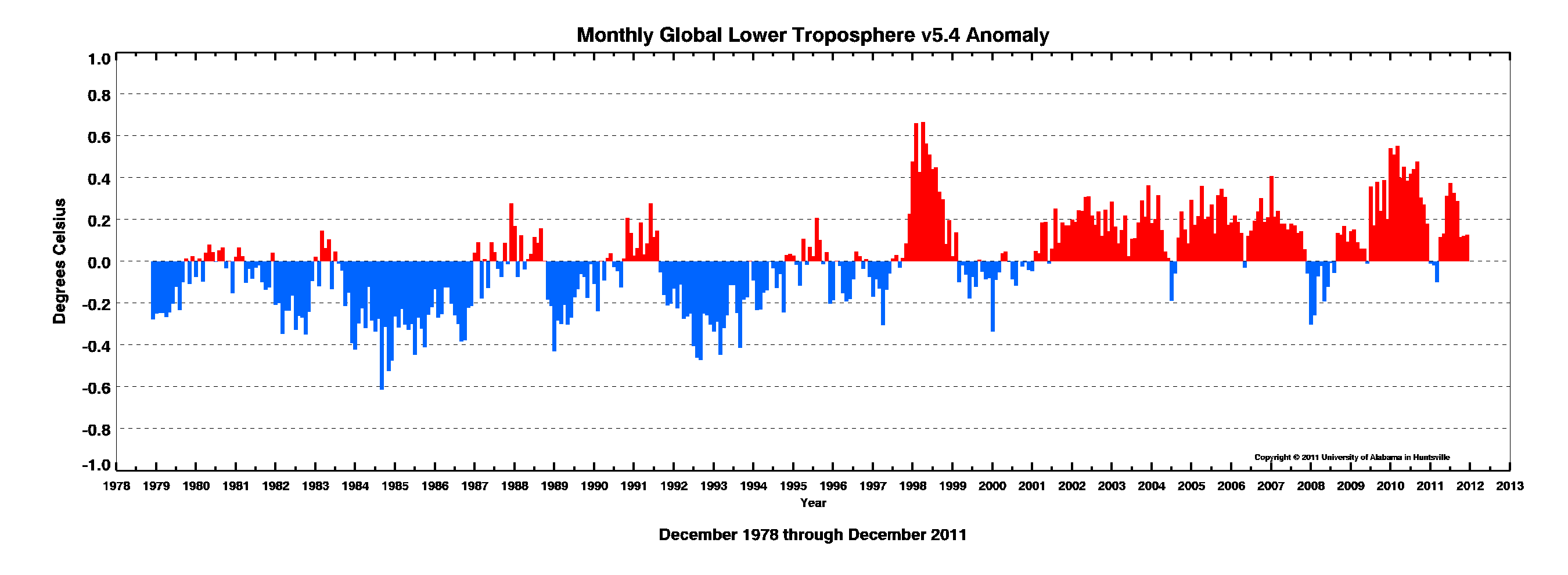
According to this article, one of the methods of assessing global temperatures is by satellite detection of O2 vibrations.

The web site that archives the readings is located at the University of Alabama in Huntsville Earth System Science Center.

To see a graph of the data they have been collecting.  Or click on the image below.


The data has only been collected since 1978.  In the grand scheme of the age of the earth, this is almost nothing.  Since industrialization (around 1800), this represents about 16%

There other data regarding the question of global warming is greenhouse gases of which CO2 gets the most attention.

There are the measurements of greenhouse gases at various sites compiled at Cape Grim in Australia since 1976.


Obviously, these two bits of data aren't the only things to consider in the question of global warming.

One can say that CO2 levels are rising.

One can say the last decade has seen above average temperatures as measured by O2 vibrations though the actual rise is somewhat modest.

Additionally, the fact that the prior decade was below average suggests CO2 levels and temperatures at least in this time scale do not directly correlate.

One might say CO2 levels help drive temps up but other forces might drive them down and in the past decade the up side has been stronger.

Looking at the basis of the temperature graph more carefully, the y-axis is based on the differential relative to the average temperatures from 1979-2011 so what is informative is the slope of the line since the beginning of the data collection (see the Dec2011GTR pdf file at UAH archive).  If I'm using my Excel program correctly (forecast function) on the annual numbers from the Dec2011GTR.pdf file), one can obtain a line through the dots with a slope of 0.014C/year.  Thus, if the rate of change remains constant, 100 years from now, there should be a 1.4C rise in average surface temperatures relative to the average over 1979-2011.

I suspect the one key to understanding the issue is to understand the field of paleoclimatology - studying what temperatures were like on earth in historic time scales - and thus relying on temperture and CO2 readings established by other methods than what we have seen in the graphs above.  And the other key is the modeling to project into the future what the temperatures might be.

Science: Vitamin D and Math Modeling

As a molecular biologist, I work on trying to better understanding the actions of vitamin D.

A few years back, we established a collaboration with a mathematician to see if there might be some way of looking at the problem from that angle.  Click the link below to see the result!

Vitamin D Binding Protein and Monocyte Response to 25-Hydroxyvitamin D and 1,25-Dihydroxyvitamin D: Analysis by Mathematical Modeling

Science: BPA Concerns May Have Been Overstated

One of the things about belonging to a professional society is that one can receive occasional news round-ups of items that might be of interest.

As someone who likes hiking, I heard about BPA in the context of Nalgene deciding to shift the making of their water bottles to plastics that do not contain BPA.

In their BPA FAQ Nalgene said this:
We are confident that the bottles which contain BPA are safe for their intended use. However, because of consumer requests for alternative materials, we have decided to transition our polycarbonate product line to Eastman Tritan™ copolyester. This product joins our family of bottles and containers made of various non-BPA materials such as HDPE, PP, LDPE and PET.
...
Based on the findings of the Food and Drug Administration, The Environmental Protection Agency, The European Food Safety Authority, The German Federal Institute for Risk Assessment, The Japan Ministry of Health, Labor & Welfare, The American Plastics Council and other reliable sources from around the world, we continue to firmly believe in the safety of our products containing BPA. However, we intend to carefully monitor the results of the National Toxicology Report and the Canadian government’s inquiry into this issue and any other relevant scientific information.


In a recent email news update from one of the scientific professional societies, there was a link to this item about BPA.

Excerpt:
“In a nutshell, says Teeguarden, “we can now say for the adult human population exposed to even very high dietary levels, blood concentrations of the bioactive form of BPA throughout the day are below our ability to detect them, and orders of magnitude lower than those causing effects in rodents exposed to BPA.”

The study was entirely funded by the Environmental Protection Agency (EPA), while the analytical work was duplicated by two other government laboratories to ensure extra rigor. The researchers used the latest and most sensitive techniques to find BPA as determined by the CDC (LC/MS/MS using on-line 2-dimensional liquid chromatography if you are curious). Moreover, the new study corroborates earlier independent studies which showed that BPA was rapidly absorbed, detoxified, and eliminated from humans.


I don't know how widely reported this study will be. But I pass it along via this blog to those who might have concerns about BPA. From a business perspective, does this mean BPA will once again be used?

As it is now, my current hiking water bottles are of the newer Nalgene BPA-free variety. Hopefully, there isn't some other chemical in those plastics that might be the subject of investigation in the future?!

Science: How much vitamin D to take?


Recently, the Institue of Medicine issued a report on vitamin D.

Some in the research community disagreed with their recommendations.

Disclaimer: My research projects are in the realm of assessing the role of vitamin D on immunity. I personally take 2000 IU/day.

Science: Contrarian views on Global Warming

Saw this item about Bjorn Lomborg who believes global warming is occurring and that humans cause at least part of it. However, he is doubtful of the worst case scenarios proposed by some climate change advocates and thinks the money used fighting global warming could be better spent on other things.

Excerpt:

Lomborg believes that the world climate summits held in Rio, Kyoto, and Copenhagen over the last 18 years have been futile, because no country—especially such rising powerhouses as China and India, just now emerging into prosperity—will agree to cold-cock its economy in order to join the wispy Western global-warming crusade. And he claims that since the $250 billion the European Union spends every year to combat warming will ultimately reduce temperatures by only one-tenth of one percent, that money would be better channeled into worldwide battles against malaria and AIDS—diseases that are killing people right now—and into funding new climate technology.

Science: Natural Obsessions and Naturally Obsessed

What is it like to be a molecular biology researcher?

Most movies have scientists in the form of the "mad scientist" or the "nerd scientist."

But what about a realistic portrait of the life of the average lab researcher?

When I was a graduate student, Natural Obsessions was the book that told the story of our profession.

For this generation, Naturally Obsessed is a one-hour documentary that attempts to capture the life of the lab. I hope to see it on Netflix at some point or if it gets shown on TV or some other venue.

The titles of the two works say it all.

To be a research scientist requires a certain level of smarts.

But a lot of people are smart and many even smarter who do other things and rightly so.

What lab research requires most is persistence and dogged determination that borders and crosses the line into obsession. It requires the willingness to try again an experiment a little differently. It requires the drive to look at the data that extra dozen times to find out what went wrong and what went right. It requires drawing up models to explain the data and then ruthlessly ripping it up for flaws. And after doing that going back to the data and trying another model that looks at the problem sideways.

No, there won't be a TV show called, LA Lab nor a soap opera called General Research Unit or Gray's Biology but our story is being told.

If you want to see if passion and reason can be combined, then talk to a research scientist.

Science: Climategate and questions I would want to have answered

Yes, Drudge can add sensationalized headlines to items and highlight odd stories.

But most of the time, he just links to articles that he thinks are interesting.

And so he links to an item that says Al Gore was confused on the emails regarding the "Climategate" scandal.

From that item, there are links to various web pages that highlight why some people are skeptical of man-caused global warming.

The daisy-chain as Dennis Prager points out is as follows:
(1) human activity produces CO2
(2) there are temperature increases
(3) CO2 increases lead to temperature increases
(4) temperature increases will result in calamity.

This is what I would want to know:
Statement #1 is probably true. But in the history of the planet has there been times when CO2 were higher than the are today which would have occurred without human activity?

Is statement #2 actually true? Modern technology gives us good temperature data from many locations. But that is using current technology. How good is the data when you go back into history? How do you figure out the temperature when nobody was sitting around with thermometers to measure it?

Is statement #3 actually true? In science there is causation and correlation. Is CO2 the cause of temperature increases? Or are temperature increases the cause of CO2 increases? Or is there some other factor driving the temperature like solar activity?

Statement #4 would be true if we get many degrees of increase in temperature. In the past, there have been ice ages when temperatures dropped which would be bad too! And in the past, there have been much warmer temperatures. So the question is, how many degrees will the temperatures rise, if indeed they are rising? There is a huge difference between global warming of 1 degree C versus 6 degree C.

I'd also want to know why man-made global warming advocates dismiss skeptics by saying they make money from energy companies (I'm sure some do but probably don't) when it could be said that global warming researchers make money from grants studying global warming?

This last question is rhetorical but the previous ones are real questions I'd have about the science of climate change.

UPDATE: Prager rounds up latest problems with global warming in regards to Himalayan glaciers melting.

Science: CCD & Fiber Optics researchers honored with Nobel Prize

2009 Physics Nobel Prize has been announced today.

We use the technology recognized by the committee every day!

Fiber optics are the backbone of telecommunications and CCD chips are what make digital cameras work to capture the moments of our lives. Thanks go to Charles K. Kao, Willard S. Boyle and George E. Smith for their work that help us "stay in touch" and "keep our memories" in photos!

The day before, the Nobel Prize for medicine was given for work on telomeres which are on the ends of chromosomes. These telomeres in most cells degrade over time so cells age and eventually don't divide. Not surprisingly, this system is altered in cancer cells opening up another avenue for investigation. Congratulations to Elizabeth Blackburn, Jack Szostak and Carol Greider for their work!

Science: Francis Collins nominated to NIH directorship

Francis Collins who ran the NIH's human genome project appears headed for the big chair to run the NIH which has a $40 billion budget ($30 billion + $10 billion in the stimulus package).

If you are curious how that money is broken up into the various units that comprise the NIH, go here. The National Cancer Institute (NCI) and the National Institute for Allergy and Infectious Diseases (NIAID) continue to be the top two.

Science: WHO declares pandemic

It's official.

Excerpts:

GENEVA - The World Health Organization has told its member nations it is declaring a swine flu pandemic - the first global flu epidemic in 41 years.

The move came Thursday as infections climbed in the United States, Europe, Australia, South America and elsewhere.

In a statement sent to member countries, WHO says it decided to raise the pandemic alert level from phase 5 to 6, meaning that a global outbreak of swine flu has begun. The decision was made after the U.N. health agency held an emergency meeting on swine flu with its experts.
.........
In Edinburgh, Sturgeon told lawmakers that a WHO announcement means countries should immediately activate their pandemic plans.

"A move to level 6 is not a verdict on the severity of the virus," she said. "It simply means that the extent of global spread now fulfills the definition of a pandemic."

It would be the first flu pandemic in 41 years, since the Hong Kong flu of 1968.

As long as there isn't a mutation increasing the lethality of the virus, this move appears to sound worse than it actually is.

Stay tuned.

Aging Parents - Random things from this season of life, part I

A handful of years ago, I entered the phase of life of helping out in looking after aging parents.  At this moment in 2024, my dad passed on...