I've understood in the abstract that if you can turnout your voters you can win.
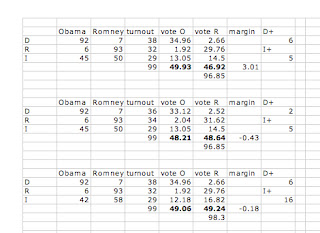
From the election day numbers, there was a D+6 turnout and Romney took independents by 5 and President Obama won re-election handily.
Show me the numbers:
Plugging in the numbers described above along with some other bits of information I've heard regarding the exit polls, you get a 3% win.
How much would the turnout need to change in order to tip the balance?
Scenario 2 has D+2.
If you had scenario 1 (D+6), how many independents would you need to win to change the outcome?
That is scenario 3 where Romney would have won if he could win independents by 16%.
Suffice to say, it is probably easier (though not easy) to bring the D+6 down to D+2 than to move independents from +5 to +16!
Now, I can see why they say, it is all about turnout.
Rambling about soccer: LA Galaxy, IF Elfsborg, Falkenbergs FF, Liverpool FC, Queens Park Rangers, and LAFC. Also random rambling about Star Trek, LA sports (Dodgers, UCLA, Kings, Lakers, Rams), politics (centrist), faith (Christian), and life. Send comments to rrblog[at]yahoo[dot]com.
Showing posts with label POTUS 2012. Show all posts
Politics: The Day After the Election, Part II
As an observer of the political process, I spent the last week making a series of post about swing state polling and the electoral college.
My three take aways are marked in bold.
In polling, the perspective is "polls are generally right unless they aren't" and last night, they were generally right.
There were reasons, which I went into, as to why the polling might have been mis-reading the public but in the end the state level polling that showed a comfortable lead for the President turned out to be correct and the national level polling that showed a close race plus/minus 1% turned out to be within the margin of error and correct as the President will clear about a 2% popular vote victory.
It was thought that it was unlikely that Obama's turnout would be as strong as 2008 and that Romney's turnout would improve on McCain's. The question was whether the combination of increase on one side and decrease on the other would change the outcome.
In 2008, Obama received 69.5 million votes compared to McCain's 59.9 million.
The 2012 figure at the moment (noon Wednesday) has Obama at 60 million and Romney at 57 million. The final figures will take a few more days to tabulate.
Thus, at this point, Obama support declined a fair amount but Romney support also declined resulting in a closer race but the outcome not all that different from 2008 which raises major questions for the Republican party.
This became clear when Florida, North Carolina and Virginia stayed too close to call early in the evening. These were the most fertile ground to Romney and if he couldn't win those outright there would have been no reason to believe Romney could breakthrough in the mid-west and get to 270.
My final political take-away is that the Electoral College remains a net positive for the political process.
The popular vote differential is about 2% which is not a big difference but people will remember the electoral college differential which is politically beneficial going forward. Whether the Founding Fathers had this feature in mind, I don't know, but this "crazy" and "quirky" device reveals and amplifies the edge in support the President has in a wider range of states.
My three take aways are marked in bold.
In polling, the perspective is "polls are generally right unless they aren't" and last night, they were generally right.
There were reasons, which I went into, as to why the polling might have been mis-reading the public but in the end the state level polling that showed a comfortable lead for the President turned out to be correct and the national level polling that showed a close race plus/minus 1% turned out to be within the margin of error and correct as the President will clear about a 2% popular vote victory.
It was thought that it was unlikely that Obama's turnout would be as strong as 2008 and that Romney's turnout would improve on McCain's. The question was whether the combination of increase on one side and decrease on the other would change the outcome.
In 2008, Obama received 69.5 million votes compared to McCain's 59.9 million.
The 2012 figure at the moment (noon Wednesday) has Obama at 60 million and Romney at 57 million. The final figures will take a few more days to tabulate.
Thus, at this point, Obama support declined a fair amount but Romney support also declined resulting in a closer race but the outcome not all that different from 2008 which raises major questions for the Republican party.
This became clear when Florida, North Carolina and Virginia stayed too close to call early in the evening. These were the most fertile ground to Romney and if he couldn't win those outright there would have been no reason to believe Romney could breakthrough in the mid-west and get to 270.
My final political take-away is that the Electoral College remains a net positive for the political process.
The popular vote differential is about 2% which is not a big difference but people will remember the electoral college differential which is politically beneficial going forward. Whether the Founding Fathers had this feature in mind, I don't know, but this "crazy" and "quirky" device reveals and amplifies the edge in support the President has in a wider range of states.
Politics: The Day After Election Day, Part I
As a citizen of the USA, I knew, regardless of who would win the election last night, our country faces a number of serious challenges and heavy responsibilities would be upon those elected. As a Romney-Ryan supporter, I was disappointed but not surprised by the outcome. Before I called it a night last night, these were my thoughts:
Congratulations to President Obama on his re-election.
Thank you Gov. Romney for expressing the views of many in our nation.
My prayer for our nation: "Lord, we commend this nation to your merciful care. Guide us that we may dwell in peace. Grant to the President of the United States and to all in authority, wisdom and strength to know and to do justice and love mercy and to serve with humility. Fill them with love of truth and righteousness. Make them ever mindful of their calling to serve the people with reverence to You through Jesus Christ our Lord, amen.
I think the prayer I wrote down would have probably been the same if Mr. Romney had been elected.
Congratulations to President Obama on his re-election.
Thank you Gov. Romney for expressing the views of many in our nation.
My prayer for our nation: "Lord, we commend this nation to your merciful care. Guide us that we may dwell in peace. Grant to the President of the United States and to all in authority, wisdom and strength to know and to do justice and love mercy and to serve with humility. Fill them with love of truth and righteousness. Make them ever mindful of their calling to serve the people with reverence to You through Jesus Christ our Lord, amen.
I think the prayer I wrote down would have probably been the same if Mr. Romney had been elected.
Politics: Electoral College Project November 201
If the state polling aggregate numbers at RCP are correct:
What if the state polls are under-reporting GOP strength by 1% and undecideds break 2-to-1 for the challenger?
Method:
1. Using the RCP state poll averages for data (O, R)
2. R1 = R*1.01 adjusts for tendency of polls to under-sample Republican voters - this is a debated assumption about systemic error in polling
3. und = O - R1 this is the percent undecided voters
4. O1 = O + (und*0.3333) and R2 = R1 + (und*0.6667) accounts for the debated assumption that undecided voters break 2-to-1 for the challenger
5. O1 + R2 to check to see if the numbers add up to 100%
6. O1 - R2 yields the final vote in that state; a negative value means Gov. Romney wins that state while a positive value means President Obama wins that state
7. EV is the electoral vote value of the state
8. O-EV and R-EV gives the various electoral college totals for the candidates if they hold/lose that state.
Result: President Obama 281 Gov. Romney 257
In order for the state polling data to show a Romney victory, the existing data needs to be under-estimating Republican support by 6.4% resulting in the table below which resembles Electionprojection.com's 2008/2004 average turnout model.
Poll pros who really do this seriously:
538 (315-223 Obama)
electoral-vote.com (294-220 Obama with 24 too close to call)
electionprojection.com (303-235 Obama)
I'm just a "blogger in pajamas" but why should they have all the fun?
The Romney people are either actually confident of their chances or they are putting on a very brave face. Geraghty offers up two items today that explain their confidence (actual or spin).
So as it stands:
1) If the state polling is accurate, the President is headed toward around 300 electoral votes and easy win.
2) If the national polling is accurate, the race is very close (on par with 1976, 2000, 2004) and the winner will probably get something in between 270-290 electoral votes.
3) It is theoretically possible that a candidate could just barely win the popular vote and collect a sizable electoral college win consistent with both sets of polling data.
As an extreme hypothetical, if a candidate won every state by 0.5%, there could be a 538-0 electoral college shutout with only a 0.5% popular vote differential. However, in practice, that is unlikely.
I went to the databank and plotted the data of the electoral votes of the winning candidate (y-axis) and the popular vote differential (x-axis). I went back only to 1964 because that was the first time the electoral college totaled 538. I dropped the 1968 election data point because there were some electors that cast their ballots for a 3rd party candidate (46 for George Wallace) which was the last time that occurred in numbers beyond the occasional lone protesting faithless elector.
As you can see, there is a somewhat linear relationship between margin and total electoral votes. There were three obvious exceptions where the electoral vote margin was disproportionate to the popular vote margin (1980, 1984, 1988). You can also see that we have very little data points on the left side of the graph. The three closest races occurred in 1976, 2000 and 2004. 2012 looks to be on that side of the graph.
Carter had a 2% popular vote margin in 1976 yielding 297 electoral votes, thus, a 1% win by either Obama or Romney would likely yield electoral votes less than 297. However, the design of the electoral college permits a narrow popular vote win to be magnified because a candidate gained support from a larger collection of states. This benefit would be lost in a popular vote only system which Democrats generally support because of their 2000 experience. Ironically, if indeed Obama gets ~ 300 EVs but only wins the popular vote by 0.5 to 1%, his political standing is enhanced by the "quirky" electoral college because he can claim his support was over a larger number of states.
What if the state polls are under-reporting GOP strength by 1% and undecideds break 2-to-1 for the challenger?
Method:
1. Using the RCP state poll averages for data (O, R)
2. R1 = R*1.01 adjusts for tendency of polls to under-sample Republican voters - this is a debated assumption about systemic error in polling
3. und = O - R1 this is the percent undecided voters
4. O1 = O + (und*0.3333) and R2 = R1 + (und*0.6667) accounts for the debated assumption that undecided voters break 2-to-1 for the challenger
5. O1 + R2 to check to see if the numbers add up to 100%
6. O1 - R2 yields the final vote in that state; a negative value means Gov. Romney wins that state while a positive value means President Obama wins that state
7. EV is the electoral vote value of the state
8. O-EV and R-EV gives the various electoral college totals for the candidates if they hold/lose that state.
Result: President Obama 281 Gov. Romney 257
In order for the state polling data to show a Romney victory, the existing data needs to be under-estimating Republican support by 6.4% resulting in the table below which resembles Electionprojection.com's 2008/2004 average turnout model.
Poll pros who really do this seriously:
538 (315-223 Obama)
electoral-vote.com (294-220 Obama with 24 too close to call)
electionprojection.com (303-235 Obama)
I'm just a "blogger in pajamas" but why should they have all the fun?
The Romney people are either actually confident of their chances or they are putting on a very brave face. Geraghty offers up two items today that explain their confidence (actual or spin).
So as it stands:
1) If the state polling is accurate, the President is headed toward around 300 electoral votes and easy win.
2) If the national polling is accurate, the race is very close (on par with 1976, 2000, 2004) and the winner will probably get something in between 270-290 electoral votes.
3) It is theoretically possible that a candidate could just barely win the popular vote and collect a sizable electoral college win consistent with both sets of polling data.
As an extreme hypothetical, if a candidate won every state by 0.5%, there could be a 538-0 electoral college shutout with only a 0.5% popular vote differential. However, in practice, that is unlikely.
I went to the databank and plotted the data of the electoral votes of the winning candidate (y-axis) and the popular vote differential (x-axis). I went back only to 1964 because that was the first time the electoral college totaled 538. I dropped the 1968 election data point because there were some electors that cast their ballots for a 3rd party candidate (46 for George Wallace) which was the last time that occurred in numbers beyond the occasional lone protesting faithless elector.
Carter had a 2% popular vote margin in 1976 yielding 297 electoral votes, thus, a 1% win by either Obama or Romney would likely yield electoral votes less than 297. However, the design of the electoral college permits a narrow popular vote win to be magnified because a candidate gained support from a larger collection of states. This benefit would be lost in a popular vote only system which Democrats generally support because of their 2000 experience. Ironically, if indeed Obama gets ~ 300 EVs but only wins the popular vote by 0.5 to 1%, his political standing is enhanced by the "quirky" electoral college because he can claim his support was over a larger number of states.
Politics: Electoral College Forecast for Nov 2012
Method:
1. Using the RCP state poll averages for data (O, R)
2. R1 = R*1.01 adjusts for tendency of polls to under-sample Republican voters - this is a debated assumption about systemic error in polling
3. und = O - R1 this is the percent undecided voters
4. O1 = O + (und*0.3333) and R2 = R1 + (und*0.6667) accounts for the debated assumption that undecided voters break 2-to-1 for the challenger
5. O1 + R2 to check to see if the numbers add up to 100%
6. O1 - R2 yields the final vote in that state; a negative value means Gov. Romney wins that state while a positive value means President Obama wins that state
7. EV is the electoral vote value of the state
8. O-EV and R-EV gives the various electoral college totals for the candidates if they hold/lose that state.
Result: President Obama 281 Gov. Romney 257
Poll pros who really do this seriously:
538 (306-232, Obama)
electoral-vote.com (281-206, Obama, 51 too close to call)
electionprojection.com (290-248, Obama)
I'm just a "blogger in pajamas" but why should they have all the fun?
The reputation of some pollsters is on the line.
Today, a poll in Michigan has Romney up one while everyone else has Obama with leads of various sizes. A Republican presidential candidate has not won Michigan since 1988. Thus, if this pollster is right, there is a huge Romney wave out there. There is a poll that is a few days old on Pennsylvania voters that has it tied. Pennsylvania has not gone to the GOP also since 1988. One pollster has Wisconsin tied and Wisconsin hasn't gone Republican since 1984.
It is entirely possible that these pollsters are outliers and Obama's situation is perfectly fine in the "midwestern firewall" (the above 3 mentioned states) and thus he is on his way to a narrow but clear re-election. But if these outlier pollsters have detected a shift, it is likely that it is a nation-wide shift given that these three states are traditionally Democratic.
In summary:
(1) The national poll data, as is, suggests a close popular vote race and probably Ohio as the decider. It plays out thusly: Romney gets the Atlantic 3 (Florida, Virginia, North Carolina) and 248; Obama gets the Midwest Firewall (Pennsylvania, Michigan, Wisconsin) and 247; Romney and Obama split the Swingy 4 (Colorado, Nevada, New Hamphire, Iowa) yielding at least 10 and as high as 15 electoral votes for each side; leaving the election to Ohio and its 18 electoral votes to decide the Presidency.
(2) If some of the midwestern firewall is actually in play and Romney actually breaks through (for example Wisconsin) then the vast majority of the pollsters will have egg on their faces. Under this scenario, Romney will probably also win Iowa, Colorado and New Hampshire that are already more favorable to Romney. In fact, a Wisconsin/Iowa/Colorado/New Hampshire combo makes up for the loss of Ohio.
1. Using the RCP state poll averages for data (O, R)
2. R1 = R*1.01 adjusts for tendency of polls to under-sample Republican voters - this is a debated assumption about systemic error in polling
3. und = O - R1 this is the percent undecided voters
4. O1 = O + (und*0.3333) and R2 = R1 + (und*0.6667) accounts for the debated assumption that undecided voters break 2-to-1 for the challenger
5. O1 + R2 to check to see if the numbers add up to 100%
6. O1 - R2 yields the final vote in that state; a negative value means Gov. Romney wins that state while a positive value means President Obama wins that state
7. EV is the electoral vote value of the state
8. O-EV and R-EV gives the various electoral college totals for the candidates if they hold/lose that state.
Result: President Obama 281 Gov. Romney 257
Poll pros who really do this seriously:
538 (306-232, Obama)
electoral-vote.com (281-206, Obama, 51 too close to call)
electionprojection.com (290-248, Obama)
I'm just a "blogger in pajamas" but why should they have all the fun?
The reputation of some pollsters is on the line.
Today, a poll in Michigan has Romney up one while everyone else has Obama with leads of various sizes. A Republican presidential candidate has not won Michigan since 1988. Thus, if this pollster is right, there is a huge Romney wave out there. There is a poll that is a few days old on Pennsylvania voters that has it tied. Pennsylvania has not gone to the GOP also since 1988. One pollster has Wisconsin tied and Wisconsin hasn't gone Republican since 1984.
It is entirely possible that these pollsters are outliers and Obama's situation is perfectly fine in the "midwestern firewall" (the above 3 mentioned states) and thus he is on his way to a narrow but clear re-election. But if these outlier pollsters have detected a shift, it is likely that it is a nation-wide shift given that these three states are traditionally Democratic.
In summary:
(1) The national poll data, as is, suggests a close popular vote race and probably Ohio as the decider. It plays out thusly: Romney gets the Atlantic 3 (Florida, Virginia, North Carolina) and 248; Obama gets the Midwest Firewall (Pennsylvania, Michigan, Wisconsin) and 247; Romney and Obama split the Swingy 4 (Colorado, Nevada, New Hamphire, Iowa) yielding at least 10 and as high as 15 electoral votes for each side; leaving the election to Ohio and its 18 electoral votes to decide the Presidency.
(2) If some of the midwestern firewall is actually in play and Romney actually breaks through (for example Wisconsin) then the vast majority of the pollsters will have egg on their faces. Under this scenario, Romney will probably also win Iowa, Colorado and New Hampshire that are already more favorable to Romney. In fact, a Wisconsin/Iowa/Colorado/New Hampshire combo makes up for the loss of Ohio.
(3) If the state polling data is correct, there is no under-reporting of GOP strength and the undecideds go 50/50 in the final days then the result is an easy re-election.
Politics: 2012 Electoral College Projections
Method:
1. Using the RCP state poll averages for data (O, R)
2. R1 = R*1.01 adjusts for tendency of polls to under-sample Republican voters - this is a debated assumption about systemic error in polling
3. und = O - R1 this is the percent undecided voters
4. O1 = O + (und*0.3333) and R2 = R1 + (und*0.6667) accounts for the debated assumption that undecided voters break 2-to-1 for the challenger
5. O1 + R2 to check to see if the numbers add up to 100%
6. O1 - R2 yields the final vote in that state; a negative value means Gov. Romney wins that state while a positive value means President Obama wins that state
7. EV is the electoral vote value of the state
8. O-EV and R-EV gives the various electoral college totals for the candidates if they hold/lose that state.
Result: President Obama 275 Gov. Romney 263
electoral-vote.com
electionprojection.com
I'm just a "blogger in pajamas" but why should they have all the fun?
The discussion within polling circles this year is whether there is systematic under-sampling of GOP support. Barone believes the polling data is so far off that he is actually calling for a large easy win for Romney.
Why do I think GOP strength is under-detected at some small but definite amount?
(1) During the 1996 campaign Clinton was expected to easily surpass 50% and defeat Dole by double digit percentages in the popular vote. The final numbers were 49.23% to 40.72% which indicated the polls overstated Clinton support. In that election, it didn't matter because it wasn't close enough for that over-estimation to matter.
(2) In looking at the 2004 RCP averages, more polls underestimated the Bush victory margin than over-estimated and in the aggregated numbers showed a differential 0.9% below the actual margin.
(3) In a much weaker under-detection, the 2008 RCP data showed the polls doing pretty well being off in the average by only 0.3% in the differential in favor of the Democrats.
(4) In the context of the 2012 election cycle, in the Wisconsin Gov. Scott Walker recall, the polls consistently under-estimated GOP turnout.
We shall have an answer Tuesday November 6 as to (1) whether the undersampling has been occurring this cycle and (2) if so, what degree. Both have to be true for Romney to even have a chance to win.
1. Using the RCP state poll averages for data (O, R)
2. R1 = R*1.01 adjusts for tendency of polls to under-sample Republican voters - this is a debated assumption about systemic error in polling
3. und = O - R1 this is the percent undecided voters
4. O1 = O + (und*0.3333) and R2 = R1 + (und*0.6667) accounts for the debated assumption that undecided voters break 2-to-1 for the challenger
5. O1 + R2 to check to see if the numbers add up to 100%
6. O1 - R2 yields the final vote in that state; a negative value means Gov. Romney wins that state while a positive value means President Obama wins that state
7. EV is the electoral vote value of the state
8. O-EV and R-EV gives the various electoral college totals for the candidates if they hold/lose that state.
Result: President Obama 275 Gov. Romney 263
Poll pros who really do this seriously:
538
electoral-vote.com
electionprojection.com
I'm just a "blogger in pajamas" but why should they have all the fun?
The discussion within polling circles this year is whether there is systematic under-sampling of GOP support. Barone believes the polling data is so far off that he is actually calling for a large easy win for Romney.
Why do I think GOP strength is under-detected at some small but definite amount?
(1) During the 1996 campaign Clinton was expected to easily surpass 50% and defeat Dole by double digit percentages in the popular vote. The final numbers were 49.23% to 40.72% which indicated the polls overstated Clinton support. In that election, it didn't matter because it wasn't close enough for that over-estimation to matter.
(2) In looking at the 2004 RCP averages, more polls underestimated the Bush victory margin than over-estimated and in the aggregated numbers showed a differential 0.9% below the actual margin.
(3) In a much weaker under-detection, the 2008 RCP data showed the polls doing pretty well being off in the average by only 0.3% in the differential in favor of the Democrats.
(4) In the context of the 2012 election cycle, in the Wisconsin Gov. Scott Walker recall, the polls consistently under-estimated GOP turnout.
We shall have an answer Tuesday November 6 as to (1) whether the undersampling has been occurring this cycle and (2) if so, what degree. Both have to be true for Romney to even have a chance to win.
Politics: 2012 Electoral College Projections
Method:
1. Using the RCP state poll averages for data (O, R)
2. R1 = R*1.01 adjusts for tendency of polls to under-sample Republican voters - this is a debated assumption about systemic error in polling
3. und = O - R1 this is the percent undecided voters
4. O1 = O + (und*0.3333) and R2 = R1 + (und*0.6667) accounts for the debated assumption that undecided voters break 2-to-1 for the challenger
5. O1 + R2 to check to see if the numbers add up to 100%
6. O1 - R2 yields the final vote in that state; a negative value means Gov. Romney wins that state while a positive value means President Obama wins that state
7. EV is the electoral vote value of the state
8. O-EV and R-EV gives the various electoral college totals for the candidates if they hold/lose that state.
Result: President Obama 275 Gov. Romney 263
Poll pros who really do this seriously:
538
electoral-vote.com
electionprojection.com
I'm just a "blogger in pajamas" but why should they have all the fun?
1. Using the RCP state poll averages for data (O, R)
2. R1 = R*1.01 adjusts for tendency of polls to under-sample Republican voters - this is a debated assumption about systemic error in polling
3. und = O - R1 this is the percent undecided voters
4. O1 = O + (und*0.3333) and R2 = R1 + (und*0.6667) accounts for the debated assumption that undecided voters break 2-to-1 for the challenger
5. O1 + R2 to check to see if the numbers add up to 100%
6. O1 - R2 yields the final vote in that state; a negative value means Gov. Romney wins that state while a positive value means President Obama wins that state
7. EV is the electoral vote value of the state
8. O-EV and R-EV gives the various electoral college totals for the candidates if they hold/lose that state.
Result: President Obama 275 Gov. Romney 263
Poll pros who really do this seriously:
538
electoral-vote.com
electionprojection.com
I'm just a "blogger in pajamas" but why should they have all the fun?
If one takes the state level polling at face-value or even using the modest adjustments I described above, the President will be re-elected. Some pundits are saying that the polls are systematically under-sampling GOP support. Using the above data, one would have to incorporate a 4% adjustment to the strength of Romney support in order to yield a Romney electoral college victory.
Politics: Taking a guess at the 2012 electoral college outcome
Method:
1. Using the RCP state poll averages for data (O, R)
2. R1 = R*1.01 adjusts for tendency of polls to under-sample Republican voters - this is a debated assumption about systemic error in polling
3. und = O - R1 this is the percent undecided voters
4. O1 = O + (und*0.3333) and R2 = R1 + (und*0.6667) accounts for the debated assumption that undecided voters break 2-to-1 for the challenger
5. O1 + R2 to check to see if the numbers add up to 100%
6. O1 - R2 yields the final vote in that state; a negative value means Gov. Romney wins that state while a positive value means President Obama wins that state
7. EV is the electoral vote value of the state
8. O-EV and R-EV gives the various electoral college totals for the candidates if they hold/lose that state.
Result: President Obama 271 Gov. Romney 267
Poll pros who really do this seriously:
538
electoral-vote.com
electionprojection.com
I'm just a "blogger in pajamas" but why should they have all the fun?
1. Using the RCP state poll averages for data (O, R)
2. R1 = R*1.01 adjusts for tendency of polls to under-sample Republican voters - this is a debated assumption about systemic error in polling
3. und = O - R1 this is the percent undecided voters
4. O1 = O + (und*0.3333) and R2 = R1 + (und*0.6667) accounts for the debated assumption that undecided voters break 2-to-1 for the challenger
5. O1 + R2 to check to see if the numbers add up to 100%
6. O1 - R2 yields the final vote in that state; a negative value means Gov. Romney wins that state while a positive value means President Obama wins that state
7. EV is the electoral vote value of the state
8. O-EV and R-EV gives the various electoral college totals for the candidates if they hold/lose that state.
Result: President Obama 271 Gov. Romney 267
538
electoral-vote.com
electionprojection.com
I'm just a "blogger in pajamas" but why should they have all the fun?
Politics: States to Watch on Election Night
If Obama wins the same states as in 2008 = 358 electoral votes.
I list the states Obama might lose with the top ones most likely and the bottom ones least likely.
Lose Indiana (11) = 347
Lose North Carolina (15) = 332
Lose Florida (29) = 303
Lose Virginia (13) = 290
Lose Colorado (9) = 281
Lose New Hampshire (4) = 277
Lose Iowa (6) = 271
Lose Ohio (18) = 253
Lose Nevada (6) = 247
Lose Wisconsin (10) = 237
Lose Pennsylvania (20) = 217
Lose Michigan (16) = 201
Remember, 270+ out of 528 electoral votes are needed win the Presidency.
Be sure to watch the key Atlantic states: Virginia, North Carolina and Florida. There is no realistic scenario where the President loses re-election if he holds onto any of these three.
The President's mid-west firewall: Wisconsin, Pennsylvania and Michigan. If Romney wins any of those three, the undecideds have clearly broken strongly to him.
If the President's mid-west firewall holds up and Romney sweeps the three Atlantic states, then Ohio will put either side over the top.
It is mathematically possible that the President wins Ohio but loses Colorado, Iowa, Nevada and New Hampshire and falls short with 265 or that Romney wins Ohio but loses Colorado, Iowa, Nevada and New Hampshire and only gets to 266. But most likely, whoever wins Ohio will win at least one of the other four closely contested states.
I list the states Obama might lose with the top ones most likely and the bottom ones least likely.
Lose Indiana (11) = 347
Lose North Carolina (15) = 332
Lose Florida (29) = 303
Lose Virginia (13) = 290
Lose Colorado (9) = 281
Lose New Hampshire (4) = 277
Lose Iowa (6) = 271
Lose Ohio (18) = 253
Lose Nevada (6) = 247
Lose Wisconsin (10) = 237
Lose Pennsylvania (20) = 217
Lose Michigan (16) = 201
Remember, 270+ out of 528 electoral votes are needed win the Presidency.
Be sure to watch the key Atlantic states: Virginia, North Carolina and Florida. There is no realistic scenario where the President loses re-election if he holds onto any of these three.
The President's mid-west firewall: Wisconsin, Pennsylvania and Michigan. If Romney wins any of those three, the undecideds have clearly broken strongly to him.
If the President's mid-west firewall holds up and Romney sweeps the three Atlantic states, then Ohio will put either side over the top.
It is mathematically possible that the President wins Ohio but loses Colorado, Iowa, Nevada and New Hampshire and falls short with 265 or that Romney wins Ohio but loses Colorado, Iowa, Nevada and New Hampshire and only gets to 266. But most likely, whoever wins Ohio will win at least one of the other four closely contested states.
Politics: What happens if the late deciders decide for the challenger?
The polls are close.
Some have Romney ahead and some have President Obama ahead.
The "conventional wisdom" is that if a voter is undecided they are more likely to vote for the challenger. Thus, let's assume for the purpose of discussion that 6 of 10 voters will vote for the challenger if they decide in the final weekend before the vote.
The Politico 10/22-10/25 poll has: Obama at 49 and Romney at 48.
Thus, there are 3% undecided.
If the 60/40 rule holds, then Obama will add 1.2% to his totals and Romney will get 1.8% more.
Final result: Obama 50.2% Romney 48.8%.
This scenario would probably mean a very long election night and possibly many days of counting absentee ballots and perhaps recounts in some swing states.
In the IBD 10/22-10/27 poll, Obama has 45 and Romney at 44.
Thus, 11% undecided.
If the 60/40 rule holds, then Obama adds 4.4% and Romney 6.6%.
Final result: Romney 50.6% Obama 49.4%.
Again, likely a very long night with a possible Romney popular vote win but an Obama re-election because the electoral votes are determinative.
On the other hand, if the Gallup 10/22-10/28 poll is right: Romney 51 Obama 46.
Thus, 3% undecided.
Final result: 51+1.8 = 52.8 Romney and 46+1.2 = 47.2 Obama.
A 5.6% popular vote differential would probably translate into a solid electoral college win with Romney probably right around 300.
So the key numbers:
(1) How many undecided there really are: 3% or 11%?
(2) If 3% then is the level of support for the President closer to 49 or 46?
(3) Will late deciders break toward Romney 60/40?
The three polls above have different readings on items #1 and #2. Of the two polls that agree the undecideds are only 3%, they differ on the level of support for the President.
Poll fans may note my omitting Rasmussen. Rasmussen is very close to Gallup as of 10/31 with Obama at 47% and 4% undecided. I wanted to highlight three very different polling scenarios.
Nate Silver appears to hold to the view that the polls point to about 3% undecided, the President's support at 49 to 50% (like Politico) and that the undecideds will probably split 50/50 yielding a popular vote of 50.5 to 51.5% and a comfortable electoral college win for the President. He also gives more weight to aggregating the state based polls over the national polls.
Electionprojection.com, like Nate Silver, also attempts to aggregate the polling data and come up with a forecast of what will happen and his model also predicts an Obama victory. However, he does point out the key is the turnout model. If the current polling data is adjusted to a 2004 turnout model or even a model somewhere in between 2004 and 2008, Romney wins. But if the data is taken as is, Obama wins. He puts it this way: Either the polls will be right and so will EP, or they'll be wrong and Romney will win the White House.
Jay Cost thinks the key polling number is Romney's edge on the economy and among independents.
Keep in mind, in the end, about 120 million votes will have been cast for president. A reported poll is on the order of 500 to 3000 people which forms a sample to assess possible outcomes in a state or national context. When they report a margin of error of 3%, that means a 51 to 49 lead could really be a 54 to 46 lead or a 48-52 deficit. Also, there is a 5% chance that the actual results will fall outside the stated range.
In 1984, 1988, 1992, 1996 and 2008, the polls all pointed to easy wins and the only question was what will be the final margin of victory. In 2000 and 2004, the polls were all very close and exit polling that major new outlets used on election night turned out to be problematic. Barring any last minute surprises, 2012 is looking to be very close.
November 6 may tell the tale. But if it is really, really close, there could be additional days of counting and recounting and we won't have an answer until several days later.
Some have Romney ahead and some have President Obama ahead.
The "conventional wisdom" is that if a voter is undecided they are more likely to vote for the challenger. Thus, let's assume for the purpose of discussion that 6 of 10 voters will vote for the challenger if they decide in the final weekend before the vote.
The Politico 10/22-10/25 poll has: Obama at 49 and Romney at 48.
Thus, there are 3% undecided.
If the 60/40 rule holds, then Obama will add 1.2% to his totals and Romney will get 1.8% more.
Final result: Obama 50.2% Romney 48.8%.
This scenario would probably mean a very long election night and possibly many days of counting absentee ballots and perhaps recounts in some swing states.
In the IBD 10/22-10/27 poll, Obama has 45 and Romney at 44.
Thus, 11% undecided.
If the 60/40 rule holds, then Obama adds 4.4% and Romney 6.6%.
Final result: Romney 50.6% Obama 49.4%.
Again, likely a very long night with a possible Romney popular vote win but an Obama re-election because the electoral votes are determinative.
On the other hand, if the Gallup 10/22-10/28 poll is right: Romney 51 Obama 46.
Thus, 3% undecided.
Final result: 51+1.8 = 52.8 Romney and 46+1.2 = 47.2 Obama.
A 5.6% popular vote differential would probably translate into a solid electoral college win with Romney probably right around 300.
So the key numbers:
(1) How many undecided there really are: 3% or 11%?
(2) If 3% then is the level of support for the President closer to 49 or 46?
(3) Will late deciders break toward Romney 60/40?
The three polls above have different readings on items #1 and #2. Of the two polls that agree the undecideds are only 3%, they differ on the level of support for the President.
Poll fans may note my omitting Rasmussen. Rasmussen is very close to Gallup as of 10/31 with Obama at 47% and 4% undecided. I wanted to highlight three very different polling scenarios.
Nate Silver appears to hold to the view that the polls point to about 3% undecided, the President's support at 49 to 50% (like Politico) and that the undecideds will probably split 50/50 yielding a popular vote of 50.5 to 51.5% and a comfortable electoral college win for the President. He also gives more weight to aggregating the state based polls over the national polls.
Electionprojection.com, like Nate Silver, also attempts to aggregate the polling data and come up with a forecast of what will happen and his model also predicts an Obama victory. However, he does point out the key is the turnout model. If the current polling data is adjusted to a 2004 turnout model or even a model somewhere in between 2004 and 2008, Romney wins. But if the data is taken as is, Obama wins. He puts it this way: Either the polls will be right and so will EP, or they'll be wrong and Romney will win the White House.
Jay Cost thinks the key polling number is Romney's edge on the economy and among independents.
Keep in mind, in the end, about 120 million votes will have been cast for president. A reported poll is on the order of 500 to 3000 people which forms a sample to assess possible outcomes in a state or national context. When they report a margin of error of 3%, that means a 51 to 49 lead could really be a 54 to 46 lead or a 48-52 deficit. Also, there is a 5% chance that the actual results will fall outside the stated range.
In 1984, 1988, 1992, 1996 and 2008, the polls all pointed to easy wins and the only question was what will be the final margin of victory. In 2000 and 2004, the polls were all very close and exit polling that major new outlets used on election night turned out to be problematic. Barring any last minute surprises, 2012 is looking to be very close.
November 6 may tell the tale. But if it is really, really close, there could be additional days of counting and recounting and we won't have an answer until several days later.
Politics: Rasmussen and Gallup Diverge On 2012
Rasmussen and Gallup Diverge On 2012 ... at the moment, as of this Friday morning, as I look at the RCP numbers. Gallup is saying Romney by 7% and Rasmussen has it tied. Rasmussen claims an MoE of 3%, so the tie could really be a 6 point lead for either side. Gallup cites an MoE of 2%, so Romney's lead could be as big as 11 and as small as 3.
Why are the two polls so divergent?
The likely voter screens they apply are different. But I wonder what aspect of their screens is leading to such different results? Any polling experts out there who can offer a hypothesis as to why the 2 big name polls are so different at this moment?
We shall see if the divergence continues.
At the moment, on RCP, Gallup is the "outlier" data point with the race being much closer if one aggregates the polls.
UPDATE: Jay Cost of the Weekly Standard was on the Hugh Hewitt radio show and suggested that Gallup's use of a tight likely voter screen ironically makes it more volatile to momentum shifts. Thus, the direction of many polls in favor of Romney results in Gallup perhaps overstating the movement. Anyway, that was the impression I got from what he was saying in the interview.
Why are the two polls so divergent?
The likely voter screens they apply are different. But I wonder what aspect of their screens is leading to such different results? Any polling experts out there who can offer a hypothesis as to why the 2 big name polls are so different at this moment?
We shall see if the divergence continues.
At the moment, on RCP, Gallup is the "outlier" data point with the race being much closer if one aggregates the polls.
UPDATE: Jay Cost of the Weekly Standard was on the Hugh Hewitt radio show and suggested that Gallup's use of a tight likely voter screen ironically makes it more volatile to momentum shifts. Thus, the direction of many polls in favor of Romney results in Gallup perhaps overstating the movement. Anyway, that was the impression I got from what he was saying in the interview.
Politics: VP debate
First reaction:
Taking into account that almost nobody votes on the basis of a VP debate ... VP Biden clearly got the memo of being more energetic which President Obama apparently missed and so the two clashed repeatedly so in that regard a real debate. But the optics of VP Biden's condescension was distracting.
"Fact" checkers:
On Points:
Biden on Libya was defensive and in essence events on the ground really overshadowed anything he could say. But otherwise, his line of defense of what would you do differently was pretty effective. On economic plans, Biden played the fairness card while Ryan critiqued the sluggish economy of the last 4 years and pushed pro-growth tax proposal. Again, events on the ground will determine which argument carries the day with undecided voters.
Taking into account that almost nobody votes on the basis of a VP debate ... VP Biden clearly got the memo of being more energetic which President Obama apparently missed and so the two clashed repeatedly so in that regard a real debate. But the optics of VP Biden's condescension was distracting.
"Fact" checkers:
As usual both candidates tossed out their share of "numbers" to support their case. They have their briefings down pat. The whole $5 trillion tax cut came around again that was kicked around repeatedly in the debate last week. The debate went into eye glazing repetition about cutting tax rates and reducing deductions. The bottom line is some think tank gave Obama-Biden that talking point saying it is a bad plan and some think tank gave Romney-Ryan the talking point that it is a good plan.
I do wonder if VP Biden's comments on Libya will hold up. My gut reaction was that Biden was trying to shift the blame on that item. We shall see how that story actual shakes out in terms of who knew what and when.
On Points:
Biden on Libya was defensive and in essence events on the ground really overshadowed anything he could say. But otherwise, his line of defense of what would you do differently was pretty effective. On economic plans, Biden played the fairness card while Ryan critiqued the sluggish economy of the last 4 years and pushed pro-growth tax proposal. Again, events on the ground will determine which argument carries the day with undecided voters.
30,000 feet:
Team Obama clearly gave the green light to Biden to go on the attack and stress they are the defenders of the middle class.
Team Romney knew Biden would be on the attack and Ryan's job would to be keep his guard up and fire off a few jabs. The main jab was to highlight that in the last 4 years the economy remains sluggish. The 10% unemployment rate in Scranton, PA was clearly a talking point and highlights that in many places the economy is still not doing well even if the overall national numbers are slowly recovering.
The meme Team Obama wants to push is that Romney-Ryan are if not outright lying are seriously uninformed about what is going on in the economy. This may fire up the base but is risky if undecided voters conclude the meme is wrong making Team Obama seem arrogant and out-of-touch.
Politics: Popular vote versus electoral college
In practice, the electoral college rarely diverges from the total popular vote.
The most recent exception was in 2000.
Bush 271 Gore 266 in the electoral college but Gore got about 500,000 more votes out of about 100,000,000 votes cast.
Could something like that happen again in 2012? According to RCP, the map looks like this today.

Since the race is very close in the grey colored states, any margin of victory in those states will add little to the margin of victory in the overall national popular vote.
Hypothetically, in a very extreme example, let's say Romney were to win most of the grey toss-up states by narrow margins of 1,000 to 10,000 votes yielding an electoral college map like this.
According to Geraghty, Obama won California in 2008 by 3.2 million votes.
What if President Obama were to win California again in 2012 by a similar margin but in the rest of the USA, Romney were to win by say 2.2 million votes. Thus, President Obama would win the national popular vote by 1 million votes but lose in the electoral college by the margin hypothesized above.
Which reflects the "will of the people?"
The national popular vote or the electoral college?
In the scenario, described, the narrow national popular vote victory is driven almost exclusively by the wide margin of victory of only one state.
Which reflects the "will of the people?"
Winning the total national popular vote or winning the popular vote in a wider number of states as reflected in the electoral college?
UPDATE: Trende at RCP offers a very detailed analysis on a possible electoral college/popular vote divergence but from the perspective of Romney winning the popular vote but losing the electoral college. I wonder how the numbers look if Trende ran his numbers under my scenario of Obama racking up huge popular vote wins in big states like California, New York and Illinois but losing narrowly in the key swing states?
UPDATE: This item over at NRO suggests a divergence is unlikely if the popular vote margin is greater than 2%. The previous divergences occurred in 2000 (0.5%), 1888 (0.8%) and 1876 (3%). 1824 was another example but that was an unusual four-candidate race. Trende at RCP describes a study that suggested that 1960 could be another example.
Could something like that happen again in 2012? According to RCP, the map looks like this today.
Since the race is very close in the grey colored states, any margin of victory in those states will add little to the margin of victory in the overall national popular vote.
Hypothetically, in a very extreme example, let's say Romney were to win most of the grey toss-up states by narrow margins of 1,000 to 10,000 votes yielding an electoral college map like this.
According to Geraghty, Obama won California in 2008 by 3.2 million votes.
What if President Obama were to win California again in 2012 by a similar margin but in the rest of the USA, Romney were to win by say 2.2 million votes. Thus, President Obama would win the national popular vote by 1 million votes but lose in the electoral college by the margin hypothesized above.
Which reflects the "will of the people?"
The national popular vote or the electoral college?
In the scenario, described, the narrow national popular vote victory is driven almost exclusively by the wide margin of victory of only one state.
Which reflects the "will of the people?"
Winning the total national popular vote or winning the popular vote in a wider number of states as reflected in the electoral college?
UPDATE: Trende at RCP offers a very detailed analysis on a possible electoral college/popular vote divergence but from the perspective of Romney winning the popular vote but losing the electoral college. I wonder how the numbers look if Trende ran his numbers under my scenario of Obama racking up huge popular vote wins in big states like California, New York and Illinois but losing narrowly in the key swing states?
UPDATE: This item over at NRO suggests a divergence is unlikely if the popular vote margin is greater than 2%. The previous divergences occurred in 2000 (0.5%), 1888 (0.8%) and 1876 (3%). 1824 was another example but that was an unusual four-candidate race. Trende at RCP describes a study that suggested that 1960 could be another example.
Politics: Debate #1
Impressions:
Style points
President Obama seemed low on energy and repetitive.
Gov. Romney seemed more energetic and organized.
"Fact" checkers
Both candidates tossed out their share of "numbers" to support their case. Without a doubt those numbers were handed to them by some staffer who found it from some think tank. Thus, the number has some basis but may be "half-true" due to how that think tank looked at the data. So unless there is a proven "whopper" the "fact" checking game is pretty pointless.
30,000 feet
President Obama's case seems to be we are making some progress on the economy and more government intervention will make it better so re-elect me.
Gov. Romney's case seems to be that the economy is very sluggish and it is government intervention that is holding it back and I can do better than the last four years.
All the talk of Romney "won" is overblown. Let's not get crazy. As in baseball, can't get too high or too low.
I think the problem is that the media pundits have seen all the negative ads run against Romney and they themselves highlight any actual or perceived mis-statement on his part. So they basically thought Romney was going to stumble and bumble on stage and be robotic. Instead, he came across as in command and accessible so the pundits were just stunned by how much Romney "exceeded" expectations.
You can be sure President Obama will be more prepared in the next debate and the media will redouble their efforts to knock Romney down.
In a sense the race has hit the reset button.
Style points
President Obama seemed low on energy and repetitive.
Gov. Romney seemed more energetic and organized.
"Fact" checkers
Both candidates tossed out their share of "numbers" to support their case. Without a doubt those numbers were handed to them by some staffer who found it from some think tank. Thus, the number has some basis but may be "half-true" due to how that think tank looked at the data. So unless there is a proven "whopper" the "fact" checking game is pretty pointless.
30,000 feet
President Obama's case seems to be we are making some progress on the economy and more government intervention will make it better so re-elect me.
Gov. Romney's case seems to be that the economy is very sluggish and it is government intervention that is holding it back and I can do better than the last four years.
All the talk of Romney "won" is overblown. Let's not get crazy. As in baseball, can't get too high or too low.
I think the problem is that the media pundits have seen all the negative ads run against Romney and they themselves highlight any actual or perceived mis-statement on his part. So they basically thought Romney was going to stumble and bumble on stage and be robotic. Instead, he came across as in command and accessible so the pundits were just stunned by how much Romney "exceeded" expectations.
You can be sure President Obama will be more prepared in the next debate and the media will redouble their efforts to knock Romney down.
In a sense the race has hit the reset button.
Politics: Is Business Experience Helpful in a Candidate for President?
Some make the case that business experience may not be all that helpful in running for political office and serving once elected. Indeed, the worlds are somewhat different. The goals and methods of a profit-making business differ from the government sector.
The importance of business experience in electoral politics was somewhat put to the test when two former CEO's Fiorina (HP) and Whitman (EBay) ran for Senate and Governor recently and lost. Some felt that their business experience didn't translate into electability. Of course, California is more left leaning than most states so those two GOP candidates were paddling against the tide. Thus, it is hard to say how they would have faired electorally in a more purple state as opposed to the deep blue of California.
In national politics, Perot ran as a can-do businessman in 1992 but was disadvantaged by two major factors: it was a third-party run and his personal style was at times off-putting.
This takes us to 2012 with Mitt Romney who has had a successful career in business and cites his understanding of how they work and experiences in turning around struggling companies as credentials for being President.
Indeed, not all the skill sets of a business executive translate into the game of politics. I suspect if Steve Jobs or Bill Gates had gotten into politics they would have had a hard time given their impatient and exacting visions of how they ran their businesses. But is that more an issue of personality than raw skills, knowledge and abilities?
On the plus side of business experience would be the analytical/troubleshooting skills and the ability to hire good staff. These two skills would be very helpful in governance and Romney has those.
Also, another plus for Romney is that he has had three significant non-business experiences.
Rescuing and running the 2002 Salt Lake Olympics combined business, governmental and non-profit aspects of organizational leadership.
Serving as governor of Massachusetts.
Many years of leadership in the Mormon church which has no "professional" clergy and relies exclusively on lay volunteers. As someone who could be lumped into the "evangelical" Christian camp, I have my theological disagreements with the Mormon church. However, I can respect the fact that he served essentially as a bishop and pastor to his church community and by all accounts was compassionate in that service.
If Mr. Romney had only business experience on in his life story, his candidacy would be less compelling. Indeed, he has led a rich and varied life and I think would be an able President.
The importance of business experience in electoral politics was somewhat put to the test when two former CEO's Fiorina (HP) and Whitman (EBay) ran for Senate and Governor recently and lost. Some felt that their business experience didn't translate into electability. Of course, California is more left leaning than most states so those two GOP candidates were paddling against the tide. Thus, it is hard to say how they would have faired electorally in a more purple state as opposed to the deep blue of California.
In national politics, Perot ran as a can-do businessman in 1992 but was disadvantaged by two major factors: it was a third-party run and his personal style was at times off-putting.
This takes us to 2012 with Mitt Romney who has had a successful career in business and cites his understanding of how they work and experiences in turning around struggling companies as credentials for being President.
Indeed, not all the skill sets of a business executive translate into the game of politics. I suspect if Steve Jobs or Bill Gates had gotten into politics they would have had a hard time given their impatient and exacting visions of how they ran their businesses. But is that more an issue of personality than raw skills, knowledge and abilities?
On the plus side of business experience would be the analytical/troubleshooting skills and the ability to hire good staff. These two skills would be very helpful in governance and Romney has those.
Also, another plus for Romney is that he has had three significant non-business experiences.
Rescuing and running the 2002 Salt Lake Olympics combined business, governmental and non-profit aspects of organizational leadership.
Serving as governor of Massachusetts.
Many years of leadership in the Mormon church which has no "professional" clergy and relies exclusively on lay volunteers. As someone who could be lumped into the "evangelical" Christian camp, I have my theological disagreements with the Mormon church. However, I can respect the fact that he served essentially as a bishop and pastor to his church community and by all accounts was compassionate in that service.
If Mr. Romney had only business experience on in his life story, his candidacy would be less compelling. Indeed, he has led a rich and varied life and I think would be an able President.
Politics: Can a critic of the President say something positive about the President
Sadly, the view is often held that if one is opposed to the President, one is called an ideologue or worse.
Well, from this blog platform which is supportive of Mr. Romney, will be trying to offer fair criticism without over-the-top negativity. And in that effort, can this critic of President Obama say some positive things?
By all accounts he is a solid husband and father. Hats off to him for that amidst all the craziness of life in the public spotlight!
His willingness to send in the SEALS to get OBL was the right call. Using a drone strike would have less certainty that they got him.
The use of drone strikes is controversial but it does indicate the Obama administration takes seriously the terrorist threats. For that, they deserve credit.
Also, taking political heat over reversing his plan to close Guantanamo Bay is to be applauded. Indeed, it is a political hot potato, but as a practical matter, what is one to do with people captured on the battlefield? Sadly, some of the people released from Guantanamo wind up back on the battlefield and fight again and plot terrorist missions. Thus, the people who are being held at Guantanamo are likely to be dangerous and it might not go over to well to transfer them from Guantanamo to some prison in the middle of Illinois or Iowa.
Foreign policy is always a tough spot for any President. The USA oscillates between too much confidence in our ability to affect other nations and retreating into inaction. One wonders if some world problems would be just as bad if we did something or do nothing. For example, I really don't know what the USA could have really done about Egypt. To side openly in defense of Mubarak would have had risks also?
Libertarians generally feel the USA should just stay out of foreign problems because (1) we can't really make it better and (2) when we try it costs us lots of lives and treasure and the situation remains bad anyway. Thus, in that regard, I have some sympathy to the view that US military power be used sparingly.
Well, from this blog platform which is supportive of Mr. Romney, will be trying to offer fair criticism without over-the-top negativity. And in that effort, can this critic of President Obama say some positive things?
By all accounts he is a solid husband and father. Hats off to him for that amidst all the craziness of life in the public spotlight!
His willingness to send in the SEALS to get OBL was the right call. Using a drone strike would have less certainty that they got him.
The use of drone strikes is controversial but it does indicate the Obama administration takes seriously the terrorist threats. For that, they deserve credit.
Also, taking political heat over reversing his plan to close Guantanamo Bay is to be applauded. Indeed, it is a political hot potato, but as a practical matter, what is one to do with people captured on the battlefield? Sadly, some of the people released from Guantanamo wind up back on the battlefield and fight again and plot terrorist missions. Thus, the people who are being held at Guantanamo are likely to be dangerous and it might not go over to well to transfer them from Guantanamo to some prison in the middle of Illinois or Iowa.
Foreign policy is always a tough spot for any President. The USA oscillates between too much confidence in our ability to affect other nations and retreating into inaction. One wonders if some world problems would be just as bad if we did something or do nothing. For example, I really don't know what the USA could have really done about Egypt. To side openly in defense of Mubarak would have had risks also?
Libertarians generally feel the USA should just stay out of foreign problems because (1) we can't really make it better and (2) when we try it costs us lots of lives and treasure and the situation remains bad anyway. Thus, in that regard, I have some sympathy to the view that US military power be used sparingly.
Politics: Politics of Grievance - Obama 2007 tape
The fact that then Senator Obama engaged in some "politics of grievance" isn't so surprising. There are occasional hints of that kind of sentiment in some of his comments during his presidential run and in his current role as POTUS. The only difference is that the tape from 2007 reveals it more openly. Thus, in a sense, there is nothing new here.
What is disappointing is that it didn't surface until 2012, five years later, and even now the tape is getting relatively little interest from the media. It really is an open secret that the media appears to give President Obama a pass for a lot of things.
People may tiring of hearing this but if a similar kind of tape existed of George W. Bush or Mitt Romney would the media be all over it?
They were all over the "47%" remark by Romney suggesting it revealed some deficiency.
"Politics of grievance" aside, $16 trillion in debt, 8% unemployment, HHS regulations targeting Catholic institutions and ever expanding government are already enough reasons to feel disappointment in the last four years.
What is disappointing is that it didn't surface until 2012, five years later, and even now the tape is getting relatively little interest from the media. It really is an open secret that the media appears to give President Obama a pass for a lot of things.
People may tiring of hearing this but if a similar kind of tape existed of George W. Bush or Mitt Romney would the media be all over it?
They were all over the "47%" remark by Romney suggesting it revealed some deficiency.
"Politics of grievance" aside, $16 trillion in debt, 8% unemployment, HHS regulations targeting Catholic institutions and ever expanding government are already enough reasons to feel disappointment in the last four years.
Politics: Mitt Romney Campaign Biography Film
Didn't get to watch too much of the conventions on TV. TV news coverage is filtered by the reporters and editors and it does seem like they prefer to highlight Gov. Romney's mis-statements and cast him in a negative light in their stories.
Of course, the campaign biography film is also an edited product to highlight the positive. So above, in the event you didn't get to see it on TV, was the film shown at the GOP Convention.
Having followed Presidential politics all my adult life, I have developed strong views on most public policy questions. Along the way, I also try to find out some of the personal stories of those who run for high office. In most cases, their lives are a bit more interesting than what is often revealed in the 30 second sound bites and 2 minute news reports. Thus, even though I may disagree with certain politicians about their policy views, I usually have some appreciation for their personal stories and seek those articles out to get a more "human" picture of who they are.
Of the current "big 4" right now, Joe Biden is probably the most lambasted. And indeed, he has provided plenty of "foot in mouth" clips for political friends and foes alike.
Nonetheless, in my readings, I came across the story of the death of his first wife and daughter. No doubt, it could have been very easy for him to have given up on life but he didn't and was a devoted single father to his two sons during that difficult time. He would eventual meet and marry his current wife in one of those almost unbelievable stories that are in the end almost typical of how two people meet and build a life together.
Thus, as we get into the final laps of campaign 2012, I will be trying my best in this blog space to offer useful political opinion and news and hopefully fair minded criticism without too much negativity that often is a part of political punditry. Taking a page from George H. W. Bush, you might say, I aim to be a "kinder and gentler" political pundit.
Politics: The challenges of polling according to Michael Barone
The polling numbers are not looking good for Mitt Romney.
However, polling is an inexact science.
Check out this interview with Michael Barone who is one of the experts in looking at polls.
Excerpt:
The Pew Research Center reports that only 9% of the people that it calls are responding to polls. That’s way down from historic levels, and it raises the question are those people representative of the population as a whole that they’re trying to sample? You know, one thing that polls can’t tell you is the characteristics of people who won’t be polled. So that raises some serious questions. Are we getting skewed samples? We know from the exit poll phenomenon over the last many cycles that the exit poll results tend to come in more Democratic than the actual vote does, and measured at the same precincts.
Since I've been voting in Presidential elections, 1984, 1988, 1992, 1996 and 2008 were the elections where there was essentially no doubt who would win. The only question was what the margin of victory would be. Only in 2000 and 2004 was it a question mark as to who would win going into election night as I watched.
If the Gallup 6% (as of Sept 25) Obama lead holds up over time, in particular after the first debate, then it may well be over barring something completely out of left field.
Skewing of 2 to 3% perhaps could be accounted for by two possible factors:
1. the historic tendency of Democrats to over-poll in polls as mentioned by Michael Barone in the excerpt above and
2. the so-called "Bradley effect."
If these phenomena are actual, then a 6% lead may really be only 3%.
Besides actually getting someone to talk on the poll call (mentioned above), the next challenge is to ask the person questions that probe how likely they will actually vote since a certain percentage of voters say they will vote but don't actually do so.
Rasmussen (as of Sept 26) has the race tied at 46-46. He has consistently had the race closer than other pollsters. When the ballots are finally counted, it will be interesting to see if his "likely voter" screen resulted in greater accuracy or not.
UPDATE: Another interesting phenomena could be the self-identification of Republican leaning voters as Independent voters. Geraghty explains as follows: Perhaps these are Tea Party conservatives fed up with a GOP they find too “establishment,” etc. If the Democratic share of the vote were stable, it would just mean voters are shifting between these two other self-classifications. If this skewing is occurring than adjusting the D/R ratios downward would overstate Romney's support.
However, polling is an inexact science.
Check out this interview with Michael Barone who is one of the experts in looking at polls.
Excerpt:
The Pew Research Center reports that only 9% of the people that it calls are responding to polls. That’s way down from historic levels, and it raises the question are those people representative of the population as a whole that they’re trying to sample? You know, one thing that polls can’t tell you is the characteristics of people who won’t be polled. So that raises some serious questions. Are we getting skewed samples? We know from the exit poll phenomenon over the last many cycles that the exit poll results tend to come in more Democratic than the actual vote does, and measured at the same precincts.
Since I've been voting in Presidential elections, 1984, 1988, 1992, 1996 and 2008 were the elections where there was essentially no doubt who would win. The only question was what the margin of victory would be. Only in 2000 and 2004 was it a question mark as to who would win going into election night as I watched.
If the Gallup 6% (as of Sept 25) Obama lead holds up over time, in particular after the first debate, then it may well be over barring something completely out of left field.
Skewing of 2 to 3% perhaps could be accounted for by two possible factors:
1. the historic tendency of Democrats to over-poll in polls as mentioned by Michael Barone in the excerpt above and
2. the so-called "Bradley effect."
If these phenomena are actual, then a 6% lead may really be only 3%.
Besides actually getting someone to talk on the poll call (mentioned above), the next challenge is to ask the person questions that probe how likely they will actually vote since a certain percentage of voters say they will vote but don't actually do so.
Rasmussen (as of Sept 26) has the race tied at 46-46. He has consistently had the race closer than other pollsters. When the ballots are finally counted, it will be interesting to see if his "likely voter" screen resulted in greater accuracy or not.
UPDATE: Another interesting phenomena could be the self-identification of Republican leaning voters as Independent voters. Geraghty explains as follows: Perhaps these are Tea Party conservatives fed up with a GOP they find too “establishment,” etc. If the Democratic share of the vote were stable, it would just mean voters are shifting between these two other self-classifications. If this skewing is occurring than adjusting the D/R ratios downward would overstate Romney's support.
Politics: Electoral College Scenarios
President Obama is leading in the polls but its close. Here is one "long night" scenario where Obama is re-elected. One can imagine 3 or 4 states counting ballots well into the night and perhaps for several days after election day before a winner is called.
If in the next month the economy takes an unexpected dive, Romney would win the toss ups and coast to a solid win pretty early in the night.
The see you in the House scenario. If the electoral college fails to determine a winner, then the House of Representatives decide.
Subscribe to:
Posts (Atom)
Aging Parents - Random things from this season of life, part I
A handful of years ago, I entered the phase of life of helping out in looking after aging parents. At this moment in 2024, my dad passed on...
-
Its been international soccer on the TV with Euro 2016 coverage at ESPN and Fox with Copa America. In the end, the US didn't measure u...
-
The other night, I went to First Presbyterian Church of Hollywood to hear a presentation by Jay Smith whose is a missionary to Muslims. H...
-
UPDATE: NIT bracket has been released ! First off, want to say I love the passion of the various fans who have visited this site! Have be...


