About every 2-3 years, I get a letter in the mail regarding jury duty.
Jury service for the Los Angeles County can be fulfilled usually in the following ways:
1) Calling the designated phone number for 5 days and being told, thanks for calling in, you do not need to report to the courthouse.
2) Upon calling in being told you must come to the courthouse where you spend one-day where you may be called into a jury panel. If you don't get on a jury or jury panel by the end of the day, your service is completed.
3) While at the courthouse, you get assigned to a jury panel for a trail. You may or may not actually wind up on the trial jury but you go through jury selection and if you are excused at some point in the process you have fulfilled your jury service.
4) Complete one trial as a juror.
There are a series of online orientation videos you have the option to view before going to the courthouse. If you have to report to the courthouse, you could view the videos at the courthouse but have to report earlier in the morning unless you have seen the videos online.
Recently, I was on jury duty and fulfilled it by #3 above.
It was a fascinating process and I plan to write more ...

Theology: The Challenge of Ehrman, part II
One has to give credit to Bart Ehrman for making the topic of New Testament textual criticism into a bestselling book. Of course, I suspect if he didn't have a talk shows garnering thesis (the NT is unreliable), the book probably wouldn't have sold quite so well.
The guild of New Testament textual scholars all acknowledge that Ehrman is a bright star in this field. Ehrman was a student of the late Bruce Metzger who is still regarded as one of the top scholars in the field.
Metzger was more confident in the reliability of the New Testament documents such that he wrote the text book, The Text of the New Testament: Its Transmission, Corruption and Restoration. The first three editions of the book he wrote on his own and he and Ehrman co-wrote the 4th edition.
One of the textual scholars I cite below remarked that the title of the book they co-wrote is: The Text of the New Testament: Its Transmission, Corruption and Restoration. These scholars who work in relative obscurity acknowledge there was textual corruptions of both accidental and intentional variety. The question for the scholars is whether the text could be restored by (1) identifying the corruptions, intentional or accidental, and (2) determining what the original (probably) said.
Thus, Ehrman's premise appears to be (1) the text can't really be restored as there are too many variants or (2) the text can be restored but that resultant text actually tells us nothing about who Jesus really was.
What is Ehrman's view?
Rhetorically, Ehrman made many statements (i.e. there are more variants in the text than there are words in the New Testament) that make him sound like he holds premise #1. However, the very process of textual criticism Ehrman employed means that he probably holds premise #2. If he indeed held premise #1 then the process of textual criticism would be a futile enterprise! In any case, either perspective calls into question the reliability of the NT documents.
As a lay person, as I see it, the number of variants (beyond the small boo-boos that are easily identified and corrected) that Ehrman discussed was actually pretty small. After all, I would figure that Ehrman has put into his book all of the variants he thinks would be detrimental to historic Christianity. In the first 4 chapters he introduced how textual criticism is done for the lay audience. In the next 3 chapters, he presented about 20 variants.
The variants fall roughly into these categories:
1) Choosing one variant over another variant where Ehrman might be right.
In these situations, Ehrman offers an explanation for why he thinks variant A is more likely the original text than variant B. In these cases he might be right as to the authentic variant but does it make as much a difference as he claims? Does it change anything about historic Christianity? In many cases, I think the answer is no. These changes may have been embellishments of what was already believed so there is an already established core belief.
2) Choosing one variant over another variant where Ehrman might be wrong.
In some other cases, his argument for why one variant is better than another is pretty complicated and scholars probably disagree on which is the more authentic variant.
3) Choosing one variant over another variant where Ehrman and others agree.
In still some other cases, the variant he described was clearly a minority variant and almost certainly inauthentic and acknowledged as spurious by most scholars. Ehrman uses this as evidence for his case, but in fairness to the New Testament, these variants would fall into the same category as obvious boo-boos that are easily accounted for.
In the final analysis, the NT document reliability cannot be impeached with a modest number of inconsistencies. To be successful in that charge, one needs to find substantial contradictions.
Does Ehrman's charges rise above modest inconsistencies into substantial contradictions?
That is for the reader to decide.
Unfortunately, Ehrman largely has the floor to himself. Thus, hearing only the prosecution's side of the story, the jury doesn't get to hear the defense.
One piece of the defense would be simply the survival of the Christian faith today holding beliefs that can be traced back 2000 years that is consistent with what the NT documents describe. This testifies to the reality that something pretty unusual happened as a result of the life, teaching, deeds, death and resurrection of Jesus.
At a more technical level, Christian scholars who are also in the Text Criticism scholarly guild have responded via the Web to Ehrman. Here are some I found worth checking out:
P.J. Williams
http://evangelicaltextualcriticism.blogspot.com/2005/12/review-of-bart-ehrman-misquoting-jesus_31.html
Daniel Wallace, short version
http://bible.org/article/review-bart-d-ehrman-imisquoting-jesus-story-behind-who-changed-bible-and-whyi-san-francisco
longer version
http://bible.org/article/gospel-according-bart
Mark D. Roberts
http://www.markdroberts.com/htmfiles/resources/biblequran.htm
Ben Witherington
http://benwitherington.blogspot.com/2006/03/misanalyzing-text-criticism-bart.html
Also, I came across an interesting project called the New English Translation (NET Bible http://net.bible.org/bible.php). Paper based Bibles have practical limitations on the amount of footnotes that could be included. This group of scholars decided to post their translation on the internet and include extensive footnotes often dwelling on the thinking behind how one variant is chosen over another variant. This is probably about the only practical way non-scholars can gain some perspective on the work of textual criticism scholars without actually becoming one.
The bottom line appears to be that the challenge lodged by Ehrman is familiar to the scholars in the field and they think that some of Ehrman's explanations for variants are plausible while others questionable but, in general, Ehrman has overstated the problem.
For Part III, I'll go through some of the variants he discussed in his book.
The guild of New Testament textual scholars all acknowledge that Ehrman is a bright star in this field. Ehrman was a student of the late Bruce Metzger who is still regarded as one of the top scholars in the field.
Metzger was more confident in the reliability of the New Testament documents such that he wrote the text book, The Text of the New Testament: Its Transmission, Corruption and Restoration. The first three editions of the book he wrote on his own and he and Ehrman co-wrote the 4th edition.
One of the textual scholars I cite below remarked that the title of the book they co-wrote is: The Text of the New Testament: Its Transmission, Corruption and Restoration. These scholars who work in relative obscurity acknowledge there was textual corruptions of both accidental and intentional variety. The question for the scholars is whether the text could be restored by (1) identifying the corruptions, intentional or accidental, and (2) determining what the original (probably) said.
Thus, Ehrman's premise appears to be (1) the text can't really be restored as there are too many variants or (2) the text can be restored but that resultant text actually tells us nothing about who Jesus really was.
What is Ehrman's view?
Rhetorically, Ehrman made many statements (i.e. there are more variants in the text than there are words in the New Testament) that make him sound like he holds premise #1. However, the very process of textual criticism Ehrman employed means that he probably holds premise #2. If he indeed held premise #1 then the process of textual criticism would be a futile enterprise! In any case, either perspective calls into question the reliability of the NT documents.
As a lay person, as I see it, the number of variants (beyond the small boo-boos that are easily identified and corrected) that Ehrman discussed was actually pretty small. After all, I would figure that Ehrman has put into his book all of the variants he thinks would be detrimental to historic Christianity. In the first 4 chapters he introduced how textual criticism is done for the lay audience. In the next 3 chapters, he presented about 20 variants.
The variants fall roughly into these categories:
1) Choosing one variant over another variant where Ehrman might be right.
In these situations, Ehrman offers an explanation for why he thinks variant A is more likely the original text than variant B. In these cases he might be right as to the authentic variant but does it make as much a difference as he claims? Does it change anything about historic Christianity? In many cases, I think the answer is no. These changes may have been embellishments of what was already believed so there is an already established core belief.
2) Choosing one variant over another variant where Ehrman might be wrong.
In some other cases, his argument for why one variant is better than another is pretty complicated and scholars probably disagree on which is the more authentic variant.
3) Choosing one variant over another variant where Ehrman and others agree.
In still some other cases, the variant he described was clearly a minority variant and almost certainly inauthentic and acknowledged as spurious by most scholars. Ehrman uses this as evidence for his case, but in fairness to the New Testament, these variants would fall into the same category as obvious boo-boos that are easily accounted for.
In the final analysis, the NT document reliability cannot be impeached with a modest number of inconsistencies. To be successful in that charge, one needs to find substantial contradictions.
Does Ehrman's charges rise above modest inconsistencies into substantial contradictions?
That is for the reader to decide.
Unfortunately, Ehrman largely has the floor to himself. Thus, hearing only the prosecution's side of the story, the jury doesn't get to hear the defense.
One piece of the defense would be simply the survival of the Christian faith today holding beliefs that can be traced back 2000 years that is consistent with what the NT documents describe. This testifies to the reality that something pretty unusual happened as a result of the life, teaching, deeds, death and resurrection of Jesus.
At a more technical level, Christian scholars who are also in the Text Criticism scholarly guild have responded via the Web to Ehrman. Here are some I found worth checking out:
P.J. Williams
http://evangelicaltextualcriticism.blogspot.com/2005/12/review-of-bart-ehrman-misquoting-jesus_31.html
Daniel Wallace, short version
http://bible.org/article/review-bart-d-ehrman-imisquoting-jesus-story-behind-who-changed-bible-and-whyi-san-francisco
longer version
http://bible.org/article/gospel-according-bart
Mark D. Roberts
http://www.markdroberts.com/htmfiles/resources/biblequran.htm
Ben Witherington
http://benwitherington.blogspot.com/2006/03/misanalyzing-text-criticism-bart.html
Also, I came across an interesting project called the New English Translation (NET Bible http://net.bible.org/bible.php). Paper based Bibles have practical limitations on the amount of footnotes that could be included. This group of scholars decided to post their translation on the internet and include extensive footnotes often dwelling on the thinking behind how one variant is chosen over another variant. This is probably about the only practical way non-scholars can gain some perspective on the work of textual criticism scholars without actually becoming one.
The bottom line appears to be that the challenge lodged by Ehrman is familiar to the scholars in the field and they think that some of Ehrman's explanations for variants are plausible while others questionable but, in general, Ehrman has overstated the problem.
For Part III, I'll go through some of the variants he discussed in his book.
Non-profit of the month: July 2010 - Stand To Reason
I listen pretty regularly to the Stand to Reason podcast.
Great topics selected by Greg Koukl for comment, interesting guests and a wide-range of caller generated discussions.
Their mission statement:
Stand to Reason trains Christians to think more clearly about their faith and to make an even-handed, incisive, yet gracious defense for classical Christianity and classical Christian values in the public square.
Definite thumbs up to the work they are doing!
Great topics selected by Greg Koukl for comment, interesting guests and a wide-range of caller generated discussions.
Their mission statement:
Stand to Reason trains Christians to think more clearly about their faith and to make an even-handed, incisive, yet gracious defense for classical Christianity and classical Christian values in the public square.
Definite thumbs up to the work they are doing!
Non-profit of the Month: August 2010 - International Assistance Mission
The news of the murder of health care workers of International Assistance Mission was shocking.
Here is a photo essay at NYT about those killed in Afghanistan.
The organization remains committed to serving the people of Afghanistan despite the loss of their teammates.
Please consider supporting their work or another group of your choice dedicated to serving people in need in the tough places of the world like Afghanistan.
Here is a photo essay at NYT about those killed in Afghanistan.
The organization remains committed to serving the people of Afghanistan despite the loss of their teammates.
Please consider supporting their work or another group of your choice dedicated to serving people in need in the tough places of the world like Afghanistan.
Life: Types of Cars I've Driven
Cars are a big part of life in the USA and certainly in Los Angeles.
What have I been driving?
Well, when I was going to college, I carpooled with friends so I only drove once or twice a week so I borrowed my parent's car. It was a Chevy Monte Carlo. It got something like 9 miles to a gallon!
When I went to graduate school, I drove a Nissan Stanza. It did pretty well for a while but when it hit about 50,000 miles, it started to fall apart with frequent costly repairs.
The next car was a Honda Civic with automatic transmission. A wonderful car! Alas, it got "t-boned" at an intersection at high speed. I was able to walk away from the crash and the car was drivable but was declared a total loss by the insurance company. Thank you Honda for a good design that protected me in the crash. This was pre-airbag days.
With affection for Honda, my next vehicle was a Honda Civic with manual transmission. Loved it! Drove across the USA twice! Went well past 100,000 miles. Alas, one work day, I got into a collision when somebody decided to make a quick left turn at the intersection and I hit the brakes ... The insurance company priced out the repair and determined the car wasn't worth that much so it was declared a total loss.
I bought a used car from a relative. It was a nice Nissan Maxima with over 100,000 miles. I drove it for several years but parking such a large vehicle in the city was challenging and gas milage wasn't so good. But it was the most luxurious car I've driven!
With the American automakers improving in quality but the economy slowing, they offered instant rebates and reduced prices to move their inventory in anticipation for the next year's cars. Thus, I took the plunge and got a Ford Focus 2004 which I drive today. It just past 58,000 miles and so far is doing pretty well.
What have I been driving?
Well, when I was going to college, I carpooled with friends so I only drove once or twice a week so I borrowed my parent's car. It was a Chevy Monte Carlo. It got something like 9 miles to a gallon!
When I went to graduate school, I drove a Nissan Stanza. It did pretty well for a while but when it hit about 50,000 miles, it started to fall apart with frequent costly repairs.
The next car was a Honda Civic with automatic transmission. A wonderful car! Alas, it got "t-boned" at an intersection at high speed. I was able to walk away from the crash and the car was drivable but was declared a total loss by the insurance company. Thank you Honda for a good design that protected me in the crash. This was pre-airbag days.
With affection for Honda, my next vehicle was a Honda Civic with manual transmission. Loved it! Drove across the USA twice! Went well past 100,000 miles. Alas, one work day, I got into a collision when somebody decided to make a quick left turn at the intersection and I hit the brakes ... The insurance company priced out the repair and determined the car wasn't worth that much so it was declared a total loss.
I bought a used car from a relative. It was a nice Nissan Maxima with over 100,000 miles. I drove it for several years but parking such a large vehicle in the city was challenging and gas milage wasn't so good. But it was the most luxurious car I've driven!
With the American automakers improving in quality but the economy slowing, they offered instant rebates and reduced prices to move their inventory in anticipation for the next year's cars. Thus, I took the plunge and got a Ford Focus 2004 which I drive today. It just past 58,000 miles and so far is doing pretty well.
Theology: The Challenge of Ehrman, part I
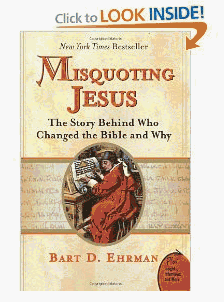
One has to give credit to Ehrman's skill as a writer. In his first 4 chapters, he made the art/science of textual criticism accessible to the lay reader by describing how accidental errors in text copying can occur and also how one might detect intentional changes to the text. In chapters 5-7, he described texts that he thinks were altered deliberately.
His chain of thought appears to be as follows:
(1) There are text variants in the NT manuscripts.
(2) Most people don't know there are variants.
(3) The variants are so numerous as to render the NT as worthless (or nearly so) as a source of knowledge about Jesus.
(4) If the general public knew about the variants, Christianity (as understood by most people) would collapse.
Claim one is beyond dispute. There are many thousands of ancient NT manuscripts (far more copies than any other ancient text) and within them are variants. The vast majority are little boo-boos as described by Ehrman in chapters 1-4 that are easily spotted and accounted for.
Claim two is true as the work of Biblical textual critics reside mostly in scholarly journals and not of interest or easily understood by the lay public. Ehrman has done a remarkable job in explaining the process to a lay audience and citing examples where there is dispute. However, in fairness to Bible translators, they do footnote Bibles to indicate where there is some question about the rendering of the text. The NIV is probably the most popular English Bible translation among US Christians and I checked some of the texts he cited and indeed the footnotes highlight briefly some issues Ehrman raised. Thus, there isn't a "conspiracy" to hide these variants.
Claim three is where sincere people will disagree. Ehrman dedicated his book to his thesis advisor Bruce Metzger who was probably one of the most noted textual critic scholars in the world was also very aware of the variants yet retained his faith while Ehrman did not. In fact, Metzger wrote this academic book to walk highly motivated (I'm not that motivated and I don't read Greek!) readers through the variants. Ben Witherington was also a student of Metzger (though older than Ehrman so their paths didn't cross in graduate school) who writes books for both the academic and lay audience retained his faith in Jesus with the same awareness of textual variants as Ehrman and Metzger. He posted his analysis of Ehrman's book at his blog.
Claim four rests on where one stands on claim three.
I think an important question is what do we expect of the Biblical text we have today?
If we think of the text as written by the finger of God and handed to humanity in one piece then we would be sorely disappointed.
However, God appears to have choose a path that involves human beings (I acknowledge that is a statement of faith). Thus, the texts of the Bible were written by humans under the guidance of God (I acknowledge that is a statement of faith) and then preserved by communities of faith. The preservation was not perfect but with the art/science of textual criticism, most variants (accidental or intentional) can be identified; thus, the Bible remains a reliable witness. Additionally, one has to acknowledge that the very survival of these communities of faith holding certain key beliefs about Jesus testifies to the enduring power of that faith and of the text these communities cling to.
Hope to post more on the challenge of Ehrman because his books are influencing the culture and need responses of both an academic and lay nature.
Subscribe to:
Posts (Atom)