Politics: The Good Old Days of President Clinton?

There is a lot of talk about the fiscal cliff.

One thread in the conversation is that the tax rates will rise from the the Bush era rates back to the Clinton era rates and Democrats state that the Clinton era was an economic boom time. But will the Obama administration and his allies in Congress also lobby for Clinton era spending levels?

Indeed, revenue during the Clinton era ranged from 17-20% of GDP. I'm not an economist so I don't know how much of the rise in revenue was due to the increased tax rates and how much was due to the economy booming.


The spending during that same period ranged from 21-18%. Spending declined as Clinton worked with the GOP Congress to reduce overall spending of which a certain amount was the post-Cold War defense draw down.
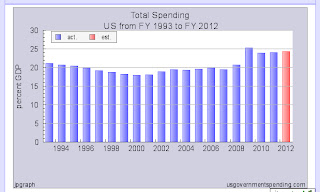

Fast forward to where we are now where any deal on the Fiscal Cliff will probably involve an increase in taxes. The current talking point is tax rates should rise to Clinton era levels for those $250,000 and above. As such, unless we go over the fiscal cliff, we actually aren't getting back to the Clinton era rates Democrats lionize since those below $250,000 would be under Bush era tax rates.

Under a rosy economic boom scenario, revenue might rise to 20% of GDP which was at the top of the Clinton boom times.

What about the spending side?

We are now at 23-25% GDP. Thus, we would still run deficits of 3-5% of GDP. US GDP is about $15 trillion; therefore, $450-750 billion deficits will result.

If we want Clinton era tax revenues, we also need Clinton era spending levels, if we want to begin to make a dent on the Federal debt. The first part of this equation (increasing tax revenues) results in cheers. The second part of this equation (decreasing spending) results in the sound of crickets.

Update:  Just came across this item from Dan Mitchell at Cato. Excerpt: You may have noticed that the White House used 20 percent of GDP as a benchmark in its chart, apparently because we should strive for the fiscal policy we had in Bill Clinton’s second term. I might be willing to take them up on that offer, so long as they’re also willing to accept Bill Clinton’s spending levels. More from Cato about the Clinton years.

World: Hewitt Interview of Author of "Little America"

Another interview spanning the full broadcast was with Rajiv Chandrasekaren who wrote Little America: the war within the war for Afghanistan.

Rajiv covers the good, bad and ugly of the US effort in Afghanistan. No question a lot of good intentions, bravery in the battlefield but sadly there was poor policy choices in the "nation building" project.

One particularly aggravating example was USAID unwillingness to help the Afghans grow cotton because the US wants to protect its cotton industry.

Another was authorization of the surge in Afghanistan but not sending enough troops and then pulling them out so quickly indicating that Washington was half-hearted about the effort.

World: Hugh Hewitt Interview of Jake Tapper Author of "The Outpost"

Hewitt devoted his entire broadcast to hearing the story behind "The Outpost."

The book gives a ground level view of the battle at Combat Outpost Keating in Afghanistan. But beyond the battle itself, Tapper delves into the people there - those who survived and those who didn't - and the people back home who love them. He also went into the history of the base leading up to the fateful battle. A story of incredible valor and infuriating decision making that left those troops in such a precarious location.

Riveting radio.

Here is a video clip from Jake Tapper on his book tour launch explaining how he got started on writing the book.


  Watch More News Videos at ABC
  |
  2012 Presidential Election
  |
  Entertainment & Celebrity News

Here is another clip from the same book tour launch with remarks from some of the soldiers profiled in the book.


  Watch More News Videos at ABC
  |
  2012 Presidential Election
  |
  Entertainment & Celebrity News


Business: Twilight for Twinkie & the Auto Bailout

The latest mediation effort has failed and as such a court supervised liquidation appears to be the next step. Companies will probably buy up some of the Hostess brands and facilities. Will be interesting to see what survives and what doesn't and in what form.

Hostess employed 18,500 people.

A handful of years ago, GM and Chrysler was essentially in a similar position: unable to pay its bills, too many unprofitable brands, costly union contracts and excess capacity. But since that industry employed so many more people, the pressure to bail them out was tremendous. The Federal government bailed them out at a cost that is still uncertain despite claims it was a success. Here is a video that explored some of the problems of the bailout beyond taxpayer cost including favoritism to unions, business decisions driven by political considerations instead of economic ones and moral hazard.

One wonders how would things have unfolded if GM and Chrysler had gone through traditional bankruptcy court?

Business: Twilight for Twinkies

I have to say I ate them as a kid but not often and haven't had one in decades.

But in any case, Hostess bakery is going out of business and the union blames management and management blames the unions.

If indeed, management was lousy, a company will buy some of the assets of Hostess that are profitable and some of the union jobs will be restored.

But I suspect as more and more Americans are health conscious about eating habits, Hostess successor company will have to change their product line quite a bit.

As for AFL-CIO President Trumka's attack on Hostess, Bain and Mitt Romney: it is emotionalism and disconnected from economic reality. His charges against mis-management of the company probably has some validity but the changing marketplace which the leadership probably failed to respond adequately to and union demands probably pushed the company over the brink.

On a broader question of unions, the one big difference between a union in the private sector and the public sector is that the private sector company may go belly up if it can't meet the union's negotiating position. Thus, a union in the private sector can only push so hard before the company just goes out of business.

In the case of the public sector union, the government can raises taxes to meet the public sector union's demands. But eventually, there are limits to that too as some city, county and state governments are having their finances pushed to the brink to meet public sector union contracts. The problem is that in this case, the fallout hit everyone taxpayer and is not just limited to the company, its workers and investors.

Politics: The press can dig up stuff when it really wants to

Wow, that was fast.

The news broke about the Gen. Petraeus scandal and now a torrent of news stories have come out since.

Meanwhile, over 2 months ago, 4 Americans were killed in Benghazi and the story of what really was going on before, during and after the attack still remains somewhat opaque such that Sen. McCain has called for a Congressional inquiry which probably won't happen because everyone is focused on the Petraeus scandal and the Fiscal Cliff.

The media likes to think of itself as the watchdog of those in power and revealers of the truth but here is an example where they go after the stories they like: sex and generals instead of why there are dead diplomats.

Some used to call Reagan the Teflon President but I think these past four years have shown the Obama should have that title.

UPDATE: Heard that President Obama will be holding a press conference. Will be interesting to see how dogged the questioning will be on the various topics.

PS: Of course, the timing of everything does feed into the perception of cover-up.

Politics: What is the "Fiscal Cliff?"

There is a lot of talk about the "fiscal cliff" and that we should NOT go off it at the beginning of 2013.

As I listen, I've been trying to figure out what this thing we should avoid really is?

From what I gather:
(1) On the revenue side, Bush era tax rates will revert to previous rates resulting in a $500 billion tax increase next year.
(2) On the spending side, the sequester will cut non-defense discretionary spending, around $54.5 billion
(3) On the spending side, the sequester will cut defense spending, around $54.5 billion.

The fear is that going over the cliff will return the USA into a recession.

This item in the WaPo describes what might happen if nothing is done and also describes the political incentives each interest group has in wanting to go over the fiscal cliff.

In brief:
One group thinks taxes are too low and so they want item #1 to happen and will live with item #2 and item #3.
One group wants all spending to be cut  and like items #2 & 3 and will live with item #1.
One group wants defense spending cut (item #3) and will live with item #1 & 2.

Is it possible that the best compromise is to actually go over the "fiscal cliff" as suggested by libertarian policy analyst Veronique de Rugy?

Within Congress, there are probably people in all three groups who despite their indicating something needs to be done would not mind the fiscal cliff because they will get something they want.

And which group would the White House be most sympathetic too?

Of course, both Speaker Boehner and President Obama have indicated they want to make some kind of deal.

Question: what can all three interest groups accept that is NOT the fiscal cliff scenario?

Of course, there is also the "kick the can" resolution: no changes in the tax rates and cancel the sequester.

Aging Parents - Random things from this season of life, part I

A handful of years ago, I entered the phase of life of helping out in looking after aging parents.  At this moment in 2024, my dad passed on...